49 works in this view — arrow keys or swipe to move between them.
Dance in Art
Pavane des patineurs: nouvelle danse de salon
Unknown artist
- Collection:
- Prints depicting dance
- Source:
- New York Public Library
- Rights:
- Public domain — free to use, share and adapt.
- Recorded as:
- Public Domain
Salon dances of this period are rarely preserved or studied, yet they were the dominant form of choreographed social dance for millions of people across Europe and America. This single cover represents an entire lost practice of domestic performance, amateur choreography, and the commercialization of dance. The juxtaposition of the pavane—a 16th-century court form—with modern salon dress and the whimsical skating theme shows how 19th-century ballroom culture mined history and fantasy for novelty.
What you are looking at
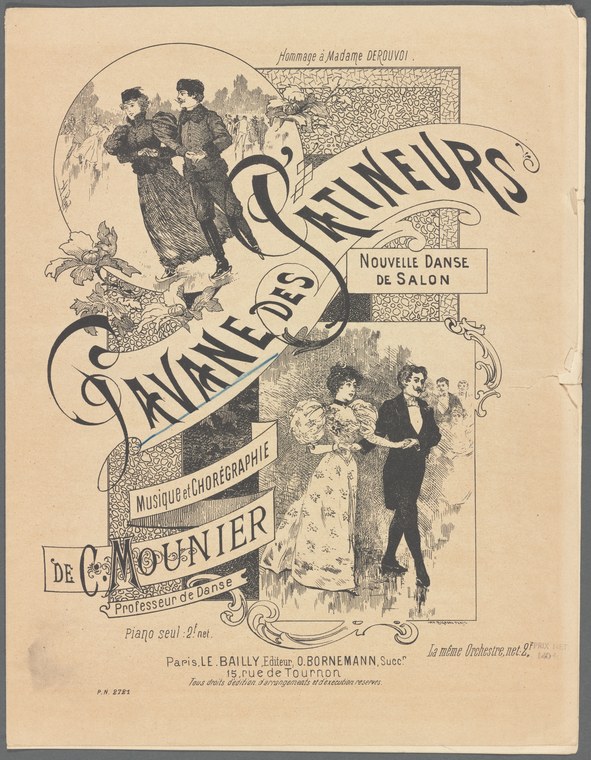
This is a French music cover or dance instruction sheet from the late 19th or early 20th century, decorated with sketched vignettes of salon dancers. The title *Pavane des patineurs* (Pavane of the Skaters) curves boldly across the center in ornamental lettering. Two principal scenes frame the composition: in the upper left, a couple in dark formal dress—the woman in a long skirt, the man in a tailcoat—face each other in conversation or greeting, with a crowd of other figures visible behind them. Below, a second couple in lighter dress enact what appears to be a more animated moment, the woman in a patterned or light-colored gown, the man in black, their bodies closer together. The layout is typical of Parisian sheet music or dance notation, with publisher details (LE BAILLY Édition, O. BORNEMANN Succ., Paris) and credits to Moulnier for music and choreography at the base. The whole design is rendered in black ink on cream paper, with decorative flourishes and a textured background suggesting a professional print.
The dancing
The dancers depicted maintain formal salon posture throughout. The upper couple stands at a measured distance, upright and composed, their interaction more social than kinetic—appropriate to the parlor context. The lower couple, while still maintaining decorum, shows greater proximity and a suggestion of movement or turning; the woman's skirt is rendered with flowing lines suggesting the swirl of fabric in motion. All figures wear period evening dress: long gowns for the women, formal jackets for the men. The bodies are schematically drawn rather than anatomically detailed, emphasizing silhouette and outline in a style suited to quick reproduction and mass circulation.
The dance depicted
The *Pavane des patineurs* is a salon dance—a choreographed piece designed for ballroom or drawing-room performance in the late 19th century. The title invokes both the pavane, a stately Renaissance court dance revived during the 19th century as a nostalgic or theatrical form, and the skaters (*patineurs*), suggesting either a skating-themed pantomime within the dance or a playful, whimsical character piece. The subtitle *Nouvelle danse de salon* (New salon dance) locates it among the fashionable social dances of the period. The sheet is attributed to Moulnier for both music and choreography, suggesting it was a composition distributed for amateur performance in middle-class homes—part of the vast repertory of parlor dances that dominated social dance in this era. The image itself does not show skating movement; instead, it depicts the formal, stationary or walking-speed interactions characteristic of salon choreography.
How it was made
This is a lithograph or chromolithograph printed for commercial distribution as a music cover. The technique allowed for rapid reproduction of text and image together, making the sheet affordable and widely available. The decorative border, the fluid lettering of the title, and the sketchy pen-and-ink style of the figures are all typical of 1880s–1900s Parisian music publishing. The cream paper and black ink suggest a standard trade production. As a cover design, it served a dual purpose: to identify and market the composition, and to communicate the character and social context of the dance to potential buyers—amateur musicians and dancers in middle-class households.
About this work
This is a French salon dance composition from the turn of the 20th century, documented through its published sheet-music cover. It represents the enormous and now largely forgotten genre of choreographed parlor dances—pieces explicitly designed for amateur performance in domestic settings, neither folk nor theatrical but a distinct middle-class social practice. The *Pavane des patineurs* exemplifies the period's taste for light, whimsical character dances with historical or fanciful themes, executed in formal evening dress within the constraints of the drawing room. The object itself—a printed music cover—is an artifact of that world: inexpensive, disposable, and mass-produced, yet essential to how such dances circulated and were learned.
How to look at it
The cover announces its content through the decorative interplay of text and image: the title dominates, but the small vignettes below ground the dance in a specific social world—evening dress, interior space, formal posture. Notice how the two scenes show variation in mood and proximity without breaking decorum; the artist is communicating the character of the dance through subtle shifts in pose and spacing rather than through dramatic movement. The sketchy, rapid line work reflects the speed of commercial production and suggests an audience of busy amateurs learning from published sheets, not connoisseurs studying a fine print.
The artist
The composer and choreographer Moulnier is not otherwise documented in surviving records. The publisher O. Bornemann (later Bailly Édition) operated in Paris during the 1880s–1920s, issuing dance music and instruction materials. The anonymity of the cover artist and the modest production suggest this was routine commercial work—not attributed to a named illustrator but produced in-house by the publishing firm. This was typical of the sheet-music industry.
The period
The salon dance flourished from roughly 1860 to 1920, a period of rapid industrialization and the expansion of a prosperous middle class with the leisure and space for home entertainment. Dance instruction was a standard part of genteel education for young women and men. Publishing houses produced thousands of salon dances—waltzes, quadrilles, polkas, galops, and character dances—many now completely forgotten. Simultaneously, in concert halls and music halls, ballet and theatrical dance were professionalizing and becoming spectacles for audiences rather than participants. The salon dance existed in this gap: neither folk tradition nor high art, but commercialized social practice. The revival of historical forms like the pavane was part of a broader 19th-century nostalgia for the pre-industrial, court-based past.
Where it lives
This sheet is held in the New York Public Library's collection of prints depicting dance. It is one of thousands of such commercial music covers produced by Parisian and European publishers in the late 19th and early 20th centuries, many of which survive only in institutional archives. The collection itself is an invaluable record of social dance history at a scale and in a form rarely preserved elsewhere.
Dance in this work
Questions about this work
What is a salon dance?
A salon dance is a choreographed social dance composed for amateur performance in private homes, ballrooms, or small social gatherings, typically to published sheet music. Unlike folk dances, they were commercial products; unlike ballet, they involved participants rather than spectators. They were the dominant form of social dancing for the middle classes in the 19th and early 20th centuries.
Did people really perform dances like this at home?
Yes. Sheet music sales, dance instruction manuals, and contemporary accounts confirm that amateur musicians and dancers regularly learned and performed these pieces in parlors and at house parties. It was considered a sign of gentility and education to be able to dance a new salon dance or play its accompaniment.
What does 'pavane of the skaters' mean?
The pavane is a slow, stately dance from the Renaissance court, revived in the 19th century as a nostalgic or theatrical form. The 'skaters' theme appears to be a playful fictional conceit—perhaps a pantomime or a whimsical character piece. The combination of historical form and modern fancy is typical of salon dance novelty.
Why has this kind of dance disappeared?
Salon dances declined with the rise of recorded music, the professionalization of entertainment, and changing social habits. By the 1920s–1930s, people were more likely to listen to recorded dance music at home or attend public dance halls than to perform choreographed pieces themselves. The social conditions that sustained the practice vanished.
More dance artwork





