49 works in this view — arrow keys or swipe to move between them.
Dance in Art
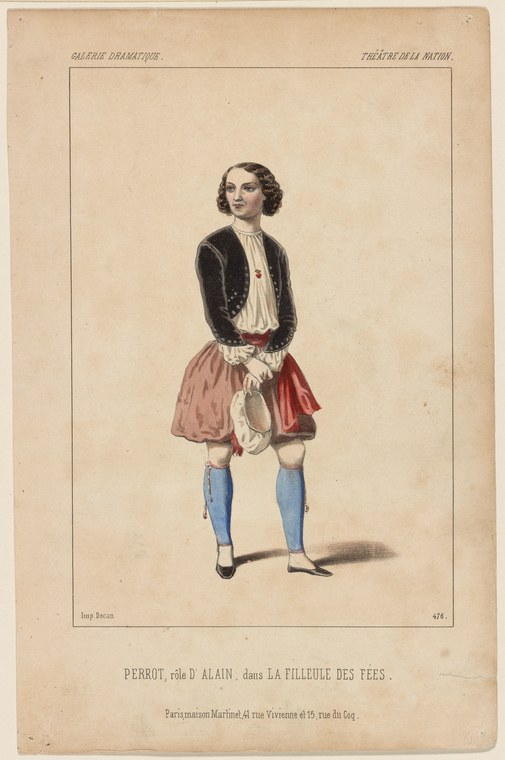
Théâtre de la Nation. Perrot, rôle d'Alain, dans La filleule des fées
Unknown artist
- Collection:
- Prints depicting dance
- Source:
- New York Public Library
- Rights:
- Public domain — free to use, share and adapt.
- Recorded as:
- Public Domain
Theater prints like this one are among the most direct sources we have for understanding how 18th-century dancers dressed, how character roles were visually distinguished, and how stage performers cultivated public identities through circulated images. The specificity of the costume—the combination of jacket, skirt, stockings, and shoes—tells us about the visual language of theatrical character types in the period, and the fact that this image was published confirms that Perrot was known enough to merit public documentation.
What you are looking at
A young male dancer in theatrical costume stands in a composed pose against a plain background. He wears a dark velvet jacket over a white shirt with a deep V-neckline, a burgundy-red skirt, and blue stockings that rise to mid-calf, completing his outfit with dark shoes. His posture is upright and frontal, with his weight evenly distributed and his arms held at his sides in a relaxed, natural position. His gaze is direct toward the viewer. The hand-colored engraving shows careful attention to fabric texture—the plush quality of the jacket, the gathered fabric of the skirt, and the knit of the stockings are all distinctly rendered. The figure occupies the center of the composition with substantial white space around it, emphasizing the clarity of the costume and stance.
The dancing
A single male figure stands in neutral, frontal presentation with both feet firmly planted and weight distributed symmetrically. His arms hang naturally at his sides with no particular tension or gesture, and his torso is erect. The pose suggests a moment of stillness rather than active movement—this is a display of costume and character rather than a frozen instant of dancing. The body line is vertical and composed, with no dynamic tilt, torsion, or asymmetry in weight.
The dance depicted
This is a theatrical portrait of a dancer in character, likely from an 18th-century French stage production. The title identifies the figure as 'Perrot, rôle d'Alain' (*Perrot in the role of Alain*) from *La filleule des fées* (*The Fairy's Goddaughter*), a work for the Théâtre de la Nation. Alain appears to be a comic or pastoral character—the red skirt, blue stockings, and simple jacket suggest a country youth or servant role. The stance is documentary rather than virtuosic: this is a character portrait intended to record both the performer's appearance and the costume of a specific role, the kind of image that would have circulated in Paris theater circles to publicize productions and performers.
How it was made
This is a hand-colored engraving, a technique that allowed for precise rendering of fine detail and broad distribution through printing. The engraving provides a clean, sharp outline of the figure, while watercolor or gouache was then applied to define color areas—the precise blues of the stockings, the burgundy-red of the skirt, the black of the jacket. This was a standard practice for theater portraiture in 18th-century Paris, producing images that were affordable enough to sell to theatergoers and collectors but fine enough to serve as a record of celebrated performers and beloved roles.
About this work
This hand-colored engraving records a dancer named Perrot in the role of Alain from a theatrical work performed at the Théâtre de la Nation in Paris. It is a character portrait—one of thousands of such prints produced during the 18th century to document performers, roles, and costumes for audiences and collectors. The image captures not a moment of dance, but a posed presentation of a theatrical character, with careful attention to the specifics of costume. The work belongs to the tradition of theater prints that documented the material culture of stage performance and the celebrity of named performers, offering evidence of how character roles were visually constructed and how dancers and actors presented themselves to the public through printed images.
How to look at it
Examine the costume in detail: the cut and fabric of the jacket, the shape and volume of the skirt, the height and fit of the stockings. Notice that the figure is posed for maximum visibility of these garments—frontal, upright, with nothing obscuring the view of the full body. This is not a dance capture but a display, the visual equivalent of a playbill entry that would have told theater patrons what to expect when they saw this role performed. The directness of the gaze and the neutral expression are characteristic of 18th-century theater portraiture: the performer is present as a character, not as a person.
The artist
The engraver is not recorded. Theater prints of this kind were produced by commercial workshops in Paris, often as collaborative projects between engravers and hand-colorists. Many were distributed by publishers who worked directly with theaters to create promotional images and souvenirs for sale in theater lobbies and through print dealers.
The period
This engraving dates to the 18th century, a period when French theater was a major cultural institution and Paris was the center of European theatrical fashion. Dance was an integral part of theatrical performance, and named dancers achieved celebrity status. The printed theater portrait was a democratic form: unlike a commissioned portrait in oils, which only the wealthy could afford, an engraved and colored print could be produced in editions and sold cheaply, making images of admired performers accessible to a broad audience. The costume visible here reflects the theatrical conventions of the period, where character types were communicated partly through dress—the blue stockings and red skirt marking a youthful or rural character in contrast to the fashionable clothing worn by aristocratic roles.
Where it lives
This is a theater print from the NYPL collection of prints depicting dance. It is one of thousands of such images produced in 18th-century Paris and circulated through printshops, theaters, and collectors' cabinets. The inscription at bottom confirms it was distributed through a Parisian publisher; the number at lower right is a catalog or series number.
Dance in this work
Questions about this work
Was this dancer famous?
The fact that a print was produced with Perrot's name indicates he had sufficient public profile to warrant documentation. Named dancers in this period achieved celebrity comparable to actors, and prints of them were commercial products sold to audiences. However, without additional archival sources, we cannot determine how celebrated this particular performer was or how long his career lasted.
What is 'La filleule des fées'?
The title translates to 'The Fairy's Goddaughter,' indicating a theatrical work with magical or fantastical themes, likely a comedy or pastoral entertainment. The Théâtre de la Nation (later the Comédie-Française) was one of Paris's premier institutions, so this was a professional, significant production. The work itself has not been identified in standard theatrical bibliographies, suggesting it may have had a limited run.
Why is he wearing a skirt?
In 18th-century theater, male actors and dancers regularly wore skirts or breeches as part of character costumes, including comic roles and pastoral or rural characters. The red skirt and blue stockings here signal a young, possibly rural or servant character, a visual convention understood by contemporary audiences. Gender-transgressive costume was a normal tool of theatrical characterization, especially in comedy.
How do I know this is actually a dancer and not just an actor?
The collection is identified as 'prints depicting dance,' and the pose and costume are consistent with 18th-century theater practice, where dance and acting were integrated. However, the image shows a moment of stillness rather than motion, so it documents the performer's appearance more than his dancing technique. The distinction between 'dancer' and 'actor' was less rigid in this period than it became later.
More dance artwork





