49 works in this view — arrow keys or swipe to move between them.
Dance in Art
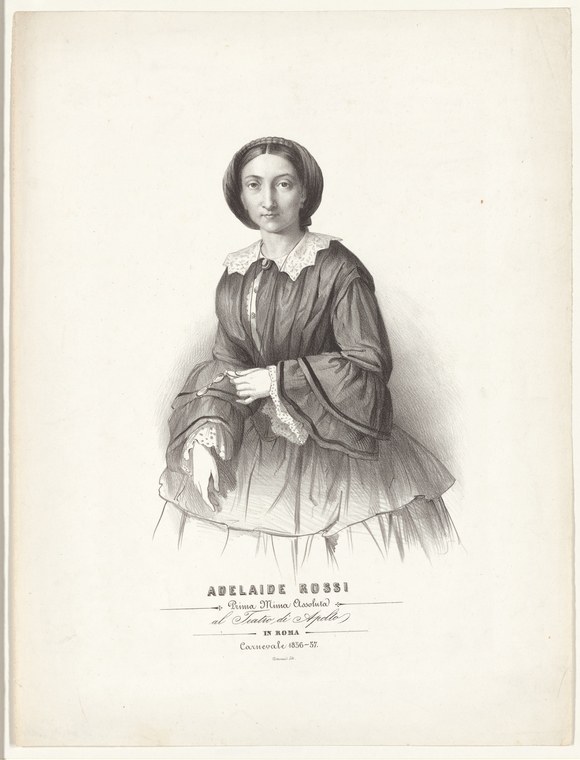
Adelaide Rossi, prima mima assoluta al Teatro di Apollo in Roma, Carnevale 1856-57
Unknown artist
- Collection:
- Prints depicting dance
- Source:
- New York Public Library
- Rights:
- Public domain — free to use, share and adapt.
- Recorded as:
- Public Domain
This portrait is one of the rare surviving images of a named, ranked performer in the 19th-century Italian mime pantomime tradition, a form now largely forgotten outside of opera and commedia-influenced theatre. It documents not technique (no footwork, hold, or step is visible) but *status*—the way a supreme mime artist chose to be seen by the public: refined, composed, authoritative, and dressed in the elevated style of a prima donna.
What you are looking at
A three-quarter-length portrait of a young woman in early-to-mid 19th-century dress, facing the viewer with a composed, direct gaze. She wears a dark wool or silk dress with full skirts and a white lace collar of the type fashionable in the 1850s; her sleeves are long and fitted, and she holds what appears to be a fan or small book in her gloved hands. The skirts occupy nearly half the composition, rendered with careful attention to the play of light and shadow across the fabric to suggest their volume and weight. The background is plain, pale, and featureless—a convention of portraiture that isolates the figure. The inscription below identifies her as "Adelaide Rossi (Prima Mima Assoluta al Teatro di Apollo in Roma, Carnevale 1856-57)" and dates the work to carnival season 1856–57. This is a formal dance world portrait, not a candid performance image.
The dancing
The figure stands at ease, her body erect but not rigid, her weight evenly distributed. Her posture is that of a performer at rest rather than in movement—this is how she presented herself to the public and to portraitists. Her hands, gloved and holding what may be a costume prop or trinket, are positioned naturally at her sides. The proportions of the figure, the fineness of the features, and the refinement of the dress all suggest a soloist of high rank and social standing, not a chorus member. The face shows the careful idealization typical of portraiture of dancers of this era.
The dance depicted
Adelaide Rossi was prima mima assoluta—a principal mime dancer of the first rank—at the Teatro di Apollo in Rome during the 1856–57 carnival season. This title indicates she was a leading performer in the tradition of dramatic mime pantomime that was central to 19th-century Italian theatrical dance. 'Mima assoluta' denotes supremacy in expressive gesture and narrative performance, a skill ranked as highly as technical ballet virtuosity. As a portrait, this image does not show her in performance, but the inscription asserts her identity as a mime specialist at a major papal-era Roman theatre, a claim worth noting given how little documentation now survives of the mid-19th-century Italian dance world.
How it was made
This is a steel engraving, a reproductive print technique used widely in the 1850s for portraiture and illustration. The image shows the hallmarks of the process: fine parallel lines (hatching) to model form and suggest texture; delicate, controlled tonality; and the capacity for multiple impressions. The inscription is engraved as well, integral to the plate. Steel engravings were far more durable than copper and could sustain longer print runs; this suggests the portrait was likely distributed as a souvenir or publicity material for Rossi, or as part of a series of theatrical portraits. The technique allows for precise rendering of fabric and fashion detail, making it well-suited to documenting the dress codes of elite performers.
About this work
This is a formal promotional portrait of an elite Italian dance performer, engraved and distributed during her season of success in Rome. It documents not a moment of performance but an identity—the persona of a celebrated mime, a specialist in dramatic gesture and narrative storytelling within the Italian theatrical dance tradition. The work is significant because so little visual documentation survives of Italian theatre dancers of this rank and era; most of what we know comes from playbills, memoirs, and a few portraits like this one. The portrait also shows the social elevation and visual prestige of a 'prima mima assoluta'—a rank that placed her among the highest-paid and most-celebrated performers of her time, on par with or exceeding ballet stars.
How to look at it
Attend to the details of dress and finish: the lace collar, the gloves, the careful rendering of the dress fabric. These details signify rank and expense; they are not incidental. Note also the directness of the gaze and the formal, frontal pose—conventions that present Rossi as a subject of authority rather than as a decorative or idealized figure. This is a professional identity portrait, the visual equivalent of a title page.
The period
The 1850s in Rome were a period of theatrical vitality under papal patronage, though the political situation was increasingly unstable. The Teatro di Apollo was a major venue, and the carnival season was traditionally when leading dancers and mimes earned their highest fees and greatest acclaim. Mime pantomime remained central to Italian dance practice throughout the 19th century, often integrated into ballet productions; a 'mima assoluta' would have been as celebrated as a prima ballerina. Steel engraving was at its height as a reproductive medium in this decade, before photography began to displace it for portraiture. The circulation of engraved theatrical portraits—sold at theatres, to fans, and through print shops—was a standard form of publicity and star-making.
Where it lives
This work comes from the Prints depicting dance collection held by the New York Public Library. It is a steel engraving, likely 1856 or 1857, and appears to have circulated as a theatrical souvenir or promotional print during or shortly after Rossi's season at the Teatro di Apollo.
Dance in this work
Questions about this work
What is a 'prima mima assoluta'?
A lead mime dancer of the highest rank within 19th-century Italian theatre. Mime pantomime—the dramatic, narrative-driven expression of emotion and story through gesture rather than words—was a core skill of professional dancers, especially in Italy. The rank 'assoluta' meant she was the first and foremost in her specialty, equivalent to prima ballerina.
Why is she not shown dancing?
This is a formal portrait, not a stage image. It presents her public identity—her status, style, and persona—rather than documenting technique. Dance portraiture of this era typically showed performers at rest, in costume but not mid-movement, emphasizing their social standing.
What was the Teatro di Apollo?
A major theatrical venue in Rome, active during the 19th century. The carnival season was the busiest and most prestigious time of year, when leading performers from across Italy would come to perform for the Roman public and papal court.
How do we know this is from 1856–57?
The inscription on the print itself states it: 'al Teatro di Apollo in Roma, Carnevale 1856–57.' This is not a later addition but part of the original engraved plate.
More dance artwork





