49 works in this view — arrow keys or swipe to move between them.
Dance in Art
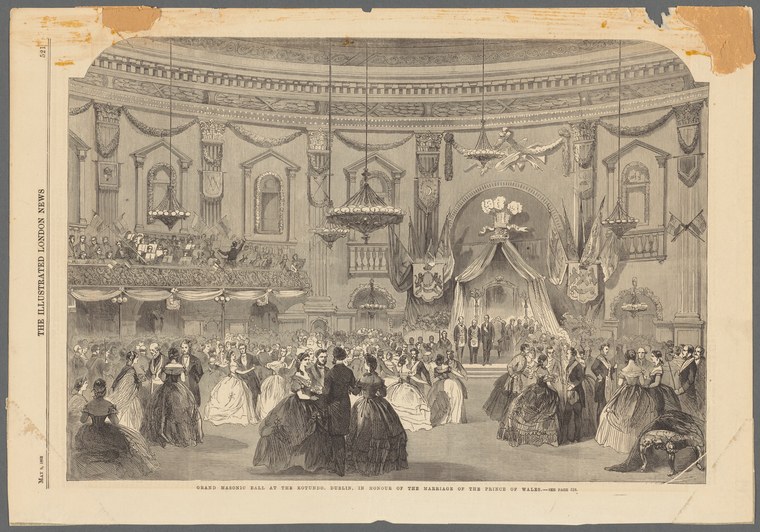
Grand Masonic ball at the Rotundo [sic], Dublin, in honour of the marriage of the Prince of Wales
Unknown artist
- Collection:
- Prints depicting dance
- Source:
- New York Public Library
- Rights:
- Public domain — free to use, share and adapt.
- Recorded as:
- Public Domain
This image documents the quadrille and cotillion at their peak as the organizing dances of formal social life in the mid-nineteenth century. It shows dance not as spectacle for an audience but as the essential ritual of a state occasion, and it preserves the dress, the spatial arrangement, the architectural context, and the conventions of formal ballroom dance of the period.
What you are looking at
A grand masonic ball fills a vast neoclassical ballroom with hundreds of fashionably dressed figures. The space is defined by tall arched alcoves punctuated with pilasters and ornamented with swags and garlands rendered in ink as decorative relief across the walls. A musicians' gallery spans the upper register of the composition. At the center of the floor, a distinguished group in formal dress occupies the focus of the scene. Candelabras hang from the ceiling. The crowd is distributed across the floor in clusters and small conversational groups, with some figures clearly dancing while others stand at the periphery observing or socializing. The dress is uniformly formal—men in dark tailcoats, women in full-skirted gowns with off-shoulder necklines characteristic of the mid-nineteenth century. The perspective is elevated and architectural, presenting the ball as both spectacle and ordered space.
The dancing
The bodies are mostly upright and stationary in conversation clusters, though several pairs are visibly engaged in coupled dance movement on the open floor. Dancers in closed position occupy the center and left of the composition, their frames held at the formal distance prescribed by ballroom etiquette of the period. The women's full skirts with multiple layers of fabric are rendered with particular attention, their volume a signature feature of ball gowns of this era. Arms are held in ballroom frame—men's left hands visible at women's backs, women's right arms extended. The standing figures demonstrate the posture of formal social occasion: upright carriage, composed engagement.
The dance depicted
This appears to be a formal Regency-era quadrille or cotillion, the dominant social dances of the mid-Victorian ball. Multiple couples in the frame suggest the structured group formations of the quadrille, which was danced in sets of four couples arranged in a square. The couples visible in the composition do not display the rotational momentum of a waltz, but rather the directional stepping and positioning consistent with quadrille figures. The setting—a grand public ballroom with hundreds of witnesses—confirms this as one of the major set dances that characterized formal social dancing of the period. The inscription references this ball as a state occasion (wedding of the Prince of Wales), confirming it as an event where the formal, choreographed quadrille would be the dominant form.
How it was made
This is an engraving, identifiable by the fine parallel line work (hatching and cross-hatching) used to create tonal gradation and shadow across all surfaces—walls, fabrics, faces, and architectural elements. The technique allowed for detailed rendering of the ballroom's architectural features and the crowd's ornate dress. Engravings of this quality and scale were produced for publication in periodicals and as standalone prints for middle-class collectors, making this an image intended for broad circulation among people interested in current events, fashion, and aristocratic social life. The artist has used the precision of the engraving line to distinguish hundreds of individual figures and to convey the formal order of the occasion.
About this work
This is a journalistic engraving documenting a state ball held at the Rotundo (likely the Dublin Rotundo, a major public assembly space) in honor of the marriage of the Prince of Wales. The work captures not the moment of the dance itself but the overall spectacle and social order of a formal Victorian ball—the architecture, the fashion, the choreographed mingling of a fashionable crowd, and the structured dances that anchored such events. It belongs in a gallery about dance because it is visual evidence of how ballroom dance functioned in the nineteenth century: not as virtuosic individual performance but as an orderly social practice that organized large public occasions, displayed formal etiquette, and structured interaction among the elite.
How to look at it
The viewer should focus first on the architectural framing of the space, which was essential to the formal experience of ballroom dancing. Then attend to the distribution of figures across the floor: where dancers are clustered, where observers stand, how the space was organized. The choice to show dozens of stationary or slowly moving figures rather than a single couple mid-leap reflects the actual experience of ballroom dance—a social practice rather than a performance art. The detail of the women's skirts and the formal dress code reveals how costume was integral to the correct execution of these dances.
The period
The mid-nineteenth century was the height of the quadrille's dominance in formal ballroom culture across Europe and America. The Prince of Wales was Albert Edward, later Edward VII; his marriage to Alexandra of Denmark took place in 1863, which would date this print to that year or shortly after. In this period, lithographic and engraved prints of current events, especially those involving the Royal Family, were major forms of mass media and popular illustration. Balls of this scale were both genuine social events and occasions for press coverage—the print served as a visual record for those who attended and those who did not.
Where it lives
The print is held in the New York Public Library's collection of prints depicting dance, which suggests it was acquired as documentary evidence of dance practice and costume history. It is a mass-produced engraving intended for publication and circulation as a topical print.
Dance in this work
Questions about this work
What is a quadrille?
A quadrille is a formal group dance for four couples arranged in a square, typically danced in sets. It was the dominant social dance at balls and formal occasions throughout the nineteenth century. It consists of five figures with specific steps and formations, performed in sequence.
Why are there so many people standing still?
A formal ball was not a continuous dance. Couples would dance one quadrille, then rest while others danced. The standing figures represent the social mingling, conversation, and observation that filled the intervals between dances. Only one set (four couples) would dance at a time on a large floor.
What do the women's skirts tell us?
The full, layered skirts are fashionable ball gowns of the 1860s, engineered with multiple petticoats and crinolines to achieve the silhouette required for formal dance. The engraver took care to render their volume and structure, indicating that costume was a central element of the visual spectacle of the ball.
More dance artwork





