49 works in this view — arrow keys or swipe to move between them.
Dance in Art
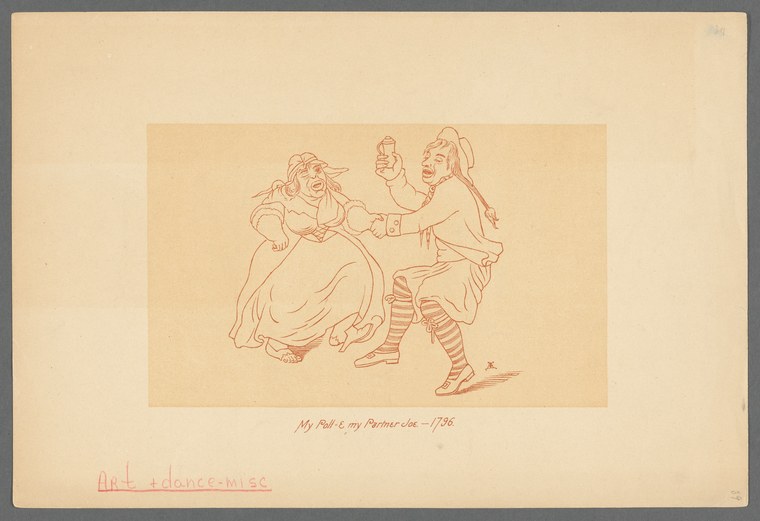
My Poll-E my partner Joe, 1796
Unknown artist
- Collection:
- Prints depicting dance
- Source:
- New York Public Library
- Rights:
- Public domain — free to use, share and adapt.
- Recorded as:
- Public Domain
This sketch records English social dance as lived practice, not as codified instruction. It captures the informality, the physical exuberance, and the gender dynamics of working-class or mixed-company dancing in the 1790s—the moment when published dance manuals were becoming standardized, but actual practice remained improvisational and varied. The named title and the comic intensity of the drawing suggest this may represent an actual performer or a specific tune, connecting the work to the oral and theatrical history of English popular dance.
What you are looking at
A spirited comic sketch of two figures in a playful encounter, drawn in reddish-brown ink on cream paper. On the left, a woman in a full-skirted dress with puffy sleeves and an elaborate bonnet leans backward with mouth open, one arm raised and the other gesturing expressively. On the right, a male figure in striped breeches and a loose shirt lunges forward with exaggerated energy, one leg extended and arms active as if mid-jest or mid-step. The poses suggest movement and interaction—a moment of surprise, flirtation, or comic mishap. The drawing style is rapid and gestural, capturing the liveliness of the moment rather than anatomical precision. The setting is undefined; the focus is entirely on the two bodies and their dynamic relationship.
The dancing
The woman's frame is open and reactive, her weight shifted back and her posture suggesting she is receiving or responding to the man's forward movement. The man's body is aggressive and animated—his leading leg extended, his torso angled, his arms spread—in a lunge or step that drives toward his partner. Neither figure stands in a formal dance frame or closed hold. Their interaction reads as social, improvisational, and theatrical rather than ballroom-disciplined. The drawing captures individual motion rather than partner technique.
The dance depicted
This appears to be a scene from English social dance of the 1790s, likely a country dance, cotillion, or convivial reel in a non-ballroom setting. The title "My Poll-E my partner Joe" suggests a named tune or a song-dance, common to English folk and popular entertainment. The energy and dress point to a working or lower-middle-class context rather than courtly practice. The figures' body language—the exaggeration, the lack of formality, the sense of surprise or banter—suggests this is a comic or theatrical representation of popular dancing rather than an instruction in technique. The artist was observing and caricaturing the social habit, not recording precise footwork.
How it was made
This is a pen or ink drawing, possibly with wash, on laid paper. The line is confident and economical, with minimal shading; the artist has prioritized gesture and expression over detail. The style suggests a sketch or study rather than a finished exhibition piece. The inscription in the margin, rendered in script, indicates this is documentary or archival material—a record of a titled dance or performer's act. The technique and paper are consistent with late 18th-century English drawing practice, suited to publication or portfolio circulation rather than expensive oil painting.
About this work
This is a sheet from a portfolio of dance and theatrical studies, likely compiled by an English artist or collector of popular entertainment in the 1790s. The inscription "My Poll-E my partner Joe" suggests the figures are named or the dance is titled—anchoring the sketch in the social reality of a named performer or a recognizable tune. The drawing sits at the intersection of dance documentation and comic illustration: it records a moment of social dancing as it was practiced in taverns and assembly rooms, while exaggerating its energy and physicality for humorous effect. The work belongs to a tradition of English graphic satire and popular theatrical documentation, a window into how dance looked and felt to observers outside the ballroom.
How to look at it
Look at the postures and the space between the two bodies: the woman is responding, the man is acting. The drawing freezes a moment of encounter or jest, not a position held. Notice the exaggeration—the arch of the back, the extension of the leg, the open mouths—these are signs of comic intention, a caricature of social energy rather than an accurate record of footwork. The rapid, unfinished line conveys motion and spontaneity. The title anchors the sketch in a named context: this is not a generic dance scene but a reference to a recognized tune or performer.
The period
The 1790s saw the consolidation of English country dance manuals (John Playford's tradition was still dominant), but also the rise of new ballroom forms—the cotillion, the contra, and the emergence of the Romantic waltz from the continent. At the same time, popular entertainment—music halls, traveling performers, printed satirical images—was creating a parallel culture of social dance outside the ballroom. This sketch sits in that popular culture, recording the energy and humor of social dancing among the working and artisan classes, for whom dance was a form of courtship, display, and entertainment rather than a codified social ritual.
Where it lives
This sheet is held in the New York Public Library's collection of prints depicting dance. It is a single-leaf drawing, likely part of a bound volume or portfolio of similar studies. The inscription and cataloging suggest it was recognized as a dance document.
Dance in this work
Questions about this work
Is this a ballroom dance?
No. The lack of formal frame, the exaggerated physicality, and the dress suggest this is a popular or folk dance, likely performed in a social context outside the ballroom. The comic treatment and the named title point to entertainment or satire rather than courtly practice.
Who were Poll-E and Joe?
The record does not identify them. They may have been named performers, or the title may refer to a recognizable tune. The inscription suggests the artist or collector knew the reference, but without further context, we cannot establish whether these were real people or character types.
What dance is being shown?
The specific dance form cannot be certain from the image alone. The energy, dress, and title suggest an English country dance, a reel, or a cotillion as performed in popular practice—more improvisational and exuberant than the formal versions in printed manuals.
More dance artwork





