49 works in this view — arrow keys or swipe to move between them.
Dance in Art
Amalia Price
Unknown artist
- Collection:
- Prints depicting dance
- Source:
- New York Public Library
- Rights:
- Public domain — free to use, share and adapt.
- Recorded as:
- Public Domain
This portrait documents the visual culture of mid-nineteenth-century theater and the public presentation of professional female performers. For dance historians, it provides specific evidence of costume design, fabric decoration, and the aesthetic conventions that shaped how dancers were imagined and celebrated in the era of Romantic ballet.
What you are looking at
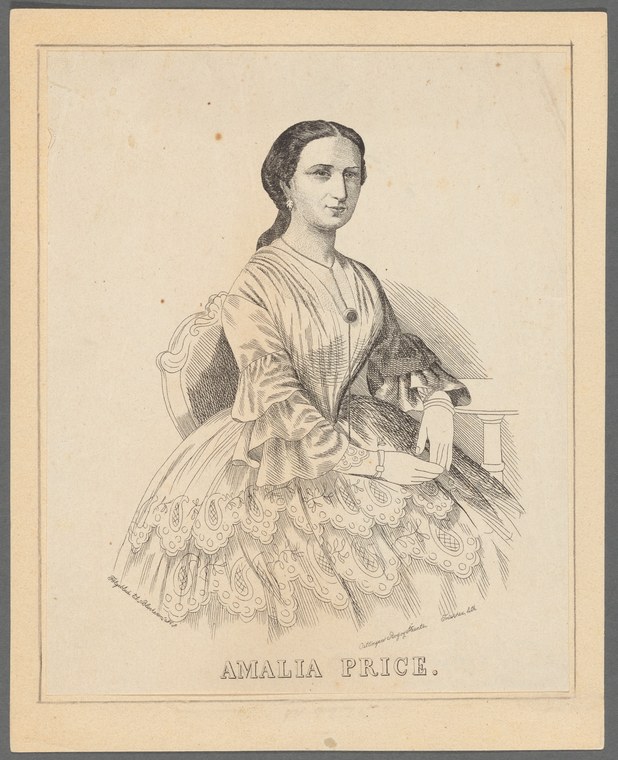
A three-quarter-length portrait of a woman seated in a graceful pose against a neutral background. She wears an elaborately decorated skirt with a dense pattern of paisleys or scrollwork that extends to the floor, paired with a fitted upper garment with vertical ribbing and draped sleeves. Her posture is refined and composed, with one arm resting across her lap and her gaze directed to the viewer's left. The engraving uses fine parallel lines and cross-hatching to create volume in the fabric, especially in the elaborate lower skirt, which reads as deeply sculptural despite being rendered in black and white. The woman's hair is parted in the center and swept back; a small brooch or ornament appears at her collarbone. The work is contained within a simple rectangular frame line, and the artist's name is inscribed below as a text label.
The dancing
The single figure is seated, not in active dance movement. Her posture suggests a moment of stillness or pause—the kind of composed repose a performer might strike between dances or at the climax of a solo. The upper body is upright and controlled, the shoulders relaxed, the arms soft. The arrangement of the skirt around her suggests it has been arranged for display, emphasizing its decorative weight and volume. There is no sense of forward momentum or vigorous extension; instead, the body reads as a static presentation of costume and poise.
The dance depicted
This is a portrait of a known dancer or performer, presented in theatrical dress rather than a scene of active dance. The elaborate, heavily patterned skirt and the refined styling suggest a professional performer of some standing in mid-nineteenth-century theater. The costume—particularly the voluminous skirt with its dense ornamental design—is consistent with Romantic-era ballet or similar theatrical performance contexts of the 1840s–1860s, though the woman is not depicted mid-movement. Without further documentation, the specific dance form and context remain unclear; this is a publicity or commemorative portrait of a performer, not a representation of choreography.
How it was made
This is a wood engraving or steel engraving, executed in the fine linear tradition of theatrical portraiture from the mid-nineteenth century. The technique allows for the delicate rendering of fabric texture and facial features, and the parallel-line shading creates a sense of form and volume. The precise, controlled line and the high degree of finish suggest this was made for circulation in periodicals or as a print for the parlor market, reaching audiences interested in theater and its celebrities. The inscription of the subject's name below the image indicates this was a commercial or semi-commercial product, likely part of a series of theatrical portraits.
About this work
This is a commemorative engraved portrait of Amalia Price, a professional performer of the mid-nineteenth century, presented in formal theatrical dress. The image documents the style and presentation conventions of theatrical costume during the Romantic era, when elaborate, heavily decorated skirts became a signature element of fashionable stage dress. The woman's composed posture and the careful arrangement of her costume suggest this was created to celebrate her status as a performer and to circulate her image among theater-going audiences. While not a scene of dance in motion, it is an important record of how dancers and performers were publicly presented and remembered in this period.
How to look at it
Attend to the extraordinary density and intricacy of the skirt pattern—the paisleys or scrollwork that covers nearly the entire lower garment. This is not mere decoration but a careful demonstration of the engraver's skill and the performer's elaborate costume budget. Notice also the contrast between the ornate lower half and the more simply rendered upper body, which creates a visual hierarchy emphasizing the skirt as the primary attraction. The woman's calm, frontal gaze and composed seat suggest a performer between moments, presented for admiration rather than in a moment of active performance.
The period
This engraving dates to the era of Romantic ballet, when theater became increasingly focused on the female body and costume as spectacular visual elements. The 1840s–1860s saw the rise of the ballerina as a celebrated public figure, with her image circulated through prints, photographs, and theatrical programs. The dense ornamental patterning on the skirt reflects the aesthetic of mid-Victorian decorative excess, while the refined facial features and composed posture reflect the cult of genteel femininity that surrounded successful theatrical performers of the period.
Where it lives
This is part of the New York Public Library's collection of prints depicting dance. It is a commercial theatrical portrait from the mid-nineteenth century, likely part of a broader series of prints celebrating performers and theatrical productions of the era.
Dance in this work
Questions about this work
Who was Amalia Price?
The name inscribed below the portrait identifies the subject, but further biographical details are not available from the catalogue record. She was a professional performer of the mid-nineteenth century, celebrated enough to warrant circulation of her portrait among theater audiences.
Is this a ballet dancer?
The elaborate costume and theatrical styling are consistent with mid-nineteenth-century ballet and theatrical performance, but the portrait does not show her dancing. It is a formal presentation portrait created for public circulation.
What is the technique?
This is an engraving, a printmaking technique that uses fine incised lines to create tone and texture. The parallel lines and cross-hatching visible in the fabric and shading are characteristic of wood or steel engraving, techniques favored for theatrical portraits because of their precision and suitability for mass printing.
Why is the skirt so ornate?
The dense patterning is both a testament to the performer's status (elaborate costumes were expensive) and a showcase for the engraver's skill. The intricacy of the design would have impressed contemporary viewers and marked the subject as a celebrated and fashionable performer.
More dance artwork





