49 works in this view — arrow keys or swipe to move between them.
Dance in Art
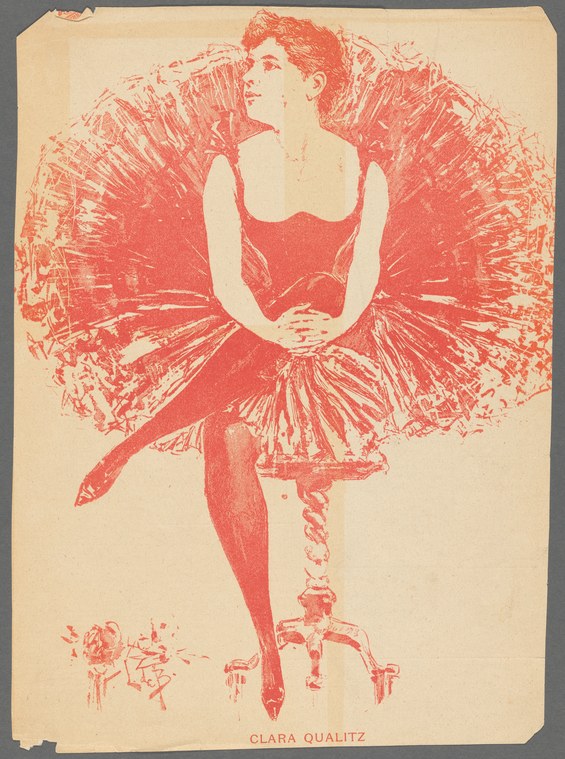
Clara Qualitz
Unknown artist
- Collection:
- Prints depicting dance
- Source:
- New York Public Library
- Rights:
- Public domain — free to use, share and adapt.
- Recorded as:
- Public Domain
This image captures a specific historical moment in how female ballet dancers were represented in mass culture, and offers a vivid record of tutu design and stage presence in the early 1900s. As a named portrait of a professional dancer now largely forgotten, it raises questions about which dancers entered the historical record and how.
What you are looking at
A female dancer in a spectacular tutu is depicted in a three-quarter view, gazing upward and to the side in a moment of rapt attention or reverie. She wears a fitted bodice with short sleeves and a dramatically voluminous skirt of pleated or gathered fabric that extends to mid-thigh, characteristic of early 20th-century stage costume. Her legs are bare and extended in a pose suggesting weight on one side, with a pointed foot visible below. The tutu dominates the composition: rendered in bold red lines with dense parallel hatching that suggests both the texture and the weight of the gathered fabric, it radiates outward in a fan or halo behind her. Her pale skin and the tutu's interior are left largely unshaded, creating stark contrast against the heavily worked background. Small sketched figures appear in the lower left corner—possibly musicians or other dancers reduced to supporting detail. The overall effect is one of theatrical glamour and energy, with the artist's linework emphasizing the sculptural quality of the costume.
The dancing
The dancer's torso is upright with shoulders relaxed, her neck extended and head tilted back in a moment of openness or emotion. One arm is positioned across her body at waist level, the other implied but less distinct. Her legs suggest she is balanced or preparing to move, with clear articulation of pointed feet. The pose conveys lightness and elevation despite the weight of the tutu, suggesting a moment between movements rather than a static portrait. The artist has understood the dancer's need to project the upper body and face forward to the audience even while the skirt fills the stage space behind her.
The dance depicted
This is almost certainly a portrait of a professional ballet dancer, most likely from the early 20th-century stage. The tutu, the upward gaze, the bare legs, and the theatrical presentation all point to Romantic or Classical ballet as it was performed in the early 1900s. The style of the tutu—voluminous, gathered, and reaching mid-thigh—is consistent with the ballet tutus of that era rather than the longer skirts of the Romantic period or the shorter tutus of later 20th-century innovation. The reverent or aspirational quality of the gaze suggests this may commemorate a specific performer or role, though without additional context the particular dance cannot be identified.
How it was made
This is a color lithograph or similar color print process, executed in red ink with heavy reliance on parallel hatching and line work to create volume and shadow. The technique—linear, expressive, economical—allowed rapid reproduction for theatrical programs, postcards, or popular art circulation. The bold graphic quality and the decision to leave large areas of the figure unshaded creates visual drama and ensures legibility at small scale. This is not a detailed naturalistic study but a celebratory poster-style image designed to capture the energy and glamour of the moment.
About this work
This is a portrait print of a professional ballet dancer in early 20th-century stage costume, capturing a moment of emotional or performative intensity. The work celebrates the virtuosity and theatrical presence of the dancer—identified in the title as Clara Qualitz—while also serving as a document of how tutus and the female dancing body were understood and marketed in that era. The dramatic tutu, the bare legs, and the upward gaze all index both the physical demands and the emotional expressiveness that defined early modern ballet.
How to look at it
Notice the artist's choice to freeze the dancer in a moment of emotional openness—head back, gaze upward—rather than in a moment of technical display. This is portraiture that values presence and feeling over the documentation of a specific step or position. Look at how the tutu is rendered: the parallel lines suggest both the weight and the buoyancy of the fabric, and the halo effect around the dancer's body emphasizes the spectacle of the costume. The bare legs and pointed feet ground the image in ballet's specific vocabulary, while the upward gaze allows the print to function as a celebration of the individual performer.
The artist
The artist is not recorded in the catalogue. The signature or attribution may be legible on the print itself but is not clear in this reproduction. The style—bold, linear, economical in its use of color—is consistent with early 20th-century theatrical graphics and poster design, a field in which many artists remain anonymous. The quality of observation and the confident handling of the figure suggest a trained artist working within the conventions of theatrical portraiture.
The period
This work dates to the early 20th century, a period of intense innovation and international circulation in ballet. The Ballets Russes, founded in 1909, was transforming dance in Europe and America; simultaneously, ballet was becoming a popular entertainment and subject for commercial graphic art. Dancers' portraits in print form—postcards, programs, lobby cards—were part of the machinery of celebrity and mass marketing. The style of this print reflects that context: it is neither high art nor documentary, but popular theatrical ephemera designed to celebrate and circulate the image of a named performer.
Where it lives
This print is held in the New York Public Library's collection of prints depicting dance. It is part of the library's historical record of theatrical and dance imagery, likely acquired as part of broader collecting around performance history.
Dance in this work
Questions about this work
Who was Clara Qualitz?
The title identifies her as a professional dancer active in the early 20th century, but detailed biographical information is not recorded with this print. She is likely a performer from the early theatrical dance world, though her fame did not survive into the later historical record. The print itself is evidence that she was celebrated enough to be the subject of a commercial portrait.
What style of ballet is this?
The tutu, bare legs, and theatrical presentation place this in the Classical or early modern ballet tradition of the early 1900s. The voluminous tutu suggests a dancer trained in the academic ballet tradition rather than in the longer-skirted Romantic style or the short skirts of later 20th-century ballet.
Is this a photograph or a drawing?
This is a color print made by lithography or a similar printing process, not a photograph. The reliance on line work, hatching, and the bold use of red ink are characteristic of graphic printing rather than photography. The artist has stylized the image for maximum theatrical impact and reproducibility.
Why is so much of the image left white?
The unshaded areas create visual focus and drama, drawing the eye to the dancer's face and the brilliant volume of the tutu. This is a deliberate aesthetic choice consistent with early 20th-century graphic design, where simplicity and bold contrasts were prized for their impact and legibility.
More dance artwork





