49 works in this view — arrow keys or swipe to move between them.
Dance in Art
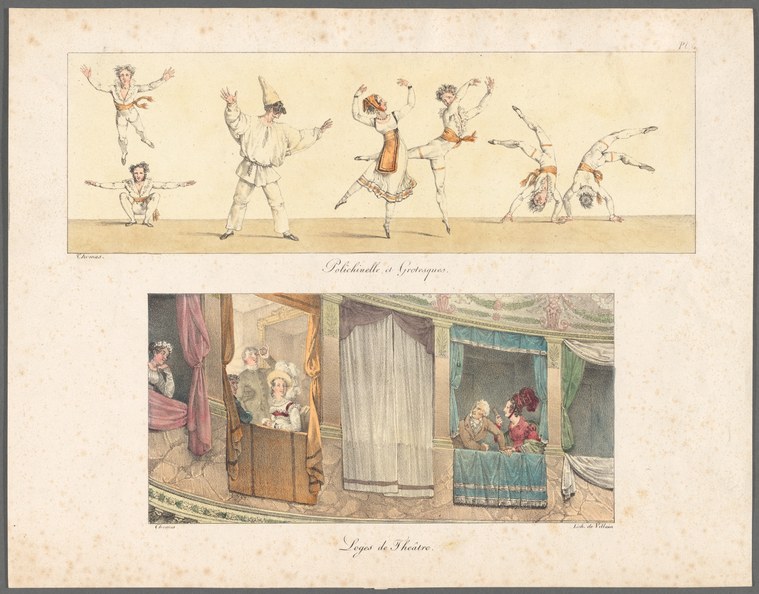
Polichinelle et grotesques ; Loges du theâtre
Unknown artist
- Collection:
- Prints depicting dance
- Source:
- New York Public Library
- Rights:
- Public domain — free to use, share and adapt.
- Recorded as:
- Public Domain
This work preserves visual evidence of commedia dell'arte performance techniques—the extreme contortions and acrobatic vocabulary that animated European popular theater for centuries but left no choreographic notation. It also documents the theater as a social institution: the architecture of spectatorship, the gender and class composition of audiences, and the performative nature of being seen in a box. For dance historians, it shows that 'dance' in the 18th century encompassed far more than the ballet or social dances recorded in Feuillet notation.
What you are looking at
This is a double-register engraving showing theatrical comedy and acrobatics. The upper register presents six figures in rapid succession across a continuous ground line, each in a different extreme posture: sprawling, inverted, contorted, or twisted. The figures wear what appear to be light-colored breeches and vests suggestive of commedia dell'arte costume. The lower register depicts a theater interior divided into four compartments by architectural framing—columns, doorways, and draped curtains in deep blues, reds, and golds. In the boxes and loges, elegantly dressed spectators recline, gesture, and converse, watching the stage or each other. The drawing style is light and precise, the hand-coloring subtle; the entire composition reads as a guide to theatrical entertainments.
The dancing
The upper figures demonstrate extreme bodily flexibility and inversion: one splays limbs in an X; another arches the back dramatically; a third performs what appears to be a handstand or cartwheel; others twist or collapse. None maintain an upright frame or classical posture. The lower register shows civilians in closed, seated, or lounging postures—arms on railings, heads turned to speak, bodies angled toward companions or toward the stage. The contrast between the kinetic extremity above and the stationary leisure below is deliberate.
The dance depicted
The upper register depicts Polichinelle (Pulcinella) and grotesque acrobatic entertainments, likely commedia dell'arte performance or itinerant spectacle. The extreme postures—contortions, inversions, tumbling—are consistent with the physicality of traditional commedia or circus performance, not theatrical dance proper. The title 'Loges du theatre' indicates the lower register is meant to show the social and spatial context in which such performances were consumed—the audience in their private boxes rather than the stage action itself. The work documents the theatrical ecology of its period, not a specific choreographed dance.
How it was made
This is a hand-colored engraving or etching. The fine linear work and the precision of the architectural detail in the lower register are characteristic of intaglio technique, likely engraved rather than etched given the consistency of line weight. The hand-coloring is selective and restrained—the costumes, textile patterns, and box interiors receive color while much of the architectural framing remains uncolored. This combination of precise printed line and selective watercolor was standard for mid- to late 18th-century theatrical documentation and was suited to wide circulation among theater-going audiences.
About this work
This work documents the theatrical cultures of the 18th century, showing both the spectacles themselves and the social space of their consumption. The upper register preserves the acrobatic and contortionist entertainments associated with Polichinelle and commedia dell'arte—a physically radical performance tradition distinct from ballet or social dance. The lower register reveals the spatial and social hierarchies of theater-going: the private loge system in which the audience themselves became a visible spectacle. Together, the two registers form a composite image of performance, spectatorship, and the economics of theatrical pleasure. The work sits at the intersection of dance history, theater history, and social history, recording both how bodies were moved for entertainment and how entertainment was consumed by different classes.
How to look at it
Attend first to the frozen moments of the upper register: the artist has chosen split-second extremes—the moment of maximum inversion, twist, or sprawl—to convey the pyrotechnic quality of commedia physicality. These are not steps or poses but instantaneous deformations. Then observe the lower register as a parallel text: the elegant, stationary, clothed bodies in the boxes form a visual comment on the underdressed acrobats above. The contrast is both comic and sociological—it reveals the gulf between performer and spectator, professional body and leisured body, that the 18th-century theater maintained.
The period
This work belongs to the tradition of 18th-century theatrical prints and satirical or documentary imagery of stage life. The commedia dell'arte tradition it depicts was at its height in the 17th and 18th centuries across Europe, particularly in Italy and France. By the period this print appears to date from (mid- to late 18th century), commedia was beginning to be displaced by other theatrical forms—sentimental comedy, melodrama, and the formalization of ballet—yet remained a living performance tradition in popular and itinerant theater. The print's focus on the social interior of the theater (the loges) reflects a broader 18th-century fascination with theater as a mirror of manners and a space of social display. Simultaneously, the extreme physicality of the upper register represents a performance tradition in tension with the refinement and restraint valued by the emerging academy of theatrical dance.
Where it lives
This work is held by the New York Public Library as part of its collection of prints depicting dance. It is catalogued under the broad heading 'Prints depicting dance' and remains largely undescribed in standard references; the artist's name has not been recorded in the catalogue.
Dance in this work
Questions about this work
Is this a ballet?
No. The upper register shows commedia dell'arte acrobatics and contortionism, a popular theatrical tradition distinct from the formalized ballet being developed in the same period. The extreme postures and tumbling do not correspond to any ballet vocabulary. The lower register shows the theater audience, not a dance performance.
What is Polichinelle?
Polichinelle (also Pulcinella) is a stock character of commedia dell'arte, traditionally portrayed by an acrobat or clown. He is often depicted as physically elastic and willing to suffer extreme contortions for comic effect. The name appears in the print's title, identifying the performance tradition being documented.
Why are there two different scenes?
The upper register shows the performer and their act; the lower register shows the space and audience. Together they form a complete image of theatrical experience—the production and its consumption. The contrast also emphasizes the social distance between the acrobat and the elegantly dressed spectators.
When was this made?
The catalogue record does not provide a date. Based on the style of the engraving, the costume, and the depiction of theater architecture, it likely dates to the mid- or late 18th century, but this cannot be confirmed from the image alone.
More dance artwork





