49 works in this view — arrow keys or swipe to move between them.
Dance in Art
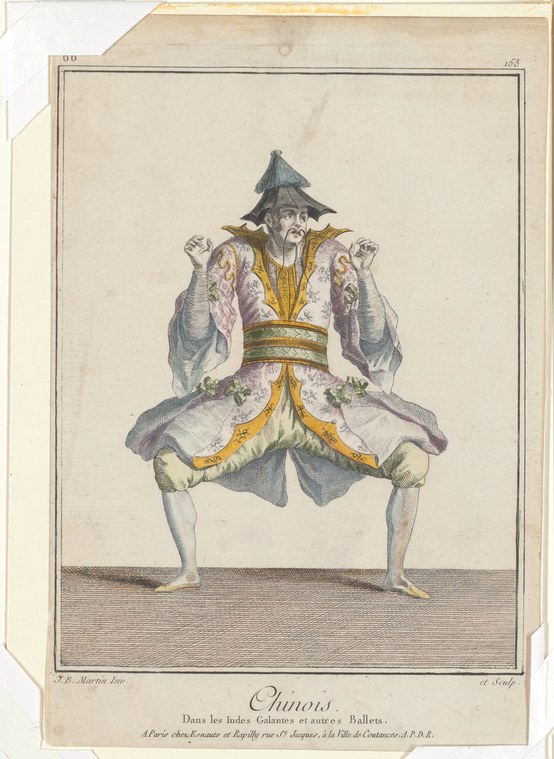
Chinois, dans Les Indes galantes et autres ballets
Unknown artist
- Collection:
- Prints depicting dance
- Source:
- New York Public Library
- Rights:
- Public domain — free to use, share and adapt.
- Recorded as:
- Public Domain
This print is essential evidence of how European theatrical dance incorporated and performed ideas of Asia during the Enlightenment—not through research but through exaggeration and stereotype that became codified as 'exotic' movement. For historians of colonialism and performance, it reveals the visual and physical vocabulary of othering in dance, while for dance technicians it documents the actual movement vocabularies and body positions that defined character roles in 18th-century ballet.
What you are looking at
A single male figure in an exaggerated squat pose dominates the composition, set against a plain background with a dark floor line. He wears a tall pointed hat (resembling a Chinese or Vietnamese style) and an ornate costume featuring a gold-buttoned yellow jacket with deep scalloped hems in white and purple, the lower edges finished with gold trim. His thin legs are bare below the knee, and his feet are planted firmly on the ground. His posture is extreme: knees deeply bent, posterior thrust outward, torso leaning forward, and both arms raised with hands and fingers spread in an emphatic, almost aggressive gesture. The facial expression is animated and somewhat grotesque, with prominent features exaggerated in the 18th-century printmaking style. The composition is symmetrical and frontal, presenting the figure as if on a theatrical stage.
The dancing
A single dancer-figure in a highly stylised, exaggerated posture with extreme knee bend and weight firmly on both feet planted wide apart. The arms are raised shoulder-high with fingers splayed outward in an emphatic gesture that suggests either theatrical display or a moment of active movement. The body is completely asymmetrical in its musculature representation, and the weight distribution suggests this is a moment of dynamic action or comic grotesquerie rather than a stable pose. The figure's frame is rigid and demonstrative rather than flowing.
The dance depicted
This appears to be a character study from 18th-century court or theatrical dance, most likely the Chinese dancer or 'Chinois' referenced in the inscription. The costume and exaggerated posture suggest this is a stereotypical or comedic European portrayal of Asian dance or theatrical movement from the period of "Les Indes galantes" (Rameau's opéra-ballet of 1735). The extreme squat, splayed arms, and pointing hat were conventions of exotic character roles in French theatrical dance of this era. This is not a representation of genuine Asian dance but rather the European theatrical interpretation and caricature of it—a common feature of Enlightenment-era spectacle that relied on exaggeration and stereotyping.
How it was made
A hand-coloured engraving or etching, executed in the 18th-century French manner for theatre documentation and circulation among the educated public. The technique combines line engraving (visible in the fine hatching and contour definition) with hand-applied watercolour or oil pigment in the costume details—yellow, purple, blue, and flesh tones applied selectively rather than comprehensively. This hybrid approach was standard for theatrical prints of the period: the engraved line provided fine detail and sharpness for the face and costume construction, while colour aided identification of the character and made the print more visually striking. The modest colouration and print quality suggest this was intended for a middle-class theatrical audience rather than a luxury commission.
About this work
This is a character print documenting a theatrical role from the French opéra-ballet tradition, specifically the exotic 'Chinois' character type popular in Rameau-era spectacle. The print serves as both performance record and cultural artifact, showing how European theatre of the 1730s-1750s visualized and performed non-European dance traditions through highly stylised, stereotypical movement vocabulary. The inscription references both the specific character and the production context (Les Indes galantes and other contemporary ballets), establishing this as professional documentation of stage practice rather than imaginative invention.
For dance historians, this image reveals the vocabulary of character dance in 18th-century French theatre: the exaggerated postures, the reliance on readable silhouette, the fusion of costume and movement as inseparable elements, and the theatrical embrace of grotesquerie as a mode of entertainment. It also documents the historical origins of Orientalist performance and caricature in European dance.
How to look at it
Attend to the posture first: the extreme squat and wide-planted feet communicate a complete departure from the turned-out, lifted verticality of simultaneously developed French ballet technique, signalling 'otherness' to its original audience. The splayed arms and finger play suggest both a moment of dynamic action and a deliberate visual excess—the figure is 'performing' rather than dancing, emphasizing display and character over technique. The costume overwhelms the body: the pointed hat draws the eye upward, while the scalloped, trailing hems anchor it downward, creating a silhouette designed for visibility from a distance in theatrical space. Note how the artist chose a moment of maximum visual distinctiveness rather than a flowing transition—this is a pose meant to be read as a complete statement, not a frame from continuous motion.
The artist
The print is signed by F. N. Martinet (engraver) and R. Smedt (colourist), indicating professional theatrical print production in 18th-century Paris. Martinet was a notable engraver of theatrical and operatic subjects, producing documentation of performances and costume designs for a broad educated market. These prints served as souvenirs, records of celebrated performers, and circulation devices for theatrical innovations, reaching beyond those who could attend live performances.
The period
This work dates to the mid-to-late 18th century, likely in the 1730s-1760s, the period of Rameau's greatest influence and the peak of the French opéra-ballet as a European cultural form. 'Les Indes galantes' (1735) was one of the most celebrated and frequently revived productions of the era, pioneering the inclusion of exotic and colonial settings in ballet spectacle. European Enlightenment theatre had become fascinated with representing the non-European world through dance and spectacle, although this 'representation' was entirely imagined and filtered through European theatrical conventions, movement vocabularies, and assumptions about 'exoticism.' The squat posture, pointed hat, and emphatic gestures would have read immediately to 18th-century audiences as coded signs of Chineseness—a visual shorthand with no basis in actual Chinese dance practice.
Where it lives
This print is part of the New York Public Library's collection of prints depicting dance, a substantial collection formed through both targeted acquisition and deposit. The print type and subject matter place it within the category of theatrical documentation and popularisation that characterises 18th-century French print production.
Dance in this work
Questions about this work
Is this depicting actual Chinese dance?
No. This is a European theatrical character type, a stereotypical interpretation created for French opéra-ballet audiences. The costume, posture, and exaggeration were theatrical conventions signifying 'exotic' to 18th-century European viewers, not representations of genuine Chinese dance practice. The inscription 'Chinois' means it is a European performer in an 'Asian' role, playing to colonial-era assumptions about other cultures.
What is 'Les Indes galantes' and why does it matter?
Rameau's 'Les Indes galantes' (1735) was one of the most celebrated opéra-ballets of its era, featuring colonial and exotic settings that were fashionable in Enlightenment European theatre. The production pioneered the inclusion of elaborate choreography for non-European characters, establishing movement vocabularies and stereotypes that would persist for centuries. It represents a key moment when European theatre began systematically incorporating the colonized world into spectacle and entertainment.
What does the posture tell us?
The extreme squat, planted feet, and forward-leaning torso are complete departures from contemporary French ballet technique, which valued vertical alignment, turnout, and uplifted carriage. For 18th-century viewers, this posture immediately communicated 'difference' and 'otherness'—it was a movement vocabulary that marked the character as non-European. The exaggerated gesture and facial expression emphasize theatrical display and character acting over pure technique.
Who were the engraver and colourist?
F. N. Martinet was the engraver and R. Smedt the colourist, both working in 18th-century Paris. Martinet specialised in theatrical and operatic subjects, producing prints that documented performances and circulated images of celebrated roles and performers to a broad educated public. These prints were affordable souvenirs and records that extended the reach of theatrical innovations beyond the theatre itself.
More dance artwork





