49 works in this view — arrow keys or swipe to move between them.
Dance in Art
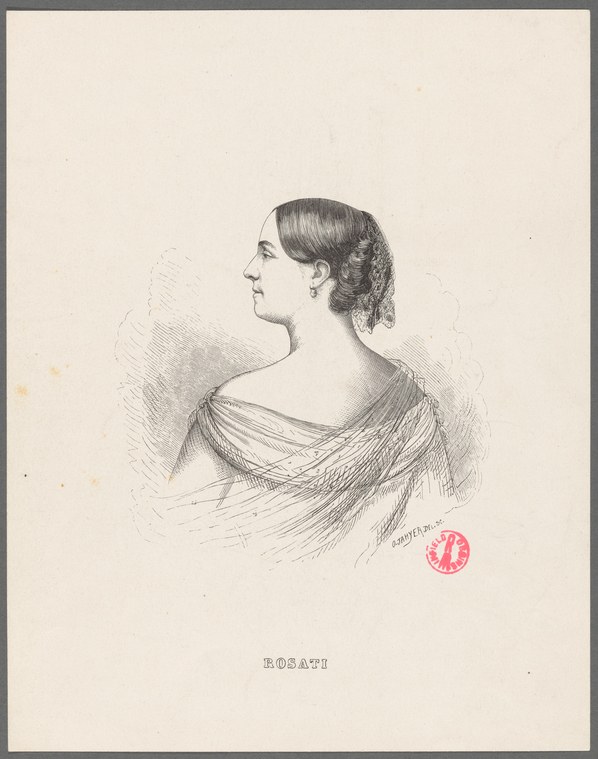
Rosati
Unknown artist
- Collection:
- Prints depicting dance
- Source:
- New York Public Library
- Rights:
- Public domain — free to use, share and adapt.
- Recorded as:
- Public Domain
Rosati was a significant dancer of the mid-19th century, and this portrait is documentary evidence of her celebrity and of the visual culture surrounding Romantic ballet. Such engravings reveal how dancers were marketed, how their bodies were idealized, and what visual codes signaled excellence and status in the theatrical world of the time. For historians of dance and performance, these prints are primary sources for understanding reputation, circulation, and the cult of the ballerina during a crucial period in ballet's development.
What you are looking at
A profile portrait in ink or engraving of a woman identified as Rosati, shown from the shoulders up against a plain background. She faces left, her head held upright with a composed, dignified expression. Her dark hair is pulled back into a low chignon typical of mid-19th-century styling. She wears a draped garment—possibly a dance costume or theatrical dress—that falls from one shoulder in classical lines, leaving the other shoulder bare. The fabric is rendered with fine hatching to suggest volume and soft folds. The drawing technique uses delicate cross-hatching for shading, particularly in the background, which creates subtle depth around the figure. A circular stamp or seal appears in the lower right corner of the page. The title "ROSATI" is printed in capitals below the portrait.
The dancing
The woman's posture is perfectly still and formally posed, with her weight centered and her body arranged for maximum grace and visibility of her profile. Her neck is elongated and elegant, her jawline defined. The bare shoulder and classical drapery suggest a trained performer accustomed to displaying her form; the dignity and poise of the carriage—neither stiff nor collapsed—speaks to disciplined bearing. There is no active gesture or movement; this is a figure study or publicity portrait of a dancer at rest.
The dance depicted
This is a portrait of a 19th-century performing artist, almost certainly a ballet dancer or prima ballerina. The name "Rosati" refers almost certainly to Carlotta Rosati (c. 1823–1905), an Italian-born ballerina who had a significant career in Europe and the United States from the 1840s onward. The classical drapery of her costume, the professional presentation, and the engraved format all point to a publicity portrait of a celebrated dancer. The image shows her at the height of her fame, when such prints were circulated to promote performances and maintain her public profile. The portrait does not depict dance in motion but rather the dancer as a figure of beauty and status.
How it was made
This is an engraving or steel engraving, executed in black ink on paper using fine line work and cross-hatching for tonal variation. The technique allows for precise detail in facial features and costume while maintaining a relatively flat picture plane. The formal composition and high finish suggest professional publication, likely as a souvenir print for distribution at performances or as part of a series of celebrity portraits. Engravings of this type were the primary method of mass-producing images of theatrical celebrities before photography became standard, allowing a single plate to yield hundreds of impressions and reach audiences across multiple cities and countries.
About this work
This is a portrait engraving of Carlotta Rosati, a celebrated 19th-century ballet dancer, presented in formal profile with the classical drapery and composed bearing characteristic of theatrical publicity prints of the era. The work belongs to a large body of engraved and lithographed portraits of dancers, singers, and actors that served as both souvenirs and instruments of celebrity promotion during the Romantic and post-Romantic periods. While it does not depict dance itself, it is an essential artifact of how dancers were presented to the public, how their images circulated, and how they controlled their visual representation. The dignity and formality of the image—the classical costume, the professional finish, the monumental close-up—all served to elevate the dancer's status from entertainer to artist worthy of collection and study.
How to look at it
The viewer should attend to the portrait's formality and restraint—Rosati is presented not in motion or mid-performance, but as a composed, classical figure worthy of study and collection. The profile view emphasizes the elegant line of her neck, head, and shoulders, a convention that highlights the physical refinement valued in 19th-century ballet. Notice how the drapery suggests both classical sculpture and theatrical costume, positioning her simultaneously as an artist and as a work of art. The engraving technique itself—precise, laboriously detailed, and deliberately finished—communicates that this is an important public figure, not a candid sketch.
The artist
The engraver is not identified in the catalogue record. The print was clearly produced by a professional engraving house with the capacity to execute fine detail and distribute multiple impressions. The style and finish suggest mid-19th-century European practice, likely Paris, London, or Milan—all centers of ballet and theatrical publishing at the time. Such portraits were typically commissioned by the dancers themselves or their managers to boost publicity and were sold at the theater or through print sellers.
The period
This engraving dates to the height of the Romantic era in ballet, when the cult of the individual dancer—especially the ballerina—reached unprecedented intensity. Carlotta Rosati's career flourished in the 1840s–1860s, a period when lithography and engraving were the dominant means of circulating images of performers. The classical drapery and idealized presentation reflect aesthetic values of the era: the ballerina as a timeless, ethereal figure, elevated above ordinary humanity. At the same time, the professional quality and wide distribution of such prints enabled dancers to build and control their public image in ways that were revolutionary for the time.
Where it lives
This engraving is part of the New York Public Library's collection of prints depicting dance. It belongs to a category of theatrical publicity and celebrity portraiture that was produced in large numbers during the 19th century and collected as both souvenirs and documentary evidence of performance culture.
Dance in this work
Questions about this work
Who was Carlotta Rosati?
Carlotta Rosati (c. 1823–1905) was an Italian-born ballet dancer who had an international career, performing in Europe and North America from the 1840s onward. She was one of the celebrated ballerinas of the Romantic era, a period when individual dancers achieved unprecedented fame and public attention. Her career spanned decades and made her one of the recognizable faces of mid-19th-century ballet.
Why was she portrayed in classical drapery rather than a tutu?
Classical drapery was a common choice for theatrical portraits because it elevated the dancer's image, connecting her to ideals of beauty drawn from ancient sculpture and Renaissance art. It also displayed the dancer's body and carriage more completely than a full costume would, allowing the engraver to showcase her proportions and poise. This choice reflects the aesthetics of the Romantic era, which valued the ballerina as a timeless, idealized figure.
How were these prints circulated and used?
Engraved portraits like this were sold at theaters, distributed by print merchants, and collected by fans and enthusiasts. They served as souvenirs of performances, tools for promoting upcoming appearances, and components of celebrity culture. A single engraved plate could produce hundreds or thousands of impressions, making it far more cost-effective than hand-painted portraits for reaching a wide audience.
What does the circular stamp mean?
The red circular stamp is likely a collection mark or library mark, indicating that the print has been catalogued and belongs to an institutional collection. Such stamps were commonly applied to prints and drawings as they entered museum or library collections.
More dance artwork





