49 works in this view — arrow keys or swipe to move between them.
Dance in Art
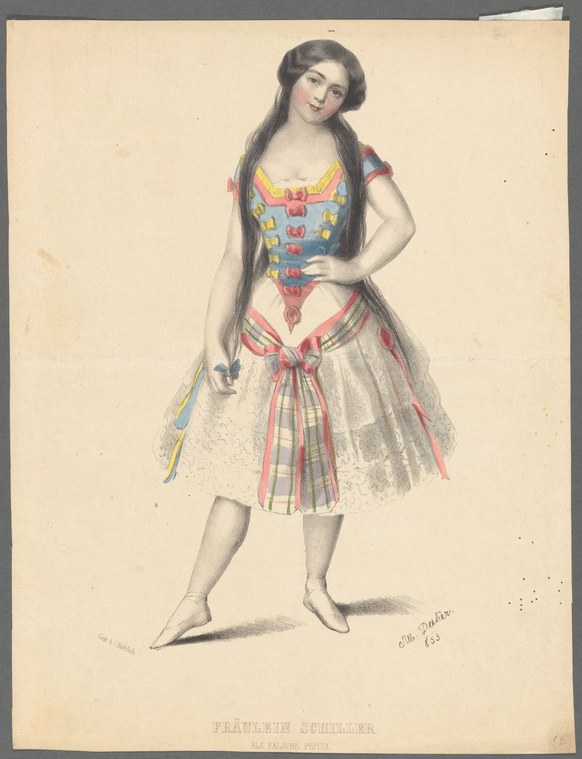
Fräulein Schiller als falsche Pepita
Unknown artist
- Collection:
- Prints depicting dance
- Source:
- New York Public Library
- Rights:
- Public domain — free to use, share and adapt.
- Recorded as:
- Public Domain
Costume prints like this are among the primary sources for understanding how theatrical dancers actually dressed and how those costumes shaped their movement possibilities and visual presence. The specific identification of performer and character allows us to potentially research the production and its choreography, making this a concrete historical witness to mid-19th-century stage dance practices in the German-speaking theater world.
What you are looking at
A young woman in theatrical costume stands in a three-quarter pose against a plain background, her weight on her left leg with the right leg slightly extended. She wears a ornate corseted bodice in shades of blue and red with geometric embroidery, paired with a knee-length skirt in cream with bold red and blue plaid or checkered patterning and a distinctive red bow at the hip. Her dark hair is long and unbound, falling past her shoulders in the Romantic-era style. She holds a small fan or feather accessory in her left hand. The artist has rendered her in delicate colored pencil or watercolor over a printed lithographic base, creating a luminous quality typical of theatrical costume studies. The title identifies her as "Fräulein Schiller as false Pepita"—a character role in a specific performance piece.
The dancing
A single standing figure in a relaxed, presentational pose rather than a captured moment of movement. Her posture is upright but natural, with the weight distributed on her supporting leg in a way that suggests the dancer's classical training but without the turned-out positions of formal ballet. The extended right leg is nearly straight, the arm positions are open and graceful, and the overall frame reads as a studied costume portrait rather than a dynamic dance action.
The dance depicted
This is a costume study for a theatrical performer, most likely from a mid-19th-century stage production. The title "Fräulein Schiller as false Pepita" indicates this is a named character in a specific work—likely a ballet, operetta, or theatrical dance piece popular in German-speaking lands. The costume itself suggests Spanish or exotic styling (the allusion to Pepita, the famous Spanish dancer), but the "false" (unechte) designation suggests parody or theatrical artifice. Without access to the original production, the specific dance form cannot be confidently identified, but the refined costuming and presentation format indicate professional theatrical dance of the Romantic era.
How it was made
This is a hand-colored lithograph or lithographically printed figure study, finished with watercolor or colored pencil by hand. The technique allowed rapid reproduction of costume designs for theater programs, souvenir prints, or costume documentation—a standard practice for major theatrical productions of the 1850s–1870s. The combination of printed line with hand coloring enabled individual artisans to customize each copy while maintaining the precision of the costume details. The signature visible in the lower right suggests this was a professional theatrical costume illustrator's work.
About this work
This is a costume documentation print from the mid-19th-century European theater, recording a specific performer's outfit for a named character role. The print format and hand-finishing indicate it was likely distributed as a souvenir or costume reference during or after the production run. It belongs in a dance collection not because it depicts movement, but because it documents the visual grammar of theatrical dance costume in the Romantic era—the relationship between corseting, the length and cut of skirts, the hairstyling, and the accessories that shaped how dancers appeared and moved on stage. The "false Pepita" character tells us something about how European theaters engaged with Spanish and exotic dance traditions, often through parody and costume spectacle rather than authentic technique.
How to look at it
Look at the costume in detail: the specific placement and color of the embroidery on the bodice, the geometric precision of the skirt's plaid pattern, the deliberate bow placement at the hip, the length of the skirt relative to the ankle, and the complete absence of the pointe shoes or turned-out positions that would mark a ballet dancer. The artist has chosen a pose of stillness and presentation rather than movement, showing us how the costume appeared when the performer stood at ease—yet the posture and carriage remain those of a trained dancer. The hand-coloring gives the work an immediacy and intimacy; each print would be slightly different depending on the colorist's choices and skill.
The artist
The artist is not recorded in the catalogue. The style and signature indicate a professional theatrical costume illustrator of the mid-19th century, likely working in a German or Central European city with an active opera and ballet culture. Such illustrators were specialized craftspeople, often working in ateliers that produced souvenir prints for theaters—skilled in rendering the specific details of costume, fabric, embellishment, and fit that mattered to theaters and audiences.
The period
The mid-19th century saw the establishment of the Romantic ballet as a dominant European theatrical form, with exotic and national character dances increasingly incorporated into multi-act spectacles. German theaters developed a rich tradition of ballet and dance-heavy operetta, and the costuming of these works became a matter of considerable artistic attention and expense. Printed costume documentation served multiple purposes: souvenirs for theater patrons, reference materials for wig and costume makers, and evidence of the production's visual splendor. The appearance of Spanish or "Spanish-flavored" characters in European theater was common, often stylized and ironized as here (the "false" Pepita), reflecting both fascination with and skepticism toward authenticity.
Where it lives
This print is held in the New York Public Library's collection of prints depicting dance. It appears to be an example of 19th-century theatrical souvenir or costume documentation prints, the kind produced in quantity for popular productions and distributed to audiences and fellow performers.
Dance in this work
Questions about this work
Who was Fräulein Schiller?
The catalogue record does not identify her beyond the title. She was likely a German or Central European theater performer of the mid-19th century, sufficiently notable that her costume as the character "false Pepita" was commemorated in this print. Research into the specific production would be needed to establish her full biographical record.
What does "false Pepita" mean?
The title suggests a character who claims to be or is impersonating Pepita, the famous Spanish dancer of the 1830s–40s. The "false" framing suggests parody or theatrical artifice—a common device in 19th-century theater, where authentic foreign dances and dancers were often presented ironically or deceptively, to comic effect.
Is this a ballet?
The image alone does not definitively show ballet technique or movement. The costume and pose suggest theatrical dance training, but the specific form of the production is unknown. It may have been ballet, operetta, theatrical dance, or a hybrid form—all common in mid-19th-century German and Central European theater.
Why is this hand-colored?
The print was produced using lithography, which allowed rapid reproduction of the design. Hand coloring added value and customization; each print could be colored uniquely, and the hand-finishing suggested artisanal quality and careful attention to the costume's actual colors. This was standard practice for high-end theatrical souvenir prints.
More dance artwork





