49 works in this view — arrow keys or swipe to move between them.
Dance in Art
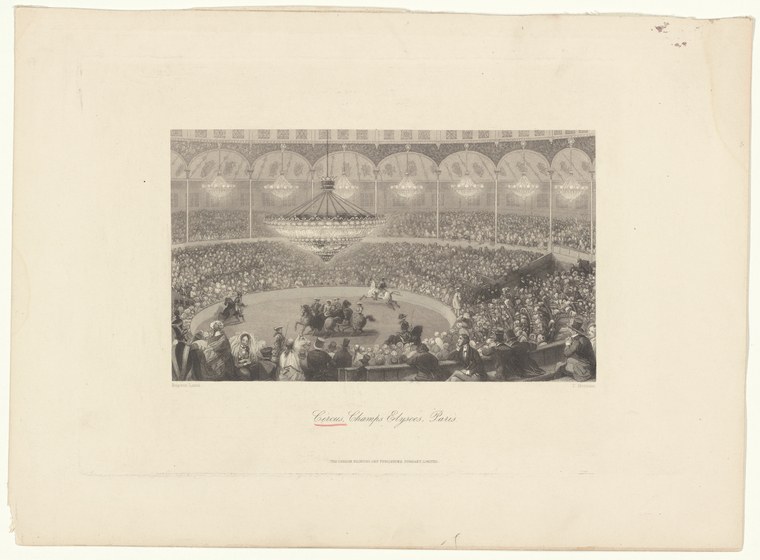
Circus, Champs Elysees, Paris
Unknown artist
- Collection:
- Prints depicting dance
- Source:
- New York Public Library
- Rights:
- Public domain — free to use, share and adapt.
- Recorded as:
- Public Domain
Circus acrobatics occupy an often-overlooked middle ground between sport, dance, and theater: they demand choreography, partner work, and precise bodily control while maintaining the risk and unpredictability of athletic performance. This engraving is one of the few detailed contemporary images of how such work was actually done and experienced, capturing both the technical achievement and the mass audience culture that surrounded it.
What you are looking at
A vast amphitheater packed with spectators surrounds a central circus ring where acrobatic performers execute aerial feats on a suspended apparatus—likely a trapeze or flying rig. The structure is a grand pavilion with a barrel-vaulted glass and iron roof supported by regular arches, flooding the scene with light. Thousands of audience members line the tiered seating, their faces turned toward the action. The performers in the ring appear as silhouettes against the bright space; some are airborne or in mid-movement on apparatus, while others stand or move across the ring floor. The composition creates a vertiginous sense of scale: the individual bodies of the acrobats are tiny against the vast crowd and the monumental architecture, yet they command complete attention as the focal point of this theatrical machine.
The dancing
The acrobats visible in the ring display the characteristic poses of aerial performance: at least one figure appears suspended or in flight above the ring, while others are positioned on apparatus or transitioning across the floor. The bodies are rendered in miniature but convey dynamic tension—legs extended, bodies angled for momentum or balance, the engagement required by apparatus work. The spatial relationship between performers and audience is crucial: the acrobats are isolated in performance space, enclosed and elevated, while spectators lean inward from all sides, creating an intimate circle around the dramatic action despite the enormous crowd.
The dance depicted
This is a professional circus scene, most likely from the mid-to-late 19th century (the period when large public circus buildings became common in Paris). The performance depicts circus acrobatics—specifically aerial or trapeze work—which involves a structured vocabulary of holds, flights, and apparatus skills distinct from theatrical dance but sharing performance space and audience convention with it. The Cirque des Champs-Élysées was a real venue in Paris, and circus acrobatics of this era were highly codified: flyers, catchers, and ground performers executed choreographed sequences that combined risk, precision, and spectacle. The image captures the scale and public spectacle that made circus a major entertainment form.
How it was made
This is a wood engraving, a relief-printing technique that allows fine detail and mass reproduction. The print shows the characteristic marks of 19th-century commercial engraving: parallel lines to build tone, fine cross-hatching to suggest volume and atmosphere in the vaulted ceiling, and careful differentiation of the crowd through varied line density. The technique was ideal for newspaper and journal illustration, suggesting this was published widely as a document of a notable public event or venue. The sophistication of the rendering—especially the perspective structure and the modulation of light through the roof—indicates a skilled practitioner, likely a professional illustrator rather than a casual observer.
About this work
This wood engraving depicts a performance at the Cirque des Champs-Élysées in Paris, showing acrobatic performers at work in an elaborate iron-framed pavilion before a packed audience. The work documents not only the acrobatics themselves but a specific moment in circus history when such entertainments had become major public institutions with dedicated architecture and thousands of regular spectators. The image is valuable as a record of how circus acrobatics were presented, understood, and experienced as a form of body performance in the 19th century—not as theater or dance per se, but as skilled physical spectacle that operated alongside them.
How to look at it
Observe how the artist constructs depth and scale: the crowd in the foreground and sides is rendered in finer detail, while distant spectators merge into tone, pulling your eye toward the central ring. Notice the isolation of the performers—they are central but small, creating visual tension between spectacle and intimacy. The vaulted ceiling is a tour de force of perspective, suggesting the soaring space that made the acrobats' flight visible and dramatic. Pay attention to which performers are actually airborne or in transitional moments: these frozen instances were the payoff of the performance, the moment when bodies defied gravity.
The period
The Cirque des Champs-Élysées opened in the 1850s and was one of the major entertainment venues of Second Empire and Third Republic Paris. By mid-century, circus had evolved from fairground entertainment into a sophisticated performance art with permanent venues, star performers, and international touring. The architectural style—the iron framework and glass vault—is characteristic of post-1850 Paris, when engineering and spectacle fused in public buildings. Acrobatics and aerial work were at the height of their prestige as performance forms, preceding the rise of stage pantomime and the later ballet revivals of the 1890s.
Where it lives
This engraving is held in the New York Public Library's collection of prints depicting dance and related performance forms. It is cataloged as a document of circus and acrobatic performance rather than dance proper, but its place in a dance collection reflects the 19th-century understanding of such spectacles as part of a broader landscape of body performance.
Dance in this work
Questions about this work
Is this actually about dance?
Technically, circus acrobatics is a distinct form from theatrical dance, but it shares the same performance lineage and audience in the 19th century. Acrobatics involve choreography, partner work, and sustained training—the core skills of any dance form. Contemporary sources often grouped circus performers, ballet dancers, and pantomime artists as related professions.
When was the Cirque des Champs-Élysées active?
The venue opened in the 1850s and operated through the late 19th century, though the exact dates and duration of operation are not established by the current catalogue record. The architectural style and engraving technique suggest a date somewhere in the 1860s–1880s.
How do we know what was being performed?
The image shows performers in mid-flight or on apparatus, and the setting is labeled as the Cirque des Champs-Élysées. The standard repertoire of such venues included aerial trapeze, hand balancing, and group acrobatics. Without additional documentation, we cannot identify specific performers or a specific date.
More dance artwork





