49 works in this view — arrow keys or swipe to move between them.
Dance in Art
Assai ben balla, a cui fortuna suona
Unknown artist
- Collection:
- Prints depicting dance
- Source:
- New York Public Library
- Rights:
- Public domain — free to use, share and adapt.
- Recorded as:
- Public Domain
This print preserves a Renaissance conceptual framework—that dancing is defined by its coordination with music and that this coordination is both difficult and precious. It shows how Renaissance writers and artists thought about the dancer's body not as an autonomous performer but as an instrument responsive to musical time. For historians of dance theory and practice, it documents an idea that shaped courtly training for centuries.
What you are looking at
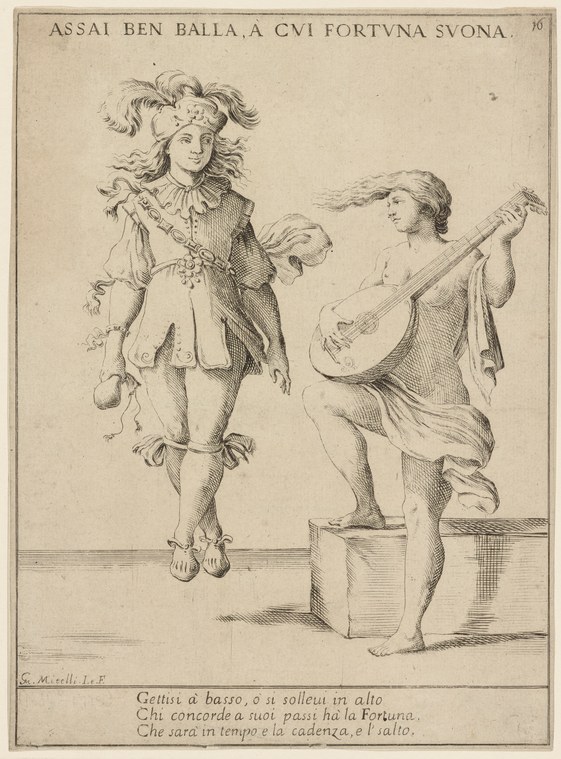
A figure in elaborate Renaissance dress—plumed headdress, ornate jacket with puffed sleeves, jeweled belt, and pointed shoes—stands at left playing a lute or similar stringed instrument. The figure's posture is animated and graceful. At right, a semi-nude woman seated on a stone block plays a larger stringed instrument, her body angled toward the standing figure. The setting is minimal: a simple ground line and a stone plinth define the space. The inscription in Latin below reads "Gatturi a basso, ò si solleur in alto / Chi concordia a suoi passi ha la Fortuna / Che sara in tempo e la cadenza, e l'alto"—a text that addresses the coordination of dance and music, the importance of accord between steps and music's tempo and pitch. The engraving's light, delicate line work creates a sense of elegance and sophistication appropriate to courtly or aristocratic contexts.
The dancing
The standing figure's weight is shifted, one leg forward in a position suggesting potential movement or a suspended moment in a step; the torso is upright and engaged. The seated figure's body twists to face the musician, her arms and shoulders active in playing. Neither figure is in a closed ballroom frame. The relationship is musical and mimetic rather than coupled dance—the two are collaborators in a performance of coordination between steps and sound, which the text emphasizes. The gesture vocabulary suggests stylized courtly movement rather than social dance between partners.
The dance depicted
This engraving illustrates the Renaissance principle of concordance between dancing and music—specifically, the accord of the dancer's steps (passi) with the musician's tempo and pitch (tempo, cadenza, alto). The text attributes this harmony to Fortune (Fortuna), suggesting it is a gift rather than technique alone. No specific named dance is identifiable, but the dress, setting, and aesthetic locate this in sixteenth-century courtly dance practice. The image documents not a performance of a particular dance but a conceptual relationship: the dancer and musician as interdependent agents whose coordination produces beauty.
How it was made
This is an engraving (identified from the fine parallel hatching, the precision of the line, and the formal presentation). The technique allows for the subtle modeling of cloth, the clarity of jewelry and ornament, and the careful articulation of the figures' poses—all essential to representing the refinement of the subjects. The engraving would have been reproductive or for circulation among the educated elite; the Latin inscription confirms a learned audience. The delicate, controlled line work is consistent with Italian Renaissance printmaking practice.
About this work
This is a conceptual print about the collaboration between dancer and musician in Renaissance courtly culture. Rather than depicting a specific named dance or a scene of social dancing, it illustrates an ideal: the dancer's steps in perfect time and pitch with the musician's performance. The Latin text makes explicit what the image suggests—that this concord is a mark of Fortune's favor and the measure of graceful movement. The engraving circulated among a cultured audience and articulates a philosophy of dance as musical cooperation rather than individual virtuosity.
The work belongs in a dance history collection because it documents Renaissance thought about dance: its intimate dependence on music, the ethical or aesthetic significance of temporal coordination, and the role of chance (fortuna) in achieving it. It is not a record of a specific performance or step vocabulary, but evidence of how Renaissance courts understood dancing as a discipline of timing and accord.
How to look at it
Look first at the positioning of the two figures: neither is in a position of rest, but neither is mid-leap. The standing figure's pose suggests a moment of suspension or preparation—the kind of poise required to respond precisely to musical time. The seated musician's engagement with the standing figure's body emphasizes the visual communication between them. The Latin text below articulates what the image implies: this is a moment illustrating a principle, not a narrative moment. The viewer is meant to read the engraving as a lesson in the coordination of dance and music, which the inscription names explicitly.
The artist
The artist is not recorded in the catalogue. The signature or monogram at lower left reads "G. Marcuili fe" or similar, but this cannot be confirmed from the image alone. The style and execution are consistent with mid-sixteenth-century Italian engraving, likely produced in Venice or Rome. The work's learned Latin inscription and courtly subject suggest production for or patronage by the educated elite.
The period
This print dates to the sixteenth century, when Renaissance dance was codified in Italy through written treatises (Arbeau's *Orchésographie*, Caroso's *Il Ballarino*, Negri's *Le gratie d'amore*). These texts systematized the relationship between musical time and bodily movement, and established rules for the concordance of steps and music. The visual culture of dance during this period—including prints, paintings, and woodcuts—often illustrated this interdependence. Musically and choreographically, the Renaissance ideal was of precision, measure, and grace, all dependent on the dancer's ability to internalize and respond to the musician's time. This engraving is a product of that discourse.
Where it lives
The work is held in the New York Public Library's print collection, specifically in a gathering of prints depicting dance. It appears to be a reproductive engraving from the sixteenth century, part of a tradition of prints documenting courtly arts and practices. The collection is a survey of visual representations of dance rather than a single artist's work or a specific historical archive.
Dance in this work
Questions about this work
What dance are these people doing?
No specific named dance is shown. The engraving illustrates a principle—the coordination of the dancer's steps with the musician's tempo and pitch—rather than a particular step sequence or named dance like the pavane or galliard. It is a conceptual image about how Renaissance dancers and musicians worked together.
Why is one figure seated and one standing?
The seated figure is the musician; the standing figure is the dancer. Their different positions emphasize their different roles while showing them as collaborators. The musician produces the temporal and sonic framework; the dancer responds to and embodies it. The image illustrates their interdependence.
What does the Latin text mean?
The inscription translates roughly as: "Let one play low, or sing high / Whoever has concord in his steps has Fortune / What will be in time and in pitch, and in height." It argues that the dancer who can coordinate steps with music's tempo and pitch possesses Fortune—a gift, a grace. The text makes explicit the image's central idea: coordination between dance and music is the measure of successful dancing.
How do we know this is Renaissance?
The dress—the man's plumed headdress, puffed sleeves, jeweled belt, and pointed shoes—is characteristic of sixteenth-century courtly fashion. The woman's pose and drapery follow Renaissance conventions. The engraving technique, the Latin inscription, and the courtly subject matter all point to Italian Renaissance production, likely mid-1500s.
More dance artwork





