49 works in this view — arrow keys or swipe to move between them.
Dance in Art
Bal de l'Opéra
Unknown artist
- Collection:
- Prints depicting dance
- Source:
- New York Public Library
- Rights:
- Public domain — free to use, share and adapt.
- Recorded as:
- Public Domain
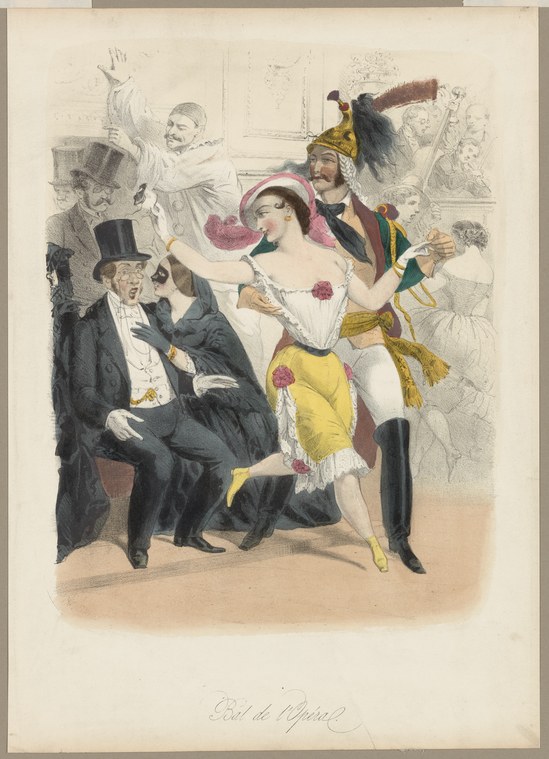
This work captures the historical reality of spaces where 'dance' and commercial sex were inseparable, and where women's bodies were simultaneously performers and commodities. For historians, it documents the Opéra ball as a distinct form of urban spectacle that combined legitimate theater with what amounted to regulated prostitution, making visible the sexual politics embedded in 19th-century ballroom culture. The image matters because it does not prettify or euphemize these transactions—the gesture is unambiguous, the imbalance of power is graphic, and the theatrical artifice (costumes, masks, setting) frames rather than obscures the economic exchange.
What you are looking at
A crowded masquerade ball rendered in colored engraving, alive with theatrical artifice and social transaction. The composition is densely populated with figures in evening dress and costume, arranged in theatrical depth from foreground to background. At center left, a gentleman in black tailcoat and top hat sits or reclines, being approached by a partially nude female dancer in yellow silk skirts and a large pink hat; she gestures toward him with one arm raised and extended, her body angled in theatrical appeal. Behind and above them, figures in military dress, elaborate costumes, and masks create a carnival atmosphere. The scene is lit to suggest indoor gaslight, with careful shading that models the figures against a neutral background. The title "Bal de l'Opéra" inscribed at bottom identifies this as depicting the famous masked balls held at the Paris Opéra during the Second Empire and Belle Époque—among the most glamorous and morally ambiguous social events of the era, known equally for their sophistication and their role as meeting places for commercial sexual exchange.
The dancing
The central dancer occupies a posture of direct address and solicitation: her torso is turned toward the seated gentleman, one arm lifted in invitation or gesture, the other at her side. Her weight appears forward, her frame open and confrontational rather than closed or balletic. The figures around her are mostly standing or in conversation; there is no sense of coordinated group movement or formal dance structure. The composition treats the woman's body as an object of display and negotiation rather than as moving through a dance vocabulary. Her gesture is acrobatic or theatrical rather than balletic—the raised arm lacks the controlled turnout and placement of classical training.
The dance depicted
This is not a depiction of formal ballroom dance, but rather of the social and sexual spectacle of the Opéra ball itself. The central figure appears to be a professional dancer or sex worker engaged in the informal transaction that was the notorious function of these events. The image captures the boundary between the ballroom (visible in background figures) and the transactional encounters that occurred alongside it. No recognizable dance form is being executed; instead, the image documents the commodified display of the body that characterized such venues. The costume—minimal dress, theatrical hat, exposed flesh—and the gesture of direct solicitation are the 'dance' here, in the sense that the body is being performed rather than that any codified choreography is occurring.
How it was made
This is a hand-colored engraving or possibly lithograph with hand coloring, likely from the mid-19th century. The technical approach shows sophisticated modeling of form through line and shadow, with careful differentiation of textures: the shine of silk, the matte of coat fabric, the translucency of skin. The color has been applied selectively to emphasize focal figures—the yellow skirts and pink hat of the central dancer, the red and gold military dress—leaving much of the background in monochrome. This combination of engraved line and selective color was typical of popular prints intended for middle-class consumption, affordable and widely distributed. The technique allowed narrative detail and social commentary to coexist with fine finish.
About this work
This colored engraving documents the Bal de l'Opéra, the masked balls that became legendary spaces of social and sexual exchange in Paris during the Second Empire and Belle Époque. The image does not depict formal dance but rather the performative display and commercial negotiation that occurred at these events. The central scene—a man of means approached by a lightly dressed female dancer or sex worker in a gesture of solicitation—captures the actual social function of such occasions, framed within the theatrical glamour of the Opéra setting. The work belongs in a dance history because it records how the body was displayed and commodified in one of the 19th century's most notorious performance venues, and because it shows the boundary between ballroom propriety and sexual commerce that the Opéra ball straddled. It is a document of urban sexuality and theatrical spectacle as much as of dance proper.
How to look at it
Note how the woman's body is rendered as available and exposed, her gesture direct and unambiguous in its offer. Observe the contrast between her theatrical undress and the formal black tailcoat of the seated man—the image makes visible the transaction occurring. The background figures, still engaged in the formal business of the ball, provide context: this is not an aberration but the actual purpose of the space. The title at the bottom grounds the image in a specific, named place, suggesting this is documentary rather than fantasy. The color choices—the bright yellow and pink of the central figure against the blacks and grays of the men—direct the eye toward the commodified body and make her the visual subject of the composition.
The period
The Bal de l'Opéra became famous in the 1830s and reached their peak of notoriety in the 1860s-1880s under the Second Empire and early Third Republic. These were masked balls held in the foyer or adjacent spaces of the Palais Garnier and earlier opéra houses, officially sanctioned but widely understood as venues where middle-class and aristocratic men could meet women who were available for sexual transaction. They were documented extensively in popular prints, literature (including Offenbach's operettas), and journalism—both celebratory and moralistic. The balls represented a distinctly modern form of spectacle: theatrical, commercial, and urban, combining the aesthetics of grand opera with the economics of sex work. Engraved and lithographed prints of such scenes were enormously popular, serving as both documentary and titillation for print-buying audiences.
Where it lives
The work is held in the New York Public Library's collection of prints depicting dance. It is part of a broader archive of 19th-century popular prints documenting ballroom and cabaret culture.
Dance in this work
Questions about this work
Is this an actual depiction of the Opéra ball, or a fantasy?
The scene reflects the actual function of the Bal de l'Opéra, though rendered through the conventions of popular print. The title grounds it in a specific venue and set of practices. Historical accounts, journalism, and other prints confirm that such transactions and spectacles did occur; this image is documentary in intent, capturing the sexual economy that made these balls famous.
What is the dance style shown here?
No formal dance style is being executed. The central figure's gesture is theatrical and solicitative rather than balletic. The image documents performative display rather than choreographed movement. The 'dance' of the Opéra ball was the performance of availability and the negotiation of desire, not the execution of waltz or quadrille.
Who made this print?
The artist is unrecorded in the catalogue. The work is attributed only to the New York Public Library's collection. Many such prints were produced anonymously or under publisher's names rather than individual artists'.
When was the Opéra ball held?
The famous Bal de l'Opéra reached their peak during the Second Empire (1852–1870) and early Third Republic, lasting well into the 1880s. This print is likely from the 1860s or 1870s, at the height of their notoriety.
More dance artwork





