49 works in this view — arrow keys or swipe to move between them.
Dance in Art
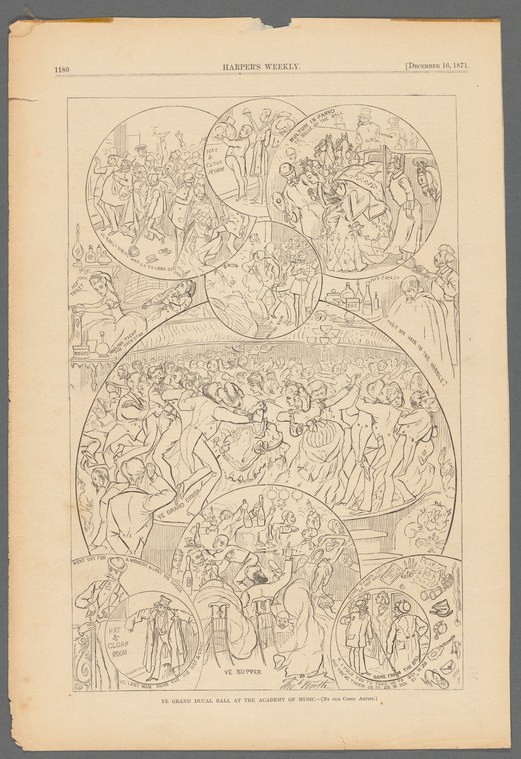
Ye grand ducal ball at the Academy of Music
Unknown artist
- Collection:
- Prints depicting dance
- Source:
- New York Public Library
- Rights:
- Public domain — free to use, share and adapt.
- Recorded as:
- Public Domain
Detailed illustrations of actual ballroom practice from inside high-society events are rare; most visual records of Victorian dance come from theatrical or artistic contexts rather than documentation of lived social practice. This engraving captures the posture, spacing, costumes, and gender dynamics of upper-class American ballroom dancing at a precise historical moment, before photography became the standard method of journalistic illustration. It also documents how an immigrant or foreign cultural moment—a European ducal visitor's ball—was assimilated into and covered as part of New York's fashionable life.
What you are looking at
This is a densely populated engraving composed of multiple circular vignettes arranged around a larger central scene, all contained within the format of a single page from Harper's Weekly (16 December 1871). The title refers to a grand ducal ball at the Academy of Music. The central oval contains the most elaborate scene: a crowded ballroom with dozens of figures in Victorian-era formal dress, moving in social formation across an ornate floor. Women wear full-skirted gowns with tight bodices; men wear evening coats and trousers. The surrounding smaller circles each contain distinct episodes or spaces related to the event—some showing couples dancing in pairs, others showing promenades, conversations, or preparation scenes. The entire composition reads as a journalistic illustration of a fashionable social occasion, with the artist recording multiple moments and spaces within a single evening's entertainment. The line work is fine and precise throughout, typical of wood-engraved newspaper illustration of the period.
The dancing
The dancers visible in the central ballroom scene and in the surrounding vignettes are shown in upright, formal posture characteristic of Victorian ballroom etiquette. Couples appear in closed position—men's right hands at the women's waists, left hands joined—though the small scale and density of the composition makes precise hold difficult to verify in all cases. The women's voluminous skirts dominate the visual weight; their bodies sway slightly to accommodate the fabric in motion. A few figures are shown in profile mid-stride, suggesting forward movement and rotation. The surrounding smaller scenes show standing conversation, seated observation, and what appears to be cotillion or promenade formations where dancers process in lines or couples.
The dance depicted
This is a depiction of fashionable ballroom dancing in 1870s New York high society. The specific dances are not labeled but the formal dress, the ballroom setting, and the ballroom etiquette suggest the quadrille and the waltz—the dominant ballroom dances of the Gilded Age in America. The cotillion (a social dance with multiple figures, often used as the closing dance of an evening) is likely represented in some of the surrounding vignettes, particularly where dancers form lines or process. The title's reference to a 'grand ducal ball' signals a prestigious social event hosted by or for European nobility visiting New York, which would have followed formal ballroom protocols. The image emphasizes the social choreography of the event—not the athletic or artistic display of the dance itself, but rather its function as structured social interaction among the fashionable classes.
How it was made
This is a wood engraving, one of the most common methods of illustrating newspapers and magazines in the 1870s. The fine parallel lines (hatching and cross-hatching) that build tone and texture throughout are characteristic of the medium; they show the hand of an experienced engraver working from an artist's design. Wood engraving allowed for high-quality reproduction at speed and scale suitable for mass circulation in a weekly magazine. The composition's density—the decision to show multiple spaces and moments within a single page—is typical of journalistic practice of the period, which aimed to give readers a comprehensive visual account of an event they had not attended. The technique permitted fine detail in costumes and faces, serving the documentary function of the image.
About this work
This is a newspaper illustration documenting a high-society ballroom event in New York in December 1871. It records both the central spectacle of the dancing and the social infrastructure around it—the waiting rooms, conversations, and ceremonies that framed Victorian ballroom entertainment. The work belongs to the tradition of social documentary in illustrated journalism, where the dance floor was newsworthy not as art but as a mirror of wealth, fashion, and social hierarchy. For historians of dance, it offers precise visual evidence of Victorian ballroom posture, dress, and etiquette at a specific moment and social level. The multiple viewpoints and episodic composition reflect how such events were actually experienced—not as a unified spectacle from a single vantage point, but as a series of overlapping spaces and activities.
How to look at it
Attend first to the central ballroom scene and observe the posture and spacing of the dancers—the uprightness, the close proximity of partners, the way the women's skirts dominate the composition. Note the formal dress code and the gender balance of the couples. Then examine the surrounding vignettes to see how the artist broke down a single evening into distinct spaces and moments: some show dancing, others show waiting, observing, or social conversation. The overall composition emphasizes that a 'ball' was as much about social ritual and display as about the dance itself. The fine line work and density of the composition are also characteristic of wood-engraved newspaper illustration—a technique that demanded both artistic skill and technical precision.
The period
The 1870s were the height of the Gilded Age in America, when ballroom dancing remained the primary social performance of the elite classes. The waltz, quadrille, and cotillion were the standard ballroom dances of the period, performed at private balls and public assemblies in America and Europe. This was also the era of illustrated newspapers as the primary source of visual news; Harper's Weekly, founded in 1857, was the leading illustrated weekly in the United States and employed the finest wood engravers and artists of the day to cover society events, politics, and daily life. The ball depicted here would have been a significant social event covered not only for its intrinsic importance to New York's elite but also for its appeal to the magazine's middle-class and aspirational readership, who could vicariously experience fashionable society through detailed illustration.
Where it lives
This engraving was published in Harper's Weekly on 16 December 1871, as part of the magazine's weekly coverage of fashionable society and current events. It comes from the NYPL's collection of prints depicting dance, where it is catalogued without attribution to a specific artist. The work is one of hundreds of such social illustrations produced for the magazine during this period, documenting the visual culture of American urban life.
Dance in this work
Questions about this work
What is a 'grand ducal ball' and why would it be newsworthy in New York in 1871?
A grand ducal ball would have been a fashionable ball hosted by or in honor of a European duke or other member of the nobility visiting New York. Such visits were significant social events in Gilded Age America, signaling prestige and international cultural capital. Illustrated newspapers covered such events extensively because they appealed to readers' interest in fashionable society and European connections.
What dances would have been performed at such a ball?
The waltz and quadrille were the dominant ballroom dances of the 1870s. The waltz was a three-count dance in closed position; the quadrille was a four-couple formation dance with multiple figures. The cotillion, a flexible social dance often used to close an evening, would also have been performed. The exact sequence and selection of dances would have been determined by the ball's organizers and the orchestra leader.
Why are there so many small scenes around the main ballroom?
The composition reflects the journalistic aim to give readers a comprehensive visual account of the entire event—not just the dancing itself, but the social spaces, ceremonies, and waiting areas that framed it. This multi-panel approach allowed the artist and engraver to show how the ball functioned as a complex social occasion with multiple overlapping spaces and activities.
Is it possible to identify the specific artist of this engraving?
The catalogue record does not attribute this work to a named artist. Many engravings published in Harper's Weekly were produced collaboratively—an artist made the design, and a specialized engraver cut the wood block for printing. Attribution records for such works are often incomplete or lost.
More dance artwork





