49 works in this view — arrow keys or swipe to move between them.
Dance in Art
The dancing lesson
Unknown artist
- Collection:
- Prints depicting dance
- Source:
- New York Public Library
- Rights:
- Public domain — free to use, share and adapt.
- Recorded as:
- Public Domain
The image is a rare documentary record of 19th-century ballet pedagogy and the master-class system that shaped professional dancers. It shows the physical environment, costume standards, and teaching methods of an era when ballet technique was codified and transmitted through daily disciplined practice in formal academies. For anyone studying ballet history or the visual culture of dance training, this is primary evidence.
What you are looking at
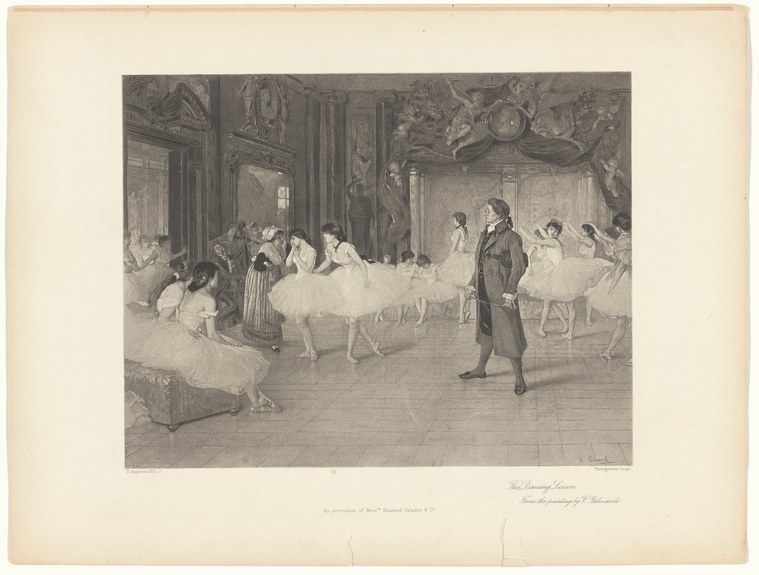
A ballet class or rehearsal in a grand interior studio, likely late 19th century. The space is defined by tall classical columns, ornate wall panels, and an elaborate sculptural relief above—the setting suggests an aristocratic or royal academy rather than a commercial studio. Multiple young female dancers in white tutus are distributed throughout the room in various attitudes of practice or rest. At the center-right stands a male figure in dark clothing—the instructor or ballet master—observing the dancers. Some dancers stand at attention or in preparatory positions; others rest or adjust their costumes. The lighting is soft and diffuse, creating a sense of calm focus. The engraving technique renders the scene with fine cross-hatching that gives volume to the tutus and definition to the architectural setting.
The dancing
The dancers wear the elongated, full white skirts characteristic of mid-to-late 19th-century ballet costume. Their arms and carriage suggest classical training: upright posture, controlled placement of the upper body. The tutu length and silhouette—knee-length to mid-calf—is consistent with the Romantic and early Classical periods rather than the longer skirts of earlier ballet. Several dancers are captured in standing positions of rest or observation rather than active jumping or turning, which is typical of rehearsal moments between combinations. The instructor's stance is authoritative but not demonstrative; he appears to be watching and correcting rather than dancing.
The dance depicted
This is a scene of classical ballet training and rehearsal, most likely from the late 19th century based on costume and setting. The work shows the institutional structure of ballet pedagogy—the master class format with a single instructor supervising multiple dancers in a formal space. There is no indication of a specific choreographic style or named dance; the image documents the teaching and practice environment rather than a performance. The dancers' positions and the calm, methodical arrangement suggest the methodical work of technique class rather than theatrical display.
How it was made
This is a steel or wood engraving, executed with fine parallel line work (hatching and cross-hatching) to create tone and volume. The technique allows precise rendering of architectural detail and the silks and tutus of the dancers' costumes; the soft modeling of light on fabric is achieved through careful gradation of line density. Engraving was the primary medium for reproductive prints and art journalism in the late 19th century, indicating this work was likely intended for circulation in a periodical, art collection, or illustrated book aimed at a broad educated audience. The quality and detail suggest professional production, not a casual sketch.
About this work
This engraving documents a moment in the formalized teaching and rehearsal of classical ballet, depicting the private studio space where technique was drilled and artistic standards maintained. The image records not a performance but the quotidian work of ballet training under the direction of a master instructor. It belongs in a dance archive because it captures both the physical practice of ballet and the pedagogical structures that sustained the art form in the 19th century. For historians, it is evidence of how ballet was actually taught and organized; for dancers, it shows the continuity of posture, dress, and studio practice across more than a century.
How to look at it
Notice the careful composition of the space: the columns frame and organize the dancers into a coherent pedagogical scene rather than a chaotic crowd. The instructor's position and gaze structure the entire image, directing attention toward the teaching relationship at the center. Observe the uniformity of costume—all dancers wear identical white tutus—which emphasizes technique and form over individual personality. The engraver has chosen to show dancers between movements, during the pauses and preparations that constitute most of a rehearsal, rather than at the peak of a jump or turn. This choice tells us something about how ballet work actually happens: it is methodical, repetitive, and involves long periods of stillness and correction.
The artist
The artist is unknown, but the work's professional execution and subject matter suggest it was created for a major illustrated periodical or art publication. The style and technique are consistent with mid-to-late 19th-century European reproductive printmaking, when engravings of theatrical and social scenes were a staple of visual journalism.
The period
This engraving was made during a period when classical ballet was being systematized and academicized. By the mid-19th century, ballet was no longer primarily a court entertainment but an institutional practice housed in national opera houses and academies with formal curricula. The Romantic era (1830s–1840s) had emphasized poetic narrative and the supernatural; by the later 19th century, technical virtuosity and classical form were reasserting dominance. The setting depicted here—a grand, formally designed studio in what appears to be a state institution—reflects the professionalization and public funding of ballet in major European capitals.
Where it lives
This work is held in the New York Public Library's Prints collection, catalogued under prints depicting dance. It is part of a broader collection of theatrical and dance-related prints that document 19th-century performance culture and studio practice.
Dance in this work
Questions about this work
Is this a real ballet class or an imagined scene?
Likely both. The architectural setting is grand enough to suggest an actual academy (possibly a court ballet school), and the details of costume and posture are too accurate to be purely invented. However, the composition is carefully arranged for aesthetic effect—the dancers are positioned to create visual balance rather than captured in a candid moment. The engraver was probably working from a sketch or memory of an actual class, then refined it for publication.
What era of ballet is this?
Based on costume and style, this is late 19th century, likely 1870s–1890s. The tutus are characteristic of the Classical period in ballet (Petipa's era), longer and fuller than 20th-century costumes but shorter and more practical than the Romantic-era tutus of the 1830s–1840s. The pedagogy shown here—formal, methodical, institutional—reflects the dominance of the Cecchetti method and Russian Imperial training at the end of the century.
What can we learn from this image about how ballet was taught?
The image shows that ballet training happened in a formal group setting under the direction of a single senior instructor, conducted in grand institutional spaces rather than intimate studios. All students wore standardized costume, suggesting uniformity of training and technique. The calm, organized arrangement suggests that corrections were made between movements, with students waiting attentively—a method very different from the intensive verbal coaching and continuous demonstration of modern ballet pedagogy. The space itself—with its classical architecture—was part of the message that ballet was an elite, formal art.
More dance artwork





