49 works in this view — arrow keys or swipe to move between them.
Dance in Art
Harlequin
Unknown artist
- Collection:
- Prints depicting dance
- Source:
- New York Public Library
- Rights:
- Public domain — free to use, share and adapt.
- Recorded as:
- Public Domain
Commedia dell'arte is foundational to modern theatrical movement and to the gestural vocabulary of dance itself, yet it survives mostly through written descriptions and later pictorial retellings. This direct image of a Harlequin performer—anatomically specific, emotionally precise—is evidence of how physical expression actually looked and worked on stage. For dancers and movement historians, it shows the extreme flexibility and control expected of performers, and how a single posed moment could communicate character and emotional state through the body alone.
What you are looking at
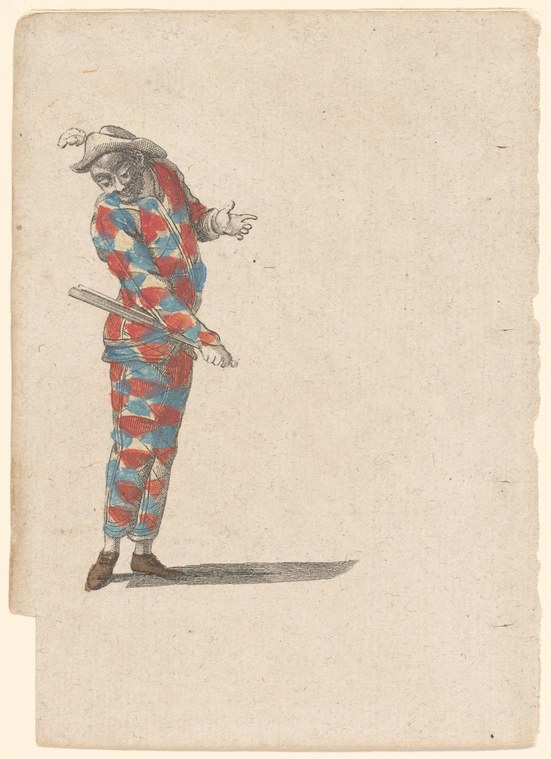
A single figure in theatrical dress dominates the composition, posed against a plain cream background with a shadow cast on the ground. The dancer wears a striking diamond-patterned costume in red, blue, and yellow, with a white ruffled collar at the neck and a white pointed cap or bonnet. The body is bent in a marked contrapposto: the torso folds forward sharply at the waist, the left arm extended outward in a gesture of address or entreaty, while the right arm hangs down. The legs are straight and close together, with brown boots visible. The figure's face is visible in profile, turned toward the viewer with an expressive, somewhat sorrowful expression. The pose captures a moment of theatrical pathos—the bent posture and downward gaze suggest vulnerability or resignation despite the jaunty costume.
The dancing
A single standing figure in a highly exaggerated contrapposto stance, the spine bent forward in an arc that brings the head down and forward while the left arm extends outward at about shoulder height with a gesture of appeal. The right arm drops straight. There is no second figure, no hold, no partner interaction. The weight appears to rest on both feet planted firmly, giving the pose a grounded, almost sculptural quality despite its contortion. The extremity of the bend—nearly a right angle at the waist—is physically demanding and reads as a deliberate expression of sorrow or supplication rather than a step in a social or narrative dance.
The dance depicted
This is most likely a Commedia dell'arte figure, specifically Harlequin (Arlecchino), based on the title and the diamond-patterned dress (the characteristic 'diamante' costume of that stock character). Commedia dell'arte was the improvisational theatrical form that dominated European popular theatre from the 16th to 18th centuries, and Harlequin was one of its most recognisable and beloved characters—a witty, acrobatic servant given to physical comedy, pantomine, and highly stylised gestures. This image captures not a formal dance but a theatrical *pose*—a single held moment of emotional expression that would have been part of the performer's gestural vocabulary. The bent posture is consistent with the physical virtuosity Harlequin characters were expected to display, though the mood here is melancholic rather than comic.
How it was made
The work appears to be a hand-coloured engraving or etching, based on the black-line definition of the figure and the selective colour application (solid reds, blues, and yellows with minimal shading). The technique of hand-colouring allowed printmakers to produce multiple versions of the same design with individual variation, making these works affordable to a broad theatrical audience. The precision of the line work and the care in rendering the fabric pattern suggest this was made for circulation among theatre-goers, dancers, or practitioners as a reference image or souvenir. The background—plain save for a single shadow—is typical of character-study prints meant to isolate and showcase the figure rather than situate it in narrative or scenic context.
About this work
This hand-coloured engraving documents the theatrical vocabulary of Commedia dell'arte, one of the most influential improvisation traditions in European theatre. Harlequin—known for virtuosic physicality and emotional range—is captured mid-gesture in a pose of pathos that demonstrates how theatrical performers of the period could shift register from comedy to vulnerability within a single character. The image is both a record of costume and a study of expressive posture: it preserves not a danced sequence but the gestural codes by which a performer communicated to an audience. For historians of theatre and dance, it offers rare documentation of how a character was actually embodied and performed—not described, but shown. The print's affordability and portability suggest it circulated among practitioners, curious amateurs, and collectors as both a reference document and a souvenir of a beloved theatrical figure.
How to look at it
Look at the extreme geometry of the pose: the bend is theatrical exaggeration, not naturalism, and signals trained physicality. The outstretched arm is a *gesto*, a gestural unit of meaning, not a step—note how the extended hand is open and directed as if in address or plea. The downward gaze and sorrowful expression contrast sharply with the bright, witty costume; this was precisely the tonal range Harlequin was capable of within a single performance. The artist has chosen the moment of pathos rather than acrobatic display or comedy, suggesting this print captured a well-known sequence or an emotionally resonant scene rather than a typical moment of slapstick.
The period
Commedia dell'arte flourished as an improvisation form from roughly the 16th through 18th centuries, reaching peak popularity and European circulation in the 17th and 18th centuries. During this period, character types—Harlequin, Pantalone, Isabella, and others—became standardised in costume and mannerism, and were documented extensively in prints and engravings for sale to an eager public. These prints served both as souvenirs and as reference material for touring companies that travelled across Europe. The precise dating of this image is unknown, but the printing style and the character's costume place it within this broad tradition of theatrical documentation. By the 18th century, Commedia dell'arte was beginning to be absorbed into court theatre and ballet pantomime, influencing the development of formal dance technique.
Where it lives
Held in the New York Public Library's collection of prints depicting dance. No artist, date, or medium is recorded in the catalogue, but the hand-coloured engraving technique and the subject matter place it within the category of European theatrical prints made for mass circulation.
Dance in this work
Questions about this work
What is Commedia dell'arte and why did Harlequin matter?
Commedia dell'arte was an improvisational theatre tradition that emerged in Renaissance Italy and spread across Europe, where it dominated popular theatre for two centuries. Harlequin (Arlecchino) was one of the stock characters—a clever, acrobatic servant known for witty wordplay, physical comedy, and emotional range. The character and his gestural vocabulary influenced ballet, pantomime, and modern theatre fundamentally; many conventions of theatrical movement trace back to Commedia troupes.
Is this a dance?
Not in the modern sense—it is a theatrical pose, not a choreographed sequence. But Commedia performers were trained in movement, flexibility, and physicality that we would now recognize as dance training. The pose demonstrates both the extreme control and the emotional expressiveness that performers possessed, and it would have been part of a larger movement vocabulary used to tell stories and communicate character.
Why was this printed and circulated?
Hand-coloured engravings of popular theatrical characters were inexpensive souvenirs sold to theatre-goers, much like playbills or lobby cards today. They also served as reference documents for touring companies, showing other performers how characters were typically embodied and costumed. The prints helped standardize and disseminate the character types across Europe.
How do we know this is Harlequin?
The title of the work identifies it as such, and the costume—the characteristic diamond or lozenge pattern in multiple colours—is the unmistakable visual marker of the Harlequin character across all Commedia documentation from this period.
More dance artwork





