49 works in this view — arrow keys or swipe to move between them.
Dance in Art
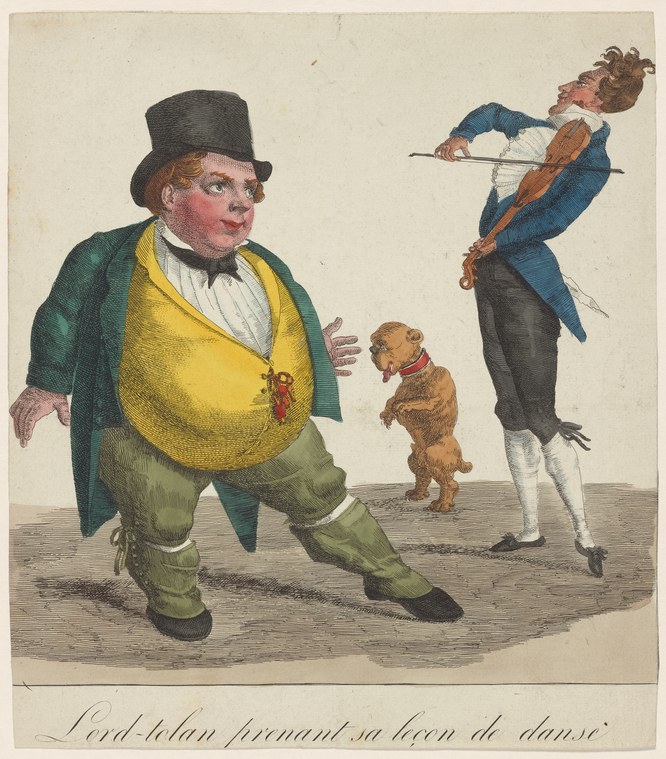
Lord-Tolan prenant sa leçon de danse
Unknown artist
- Collection:
- Prints depicting dance
- Source:
- New York Public Library
- Rights:
- Public domain — free to use, share and adapt.
- Recorded as:
- Public Domain
This print documents a moment when ballroom dance instruction was a marker of gentility and social standing, and it reveals how visual culture used dance to explore bodily shame and social ambition. For historians of dance pedagogy, it is evidence of how canes were used in teaching and how the body of the dance master was positioned as an idealized model to be imitated by often-resistant pupils.
What you are looking at
A portly gentleman in early 19th-century dress takes a dancing lesson from an elegant male instructor. The pupil wears a yellow waistcoat, green jacket, and breeches, his rotund frame dominating the left side of the composition. His instructor, poised on his right leg on the right side of the frame, demonstrates an arabesque or attitude position, holding a walking stick or cane as a teaching prop. Between them stands a small spaniel dog, alert and engaged with the scene. The background is plain and neutral, focusing all attention on the figures and the moment of instruction. The print is hand-colored in bright reds, yellows, greens, and blues, with fine linear detail characteristic of early 19th-century satirical printmaking.
The dancing
The instructor's posture is formally trained: he stands on one supporting leg in an extended position, the other leg raised behind him or held in space, with his torso upright and arms positioned to demonstrate proper frame. His carriage is balletic and controlled. The pupil stands in a more grounded, less confident stance, watching the demonstration. The cane held by the instructor serves as a teaching tool, common in dance pedagogy of the period. The small dog adds a note of domestic comedy to the lesson, suggesting this is a private home instruction rather than a formal dance academy.
The dance depicted
This appears to depict a social dance lesson—likely a waltz, quadrille, or general ballroom dance instruction—from the Regency or early Georgian period, when such private lessons were fashionable among the gentry. The formal dress, the indoor setting, and the use of a cane for instruction all point to the conventions of English social dance teaching in this era. The exaggerated physique of the pupil and the formal elegance of the instructor create a satirical contrast typical of caricature prints, which often used dance lessons as a subject for humor about social pretension and bodily incapacity.
How it was made
This is a hand-colored engraving or aquatint, a popular medium for satirical and topical prints in early 19th-century Britain. The fine linear hatching visible in the background, combined with broad areas of flat color applied by hand, is characteristic of prints made for relatively wide distribution among the reading public. The technique allowed for multiple impressions to be hand-colored individually, making these works affordable for middle-class households. The print's sharpness and careful detail suggest professional execution for a London or provincial printer.
About this work
This is a satirical print depicting a dancing lesson, likely from the 1810s–1830s, playing on the physical comedy of an overweight gentleman attempting to learn fashionable ballroom dance from a trim, formally trained instructor. The work belongs to a rich tradition of British satirical prints that used dance—and the human body in motion—as a vehicle for social commentary and humor. The title in French, *Lord-Tolan prenant sa leçon de danse* (Lord Tolan Taking His Dance Lesson), suggests the print circulated in both English and French contexts, or was aimed at an audience with French cultural reference points.
This image preserves a record of how social dance instruction was visualized and mocked in the Regency era, revealing contemporary anxieties about bodily propriety, social aspiration, and the vulnerability of the human form when asked to move in prescribed ways. The presence of the spaniel and the domestic interior setting ground the lesson in lived social reality, while the caricatural exaggeration of the pupil's body transforms it into a commentary on class and decorum.
How to look at it
Attend to the positioning of the two bodies: the instructor's extended, weightless posture versus the pupil's grounded, earthbound stance. The cane in the instructor's hand is not a prop of authority but a teaching tool, used to correct or guide the pupil's movement. Notice how the artist has frozen a moment of demonstration—the pupil is watching, not dancing; the lesson is in the showing, not the doing. The small spaniel, seemingly more graceful than the pupil, underscores the satirical point. The bright colors and clean lines are typical of prints meant to be read quickly and enjoyed for their immediacy and comic exaggeration.
The period
In the early 19th century, private dancing masters were essential figures in the education of the English gentry and aspiring middle classes. Ballroom dancing—particularly the waltz, cotillion, and quadrille—was a crucial social skill, and instruction in the home or at assembly rooms was standard. Satirical prints flourished in this period as a means of commenting on social manners and bodily conduct. Artists and printmakers frequently depicted the dancing master as a figure of both authority and ridicule, embodying foreign (often French or Italian) refinement while teaching British pupils who might resist or bungle the forms. The contrast between the master's elegance and the pupil's awkwardness was a perennial source of humor.
Where it lives
This hand-colored engraving is held in the New York Public Library's prints collection, which documents dance through popular visual culture of the 18th and 19th centuries. Such prints were commercial products, sold individually or in series, and circulated among the middle and upper classes as both souvenirs and social commentary.
Dance in this work
Questions about this work
What dance is being taught?
The print does not specify, but the formal dress, interior setting, and period suggest a Regency-era social ballroom dance—likely a waltz, cotillion, or quadrille. These were the fashionable dances among the English gentry in the 1810s–1820s, and private instruction in them was standard.
Why is the pupil drawn so grotesquely?
This is a satirical print, and the exaggerated physique of the 'Lord Tolan' character is the joke: his body is presented as comically ill-suited to the grace and discipline required by fashionable dance. Satire of this kind mocked social pretension and bodily incapacity in equal measure.
What is the cane for?
In 18th and 19th-century dance pedagogy, the dancing master's cane was used to correct posture, mark time, or point to the feet to guide the pupil's steps. It was a standard teaching tool, not a weapon or badge of rank.
Is this a real person or a fictional character?
The title 'Lord Tolan' suggests a named (or invented) figure, possibly a real nobleman known in print culture for his misadventures in fashionable life. Without additional documentation, we cannot establish whether he was a real person or a stock character used by the satirist.
More dance artwork





