49 works in this view — arrow keys or swipe to move between them.
Dance in Art
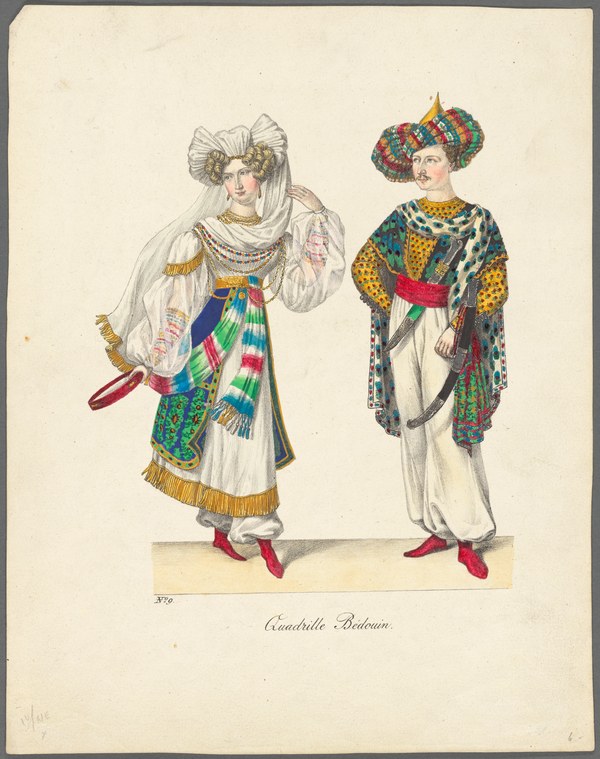
Quadrille Bédouin
Unknown artist
- Collection:
- Prints depicting dance
- Source:
- New York Public Library
- Rights:
- Public domain — free to use, share and adapt.
- Recorded as:
- Public Domain
This work documents the 19th-century European appetite for orientalist dance imagery and the way the quadrille—a newly fashionable social dance—became the default frame for representing non-European choreography. It also reveals how a single printmaking tradition (hand-colored engravings) served dual audiences: those interested in dance instruction, and those seeking erotic or exotic fantasy.
What you are looking at
This hand-colored engraving depicts two dancers in orientalist costume against a plain background. On the left, a figure in white drapery wears a large gauzy headdress and decorative striped skirt in jewel tones; they hold a curved dagger and gesture with one arm raised in a flowing motion. Their companion on the right wears a patterned tunic in ochre and teal over white hose and red slippers, topped with an elaborate tall headdress. Both figures are positioned as if mid-movement, their bodies angled in dynamic poses that suggest active choreography. The engraving's delicate line work and careful hand-coloring—particularly in the fabrics and ornamental details—suggests this was a high-quality print intended for a cultivated audience familiar with orientalist aesthetics.
The dancing
Both dancers stand in upright, animated poses rather than closed partnership. The left figure's raised arm and curved-weapon gesture suggest a solo or solo-within-group performance; the right figure's body leans slightly forward with arms positioned low and to one side. Neither assumes the formal square frame or paired hold of European ballroom dance. The weight appears distributed equally, neither figure leaning into or away from the other, and the arm positions are asymmetrical—characteristic of movement vocabularies beyond the European partnered tradition.
The dance depicted
The title *Quadrille Bédouin* claims this represents a quadrille—a group square dance that dominated European ballrooms in the 19th century—but rendered in Bedouin style. However, the costumes, gestural vocabulary, and compositional treatment suggest this is orientalist fantasy rather than documentation. The orientalism is primary; the quadrille frame is secondary, applied as a label by a European printmaker interpreting North African or Middle Eastern movement through the lens of European dance categories. The result is a costume piece or theatrical variant rather than an authentic representation of either tradition.
How it was made
This is a hand-colored engraving, likely made in the early-to-mid 19th century. The fine parallel lines and careful crosshatching used to model form are visible in the drapery and headdresses, while the hand-coloring in watercolor or gouache adds jewel-tone saturation and gilt accents that would not survive in a monochrome print. This technique was expensive and time-consuming, placing the work in the luxury print market—sold individually or bound into albums for educated collectors familiar with orientalist imagery and European dance.
About this work
This engraving belongs to the 19th-century European fascination with orientalism, specifically the romanticization of North African and Middle Eastern peoples and their customs through a ballroom-dance lens. The artist presents two figures in elaborate costume posed as if dancing, using the vocabulary of European choreography (the quadrille) to frame movement imagined to be non-European. It is both a dance print and an orientalist ethnographic fantasy—a category that dominated visual culture in this period. For historians of dance imagery, it reveals how European artists simultaneously celebrated ballroom dance as a sign of civilization while exoticizing non-European bodies and practices, and how the quadrille became a template for representing any group movement, regardless of origin.
How to look at it
Observe the asymmetry in the two figures: they do not mirror each other, and they occupy separate spatial planes rather than forming a coupled unit. The left figure's raised arm and weapon-holding gesture suggest solo display or weapon-dance (possibly influenced by accounts of Near Eastern or North African performance). The right figure's posture is more restrained, almost serving as a still point against which the left figure's animation plays. Notice how the print's ornamental frame—the title, the blank ground, the formal composition—tries to contain and civilize movement that the costumes and gestures code as exotic and wild.
The period
The quadrille arrived in European ballrooms from France around 1800 and became the dominant group dance of the 19th century, eventually spreading worldwide as a marker of gentility and modernity. Simultaneously, Orientalism—the European fantasy of North Africa, the Middle East, and Asia—reached its peak as a subject for painters, printmakers, and writers. The intersection of these two cultural forces produced works like this: the quadrille given an oriental costume and setting. Dance prints of this kind, issued in series or collected in albums, were a commercial and social phenomenon; they served as both instruction manuals for fashionable dancers and entertainment for armchair travelers.
Where it lives
Held in the New York Public Library's collection of dance-related prints. The print appears to be part of a broader 19th-century run of orientalist dance imagery, likely issued in Paris or another major European printing center, though the original publisher and exact date remain unrecorded.
Dance in this work
Questions about this work
Is this a real dance or an invented one?
It is almost certainly invented—a European artist's fantasy labeled with the quadrille (a European ballroom dance) and the Bedouin name. The quadrille was a structured four-couple dance in square formation; these two figures do not match that pattern. The costumes and gestures draw on orientalist stereotypes rather than ethnographic observation.
Who would have bought or seen this print?
Educated, wealthy European collectors interested in dance, exoticism, or fashion. The hand-coloring and fine engraving indicate a luxury product—expensive enough to be owned by individuals rather than mass-distributed. It would have circulated in albums, private collections, or high-end print shops.
What does 'Bédouin' mean in this context?
Bedouin refers to the nomadic peoples of the Arabian Peninsula and North Africa. In 19th-century European art, 'Bédouin' was a catch-all label for anything imagined to be wild, exotic, and non-European—often applied without regard to actual Bedouin culture or practice. It functioned more as a fantasy category than a geographic or ethnic descriptor.
More dance artwork





