49 works in this view — arrow keys or swipe to move between them.
Dance in Art
Habit de masque
Unknown artist
- Collection:
- Prints depicting dance
- Source:
- New York Public Library
- Rights:
- Public domain — free to use, share and adapt.
- Recorded as:
- Public Domain
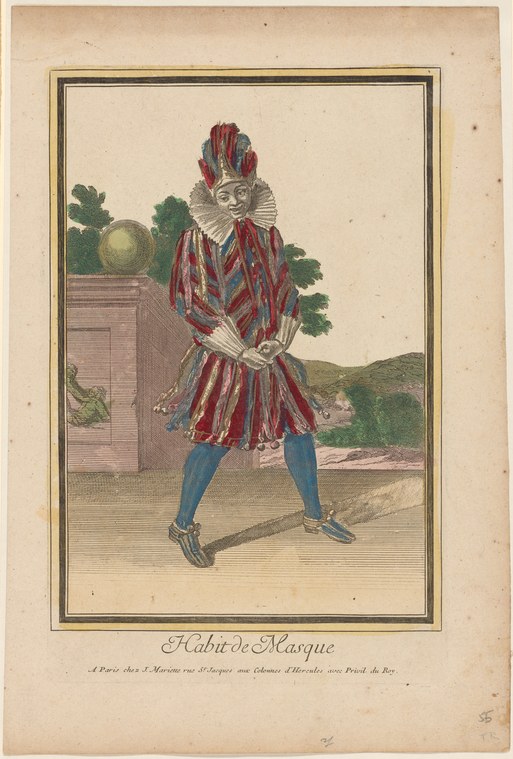
This print documents the visual language of 18th-century French theatrical comedy and the importance of costume in establishing character and comedy. For historians of dance and theatre, it records how comic characters were presented and embodied in this period, even when the specific work is not yet identified.
What you are looking at
A single figure in theatrical costume strikes a proud, legs-apart stance against a landscape background. The performer wears a red and blue striped doublet or tunic with vertical pleating, a tall feathered headdress in red and blue, and blue stockings with dark shoes. A white ruff collar frames the neck. The figure's left hand rests on the hip while the right arm hangs at the side, both relaxed. Behind stands a classical stone urn or monument on a pedestal, with green foliage at either side and rolling hills in the distance—a theatrical set piece rather than a naturalistic landscape. The hand-coloured engraving uses warm tones for the flesh and fabric, cool greens for the vegetation, and preserves the fine line work typical of 18th-century printmaking.
The dancing
One figure, weight distributed equally on both legs planted wide apart in a confident, spraddled stance. The torso faces front, the head held high beneath the tall feathered crown. Both arms are relaxed and lowered—no arm frame, no partnering, no suggestion of motion through the body. The posture is display rather than dance: a portrait attitude, or a freeze moment from a theatrical entrance or solo.
The dance depicted
This is a theatre costume study from the era of French comedic theatre, most likely from the commedia dell'arte tradition or early 18th-century French comedy. The costume—the 'Habit de Masque' (Costume of the Mask)—and the title suggest this is either a stock character type or a specific role from a known play. The figure's proud bearing and absurdist costume (the towering headdress, the striped hose, the wide-legged stance) indicate a comic or farcical character rather than a serious dancer. This may record a dancing role in a theatrical comedy, but the image itself captures a stationary pose of presentation rather than an action of dancing.
How it was made
Hand-coloured engraving, a common format for distributing theatre costume designs and character studies in 18th-century France. The fine engraved line work defines the silhouette precisely, while the applied watercolour or gouache adds local colour without covering the print beneath. This technique allowed wide circulation of theatrical imagery to artists, performers, and educated audiences, establishing costume and character types across the French-speaking world. The quality of the line work and finish suggests a professional workshop production.
About this work
A hand-coloured engraving depicting a theatrical figure in full costume from 18th-century French theatre. Titled 'Habit de masque' (Costume of the Mask), it records a stock character or comedic role, rendered in the elegant draughtsmanship typical of French costume prints of the period. The figure strikes a proud, wide-legged stance with feathered headdress and striped doublet—a display of theatrical character and costume rather than a capture of dance in motion. Such prints were essential documents of theatrical practice, circulating designs and character types across professional and amateur stages.
How to look at it
Attend to the confidence and absurdity of the pose: the figure is not captured mid-movement but frozen in a moment of presentation or entrance. The wide-planted legs, the proud head, the relaxed arms all declare character and status. The feathered headdress dominates the composition, making visual height and spectacle central to the character's identity. Note how the costume—the vertical stripes, the contrasting hose, the white ruff—breaks up the body into zones of colour and pattern, a key tool of theatrical costume design. The classical urn and landscape behind suggest this is a theatrically framed moment, not a real space.
The period
The print belongs to the 18th century, when French comedy and commedia dell'arte traditions were flourishing. Costume prints served as visual records of theatrical roles and character types, circulating among professional companies, amateurs, and patrons. The style and fashion of the dress—the vertical striped doublet, the feathered headdress, the blue hose—are consistent with early-to-mid 18th-century theatrical fashion. The engraving technique and hand-colouring method were the standard means of reproducing and distributing theatre imagery before lithography.
Where it lives
Part of the NYPL Prints collection depicting dance. The print is catalogued generically as a work in the 'Prints depicting dance' collection with minimal bibliographic information.
Dance in this work
Questions about this work
Is this actually a dance image?
The figure is shown in a stationary pose of presentation rather than captured dancing. However, it records a character from theatrical comedy who may well have danced, and it belongs in a dance archive as part of the visual history of how bodies and characters were presented in theatrical performance. The 'Habit de masque' tradition often involved acrobatic and danced movement as part of comic performance.
What does 'Habit de masque' mean?
The title translates as 'Costume of the Mask.' In 18th-century theatre, 'masque' often referred to comic or disguised roles in commedia dell'arte or comedic plays. The 'habit' was the complete costume. The image is a costume design or record, showing how the character would appear to the audience.
What is the feathered headdress?
A tall, extravagant crown or plume headdress typical of comic or theatrical roles in this period. It served to make the character visually distinctive and absurd, enhancing the comedy and ensuring visibility from the back of the theatre. Such headdresses are often found in depictions of commedia dell'arte and French comedic roles.
More dance artwork





