49 works in this view — arrow keys or swipe to move between them.
Dance in Art
Social dancing
Unknown artist
- Collection:
- Prints depicting dance
- Source:
- New York Public Library
- Rights:
- Public domain — free to use, share and adapt.
- Recorded as:
- Public Domain
This is evidence of what trained amateurs actually did with their bodies in the 18th-century ballroom—not the measured formality of a minuet, but the exuberance and athleticism that proper training and confidence permitted. The image reveals that social dancing of this period, for the skilled and privileged, was genuinely athletic and visibly joyful, not the rigid formality it is sometimes caricatured as.
What you are looking at
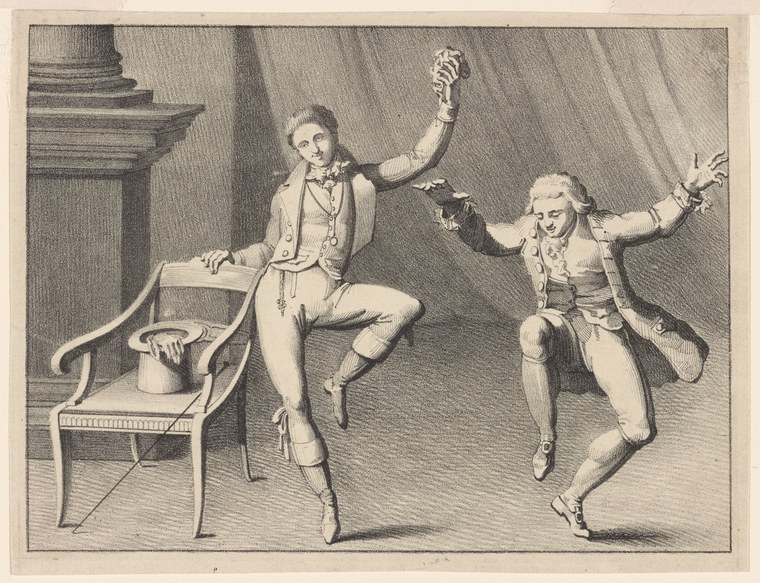
Two young men in aristocratic dress execute exuberant jumps in an interior space defined by a fluted column and draped fabric. The man on the left leaps with one leg extended, raising both arms in celebration, while his companion springs into the air with arms flung wide. Both wear the fitted coat, waistcoat, breeches, and stockings typical of 18th-century formal wear. The figure on the left rests one hand on an ornate chair, grounding the composition spatially. The fabric backdrop and classical column suggest a ballroom or drawing room. The artist captures the height of exuberant movement—toes pointed, bodies fully extended—in a moment of joyful abandon that speaks to the sociability and physical expression of polite dancing in this period.
The dancing
Two male dancers are captured mid-leap, their bodies achieving considerable height and extension. Both stand on the balls of their feet with pointed toes, a characteristic of 18th-century dance technique. The figure at left jumps with knees bent in recovery, left leg bent and raised, right arm lifted high, left hand touching or resting on the chair back. The figure at right springs higher still, arms fully extended laterally at shoulder height, legs in mid-scissor. Neither demonstrates a closed hold or couple's frame; this is individual display within a shared moment. Both have the wiry, upright carriage and elongated line typical of period social dance training.
The dance depicted
This appears to document the joyful social dancing of the 18th-century European ballroom—most likely a minuet or other courtly dance captured at a moment of exuberance. The title 'Social dancing' suggests this is not theatrical or performance-oriented work but rather the actual social practice of educated young men. The height, control, and pointed toes indicate these are trained dancers following the technique of the period. The unbounded joy and vertical leap, however, suggest a more uninhibited moment than the formal minuet would typically permit—perhaps the moment after a measured dance, or a stylised interpretation of the freedom and delight proper dancing afforded the young and privileged. The print likely documents or celebrates the grace and vigour considered marks of good breeding.
How it was made
This is an engraving, executed with fine parallel lines (hatching and cross-hatching) to create tonal modulation and volume. The technique is precise and controlled, allowing the artist to render fine details of drapery, the chair's carved form, the column's fluting, and the musculature of the dancers' legs. Engravings were the primary vehicle for circulating images of refined manners and approved social practice in the 18th century, suggesting this work was meant for a wide educated public—the viewers learning both how to dance and how to behave. The absence of colour concentrates attention on form, line, and the bodies' articulation.
About this work
This engraving documents the physical culture of 18th-century social dancing among the European aristocracy and gentry. Two young men execute high-spirited jumps in a ballroom setting, their trained bodies and expensive dress signalling both skill and social status. The work belongs to a long tradition of printed images circulating models of correct—or at least aspirational—behavior: dance as a visible measure of education, grace, and fitness for polite society. It captures not a performance for an audience but a moment of authentic pleasure in the physical and social practice that defined courtship, courtship, and genteel leisure.
How to look at it
Notice the moment the artist chose: not a static pose but the apex of the jump, when both dancers' feet are visibly off the ground and their bodies at full extension. This captures the acme of physical control and effort—the instant when the dancer seems to defy gravity. Observe how the artist has rendered the figures' musculature and the articulation of each leg from hip to pointed toe; a contemporary viewer would have read these anatomical details as evidence of proper training and natural aptitude. The chair and column are there not as mere props but to establish scale: these are real bodies achieving real height in a real room, not abstract symbols.
The period
The 18th century saw the minuet and other courtly dances become increasingly codified in written notation and instructional manuals, yet paradoxically, prints from this era often depict dance at moments of release and exuberance. Social dancing was a central practice of courtship and social advancement for the European gentry; being able to dance well and with ease was a key marker of breeding. Engravings like this one served both as models of behavior and as records of fashionable practice, circulating among people who learned to dance from masters and from observation. The emphasis on vertical lift and pointed toes shows the influence of French academy training, which was the standard for polite society across Europe.
Where it lives
The work is held in the New York Public Library's Prints collection, which documents the visual culture of manners, fashion, and social practice across several centuries. It is one of many didactic engravings on the subject of dancing that circulated in the 18th century, intended for viewers who wanted both to understand and to emulate fashionable behavior.
Dance in this work
Questions about this work
What kind of dance is this?
The title 'Social dancing' and the 18th-century dress suggest this documents the ballroom dancing of the period—likely a minuet or similar courtly dance. The moment shown, however, captures the dancers at a point of exuberance and release rather than the formal positions of the dance itself. It is possible this represents either a transition between dances or an idealised impression of the joy and freedom that skilled dancing afforded.
How do we know these are trained dancers?
Several details confirm training: the pointed toes, the height and control of the jump, the upright carriage, and the elongated line of the legs and arms. These are hallmarks of the French academy method that was the standard training for the European gentry in the 18th century. An untrained person would not achieve this line or this height with such apparent ease.
What is the purpose of the chair and column?
These elements anchor the scene spatially, establishing that we are in an interior—a ballroom or drawing room—rather than watching an abstract or allegorical image. They also provide scale, allowing the viewer to judge the actual height the dancers achieve. The column's classical form reinforces the refined, educated context of the activity.
Why were images of social dancing printed and circulated?
Dancing was a crucial social skill and a marker of breeding and education. Engravings showing correct technique, fashionable dress, and approved behavior served as models for people learning to dance or refining their manner. They also functioned as status markers—a way for viewers to see themselves as part of a refined, educated world.
More dance artwork





