49 works in this view — arrow keys or swipe to move between them.
Dance in Art
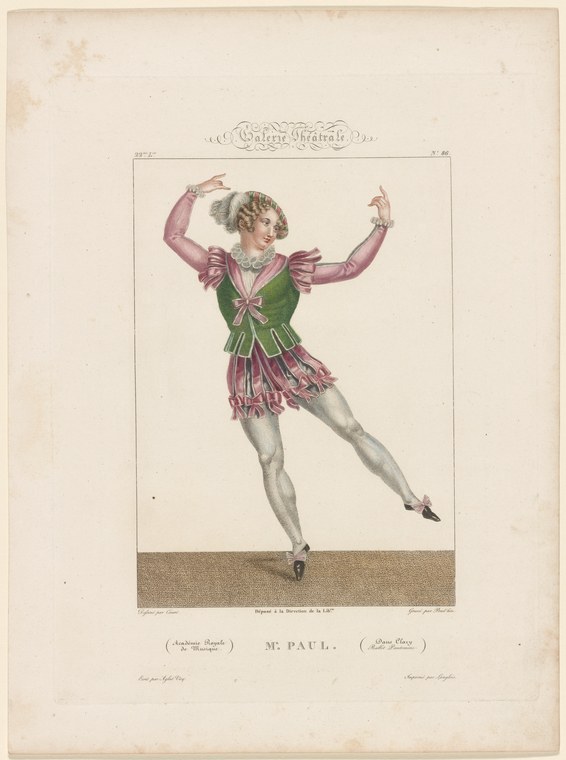
Mr. Paul dans Clary, ballet pantomime, Académie royale de musique
Unknown artist
- Collection:
- Prints depicting dance
- Source:
- New York Public Library
- Rights:
- Public domain — free to use, share and adapt.
- Recorded as:
- Public Domain
M. Paul is now obscure, but this engraving is an irreplaceable record of early 19th-century French theatrical dance—how the body moved, what it was clothed in, and what moments mattered enough to preserve. Without such images, the vocabulary and scale of comic opera and pantomime in this period would be nearly invisible to us; this engraving is direct testimony from the stage.
What you are looking at
A single female dancer, identified as M. Paul, is depicted mid-leap against a plain brown floor and neutral background. She wears an ornate costume: a short green tunic or bodice with pink puffed sleeves and decorative trim, paired with a pink skirt of gathered or pleated fabric that extends to mid-thigh. Her legs are bare and she wears dark heeled shoes. Her blonde hair is styled up with a decorative headpiece. Her pose is explosive—one leg extended behind her, the other bent beneath, torso arched backward, and both arms raised above her head in an emphatic gesture of exuberance or triumph. The composition freezes a moment of spectacular elevation, the dancer seemingly suspended at the apex of her jump. This is a hand-colored engraving with fine detail work typical of early 19th-century theatrical portraiture.
The dancing
A single figure dominates the frame, captured in a ballistic leap. The dancer's weight appears to be fully airborne, with dynamic opposition between upper and lower body—the extended rear leg and raised arms create a sweeping diagonal line that reads as both powerful and celebratory. The pose suggests virtuosity: the height of the jump, the extreme arch of the back, and the controlled positioning of the limbs all indicate training in the theatrical dance of the period. The gesture of the upraised arms is exuberant and emphatic rather than balletic in the classical sense.
The dance depicted
This appears to be a portrait of a dancer performing in a comic opera or ballet pantomime, the genre indicated by the catalogue title. The costume is characteristic of early 19th-century theatrical dress—not classical ballet garb (no pointe shoes, no tutu), but rather the more elaborate, often comedic costumes of the Opéra-Comique or similar venues. The pose and the celebratory tone suggest a comic or character dance moment rather than classical ballet technique. The extreme jump and theatrical gesture align with the acrobatic, gestural vocabulary of pantomime, which emphasizes clarity and exaggeration of emotion over the restraint typical of ballet.
How it was made
This is a hand-colored engraving, one of the standard formats for theatrical portraiture in the early 19th century. The technique allowed for the mass production and distribution of performer portraits to audiences, creating a market for images of celebrated dancers. The fine line work and careful modeling visible in the figure's anatomy and drapery is characteristic of professional engravers working from drawings or paintings. The hand-coloring has been applied skillfully but is now slightly faded, which is typical of period works of this type. Such engravings served both as souvenirs and as documentation of contemporary stage spectacle.
About this work
This is a theatrical portrait engraving of M. Paul, a performer in a comic ballet pantomime staged at the Académie royale de musique (the Opéra). The work captures a single, spectacular moment—a high jump with arms raised—frozen in an engraving for public circulation. The costume and pose are those of early 19th-century comic opera rather than classical ballet, and the image documents both the performer's celebrity and the aesthetic values of theatrical dance in the Romantic era, when performers were celebrated for athletic prowess, gestural expression, and technical daring as much as for balletic purity. The work belongs in a gallery of dance because it is an eyewitness record of what this moment of performance looked like, and because it was made and circulated specifically as an artifact of performance culture.
How to look at it
Attend to the exact moment the engraver chose: not a pose, but a moment of flight. The arms are raised not in a formal balletic port de bras but in a gesture of emphatic emotion—surprise, joy, defiance, or theatrical exuberance. This is not a moment of stillness but of action, and the composition emphasizes the athleticism and the theatrical excess of the performance. Notice also the detail of the costume: the ornate trimming, the puffed sleeves, the gathered skirt. These are not the minimalist tights and tutu that would later define classical ballet; they belong to a richer, more decorative theatrical tradition. The engraver has captured not just a body but a complete theatrical image.
The period
This engraving dates to the early 19th century, an era of extraordinary expansion in theatrical dance in Paris. The Opéra and Opéra-Comique were centers of innovation, and the period saw the rise of both classical ballet (pushed forward by figures like Marie Taglioni) and comic opera and pantomime, which remained popular and lucrative. Performers like M. Paul, though now forgotten, were celebrated in their time through engravings, playbills, and lithographs. The image reflects the aesthetics of the Romantic era—the emphasis on virtuosity, on the body as a vehicle for expression, and on the dramatic leap as a sign of technical mastery. The fashion for theatrical portraiture also reflects the celebrity culture of the age: these engravings were sold and collected by audiences who wanted to own an image of the performers they had seen or hoped to see.
Where it lives
This engraving is held in the New York Public Library's collection of prints depicting dance, a collection that preserves visual documentation of dance practice and performance across centuries and cultures. Works of this type were typically sold to the public as souvenirs or prints in sets documenting celebrated performances or performers.
Dance in this work
Questions about this work
Who was M. Paul?
M. Paul was a performer in comic ballet pantomime at the Académie royale de musique (the Paris Opéra) in the early 19th century. Beyond this engraving and the title of the work—a ballet pantomime called Clary—very little is documented about her career or life. She was celebrated enough at her time to warrant this professional engraving, but like many theatrical performers of the era, she has been largely forgotten by later historians.
What is the difference between this and classical ballet?
Classical ballet emphasizes turnout, line, and restraint. This image shows a comic opera or pantomime performer, whose vocabulary included broader, more emphatic gestures, higher and more explosive jumps, and ornate, detailed costumes rather than the streamlined dress that classical ballet would adopt. The pose here is also unabashedly theatrical and playful, where classical ballet technique typically aims for an appearance of effortlessness and control.
Why is this a hand-colored engraving?
Before photography, theatrical portraiture was produced as engravings, which could be printed in quantity and then hand-colored by assistants. This allowed theaters and performers to reach audiences and sell commemorative images. The hand-coloring added value and gave each print a unique quality, even though the process was semi-industrial.
What does the pose tell us about how dancers trained?
The height of the jump, the control of the limbs in the air, and the arched back all indicate serious technical training. Even in comic performance, dancers were expected to be athletic and skillful. The pose suggests flexibility, strength, and the ability to achieve and hold positions in the air—capacities that required years of systematic training.
More dance artwork





