49 works in this view — arrow keys or swipe to move between them.
Dance in Art
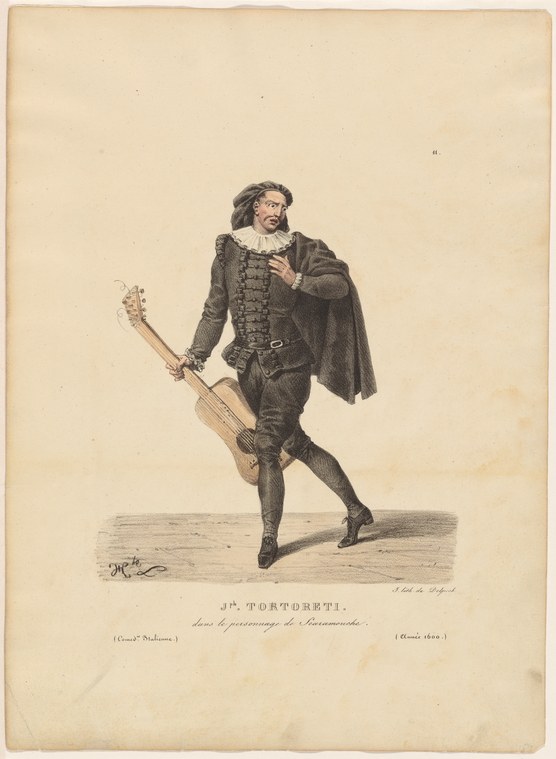
J'ph Tortoreti dans le personnage de Scaramouche
Unknown artist
- Collection:
- Prints depicting dance
- Source:
- New York Public Library
- Rights:
- Public domain — free to use, share and adapt.
- Recorded as:
- Public Domain
Scaramouche roles required a performer who could combine acrobatic physical comedy with musicianship and rhythmic movement—the character often sang, danced, and performed in quick, witty physical sequences. This engraving documents the transition moment when commedia dell'arte was evolving into modern theatrical forms, and shows how a skilled performer of the era was expected to command both the body and the musical instrument. For dance historians, it is a rare image of how a character role expected movement and gesture as primary tools of performance.
What you are looking at
A single male figure dominates the composition, shown in three-quarter view against a plain background. He wears early 19th-century theatrical costume: a dark doublet with ornate frogging (decorative braid fastenings) across the chest, fitted dark hose, and a short cloak draped from one shoulder. His hair is styled in dark curls characteristic of the Romantic era. He holds a lute or similar stringed instrument in his left hand, angled across his body, while his right arm gestures expressively outward. His weight is distributed in a dynamic stance with one leg forward, the body turned and animated. The figure appears to be captured mid-movement, as if performing or declaiming. Below the image is French text identifying him as 'J.ph Tortoreti dans le personnage de Scaramouche' (J.ph Tortoreti in the character of Scaramouche), with additional text indicating 'dans le personnage de Pirouetomedia' or similar. The print is finely rendered in what appears to be engraved or etched technique, with careful attention to fabric texture, shadow, and the subtle modeling of the figure.
The dancing
The dancer occupies the full height of the composition, legs extended in a walking or striding position with weight clearly shifted forward. The torso is turned in a contrapposto stance that suggests both presentation to the viewer and forward motion. The right arm is raised and extended in an expressive gesture—neither a formal balletic port de bras nor a folk gesture, but something between declamation and invitation. The left arm holds the lute at mid-body. The overall frame is upright, alert, and theatrical rather than balletically composed. This is a single figure, not part of an ensemble or partnership, and the positioning suggests a moment of solo performance or address.
The dance depicted
Scaramouche is a stock character from the commedia dell'arte tradition—a cowardly, boastful soldier often played for comic effect. The costume and character name identify this as a theatrical or masked-comedy performance rather than a concert or ballroom dance. The lute-playing suggests a musical or serenading scene. The dynamic stance and expressive gesture indicate a performer trained in theatrical movement rather than strict dance technique. This is likely a record of a famous performer (Tortoreti) in a celebrated role, possibly from a theatrical production that combined music, comedy, and danced or choreographed movement. Scaramouche roles in early 19th-century theater often involved physical comedy, mimicry, and stylized movement—closer to pantomime or physical theater than to formal dance genres, though the figure's animated stance shows clear training in bodily expression.
How it was made
This is a finely engraved or etched print, likely from the early 19th century, rendered with considerable technical skill. The line work shows sophisticated modeling of fabric, shadow, and anatomical form. The plain background throws the figure into sharp relief, typical of portrait engravings of the era. The technique allowed for mass production and wide circulation of images of celebrated performers—this is clearly a print intended for distribution to audiences and collectors, not a unique artwork. The care lavished on costume detail suggests this was made from a drawing or painting of an actual performance, or possibly from life.
About this work
This is a character portrait engraving of a celebrated early 19th-century performer in the comic role of Scaramouche, a commedia dell'arte character. The figure is shown in a dynamic theatrical stance, holding a lute and gesturing expressively, caught mid-performance. Though Scaramouche roles were primarily theatrical and comedic rather than dance-focused, this image belongs in a dance archive because it documents the physical vocabulary of an era when theatrical movement, music, comedy, and dance were not yet separated into rigid genres—when a skilled performer was expected to move, gesture, and emote with the expressiveness expected of a trained dancer. The engraving is a historical record of how a celebrated performer inhabited a famous role, and what physical virtuosity and training that demanded.
How to look at it
Pay attention to the weight and balance of the figure: the forward stride and the distribution of weight suggest a performer who moved with trained, confident physicality. Notice how the gesture of the right arm—raised, open, expressive—is neither the formally prescribed port de bras of ballet nor the naturalistic gesture of spoken theater, but something between: the physical language of a performer trained to move fluidly and expressively for an audience. The lute is held as an integral part of the pose, not secondary to it—suggesting that in Scaramouche roles, music and movement were equally important. The moment captured is one of presentation and address, the performer 'showing' himself to the audience rather than captured in a narrative moment.
The artist
The artist is not recorded. The print bears a signature or mark in the lower left (appearing to read 'Jo.Mo' or similar), but this cannot be definitively identified from the image alone. The style is consistent with French or European portrait engravings of the 1820s-1840s. The technical skill suggests a professional engraver working for a theatrical print publisher, likely producing images of celebrated performers for public sale.
The period
The early 19th century saw commedia dell'arte traditions being revived and romanticized in European theater, particularly in France. Scaramouche, the blustering Spanish military character, was a beloved stock role that had been performed continuously since the 16th century but experienced a new wave of popularity in the Romantic era. Around the same time, ballet was becoming increasingly formalized and separated from spoken theater and comedy—yet theatrical characters and roles still demanded the full physical vocabulary that dancers possessed. Tortoreti's Scaramouche represents a performer working in a tradition that predates the rigid separation of 'dance' from 'theater' or 'comedy.'
Where it lives
This engraving is held in the New York Public Library's Prints collection, specifically in a collection of dance-related prints. The catalogue description identifies it as a portrait of performer J.ph Tortoreti in the character of Scaramouche, but provides no date or artist attribution. The print's style and the theatrical traditions it records suggest early-to-mid 19th century.
Dance in this work
Questions about this work
What is Scaramouche?
Scaramouche is a stock character from commedia dell'arte, the Italian improvisational theater tradition that flourished from the 16th century onward. He is a cowardly, boastful Spanish military captain, usually played for comic effect. The character required performers to combine physical comedy, rapid witty movement, and often music. Scaramouche roles were revived and celebrated in 19th-century European theater.
Was Scaramouche a dance role?
Not strictly, but it required a performer with a dancer's training in movement, rhythm, and physical control. Scaramouche scenes often included musical performance (the lute), rapid physical comedy, and choreographed or semi-choreographed movement. In the early 19th century, the boundaries between 'actor,' 'dancer,' and 'musician' were still fluid; a skilled performer in a demanding role like Scaramouche needed all three skillsets.
Who was J.ph Tortoreti?
The catalogue provides only the name. Tortoreti was celebrated enough to have portrait engravings made and circulated, suggesting he was a notable performer of his era. His fame appears to have been tied to his performance of Scaramouche and related commedia roles, but further biographical details would require additional research.
Why is this in a dance collection?
Because Scaramouche roles demanded trained physical movement and rhythm, and because this image documents the era when theatrical movement, music, and dance were not yet separated into distinct professions. For historians of theatrical movement and physical comedy, this is a valuable record of what a celebrated performer in the role looked like and how he inhabited it.
More dance artwork





