49 works in this view — arrow keys or swipe to move between them.
Dance in Art
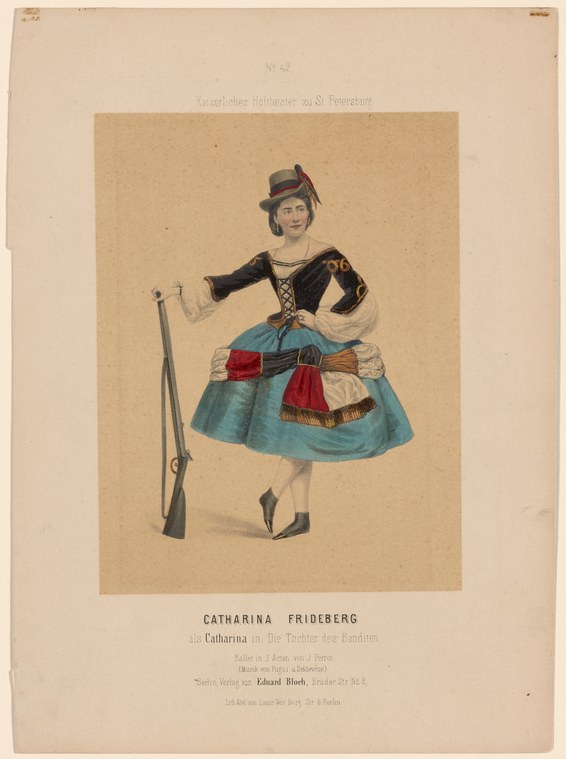
Catharina Frideberg als Catharina in Drei Tochter des Banditen
Unknown artist
- Collection:
- Prints depicting dance
- Source:
- New York Public Library
- Rights:
- Public domain — free to use, share and adapt.
- Recorded as:
- Public Domain
This is evidence of how 19th-century theater audiences encountered and understood character, costume, and theatrical movement. The rifle-bearing female soldier or outlaw was a stock theatrical character, and this image shows how such roles were visualized, advertised, and performed. For historians of stage dance, costume, and spectacle, it documents the look and pose of mid-19th-century theatrical character work.
What you are looking at
A single female figure stands against a pale tan background, posed in a moment of theatrical display. She wears a dark corseted bodice with long sleeves and a full skirt of turquoise blue gathered at the waist with decorative red fabric, suggesting either a sash or apron detail in contrasting colors. A white chemise or underdress shows at the neckline and sleeves. She holds a rifle upright in her left hand, barrel angled forward, and extends her right arm outward in a declarative gesture. A red feathered or ornamental hat crowns her head. The figure's weight is settled on one leg, the other foot lifted slightly, giving the pose both stability and theatrical presence. The composition is frontal and heraldic—a single actor captured in costume, mid-gesture, against neutral space.
The dancing
The dancer stands in profile-frontal stance, weight forward on her front leg with the rear leg slightly flexed and lifted. Her right arm extends horizontally in a gesture of proclamation or defiance; her left grips the rifle at hip height. The torso remains upright and contained within the tight corseted bodice. The pose reads as a moment of address or announcement rather than locomotion—a theatrical 'freeze' for the benefit of the audience. There is no partner, no spatial relationship to other bodies.
The dance depicted
This is a theatrical character dance or incidental dance from a stage production—specifically, it appears to depict a female bandit or soldier character. The title references 'Catharina in Drei Töchter des Banditen' (Catharina in The Bandits' Three Daughters), a 19th-century Austrian or German play or opera. The rifle, the military-style dress with turquoise skirt and decorative elements, and the defiant gesture all suggest a woman warrior or outlaw role. The pose is not a standard ballroom or folk dance form but rather a theatrical character portrait—the kind of costume plate used to document stage roles and actors' appearances. The dance content here is incidental to character: it is the pose of an actor in costume, selected for its dramatic and narrative power rather than for its embodiment of any particular dance technique.
How it was made
This is a hand-colored engraving or lithograph, likely a 19th-century theatrical costume plate. The printed line work defines the figure with crisp edges and careful detail, while watercolor or hand-applied pigment adds the turquoise, red, and skin tones. The technique was standard for documenting stage roles, actors, and costumes in the mid-to-late 19th century, allowing rapid reproduction and circulation among theater audiences and subscribers. The method allowed for both precision in costume detail and the kind of full-frontal theatrical display suited to promotional imagery. The pale tan ground is the paper itself; the composition and framing conventions are those of commercial theater ephemera.
About this work
This is a 19th-century theatrical costume plate depicting an actress in the role of Catharina, a female bandit character from an Austrian or German play. The hand-colored engraving or lithograph captures her in full costume—corseted bodice, full skirt, feathered hat, and rifle—in a moment of theatrical address. It is not a document of dance technique but rather of theatrical character and stage dress. Such plates served as promotional images, distributed to audiences and theater subscribers to document the roles, actors, and visual spectacle of contemporary stage production.
The work belongs in a gallery of dance in art because theatrical dance and incidental movement were integral to 19th-century stage plays and operettas, and because such costume plates are primary evidence of how movement and character were visualized and marketed. The pose itself—the extended arm, the balanced stance, the moment of gesture—is choreographed for theatrical effect, designed to convey both narrative character and visual drama to an audience.
How to look at it
Attend to the balance and weight in the pose: the lifted foot and slightly bent rear leg give the figure forward momentum and readiness, even in stillness. The extended arm is a gesture of speech or declaration, not a balletic port de bras—it is rhetoric made visible. Note how the costume details—the rifle, the feathered hat, the turquoise skirt—combine to create a composite image of a theatrical character type. The frontality and the neutral background are conventions of the costume plate: the figure is presented as a type or role, not as an individual embedded in a scene. The moment captured is one of address, of the performer's consciousness of the audience.
The artist
The engraver or lithographer is not recorded in the catalogue. The text at the base references an artist or publisher named Eduard Bloch ('Druck und Verlag von Eduard Bloch, Dresden'). This suggests the work was produced by or for the Dresden printing and publishing firm of Eduard Bloch, a mid-19th-century printer known for theatrical ephemera and costume plates. The style and technique are consistent with German and Austrian theatrical costume documentation of the 1850s–1870s.
The period
The 19th century saw an explosion in the production and circulation of theatrical costume plates, particularly in German-speaking territories. Stage plays and operettas were immensely popular, and theater companies and publishers produced thousands of lithographed or engraved images of actors in costume to attract audiences and commemorate celebrated roles. The character of the female warrior or bandit—often associated with Romantic nationalism and the literary tradition of robber plays—was a staple of mid-19th-century theater. 'Die Räuber' (The Robbers) by Schiller and similar works spawned numerous adaptations and sequels. Dance in the theater of this period was not yet professionalized as classical ballet or modern dance but rather remained integrated into dramatic productions as incidental movement, gesture, and choreographed spectacle. Such costume plates are invaluable evidence of how actors moved and posed on stage.
Where it lives
This work is held in the Prints collection of the New York Public Library, catalogued as part of a series of theatrical costume plates and dance-related ephemera. It is one of thousands of such promotional images produced in the 19th century to document and advertise stage roles and actors.
Dance in this work
Questions about this work
Is this a photograph or a hand-drawn image?
It is an engraving or lithograph—a printed image hand-colored with watercolor or pigment. The technique allowed for precise reproduction of costume detail and rapid circulation to audiences. Photographic processes did not yet exist when this was made.
Who was Catharina, and what play is this from?
'Die Drei Töchter des Banditen' (The Bandits' Three Daughters) is an Austrian or German play from the mid-19th century. Catharina is a female character, here depicted as an armed fighter or soldier. No other documentation of this specific work is easily accessible, but similar plays and operettas of the period treated similar themes of brigands, outlaws, and female warriors.
Is this a dance image?
It is an image of an actor in a theatrical costume, captured in a posed moment of gesture and character. The pose is choreographed for theatrical effect, but the work documents character and costume rather than a named dance form or technique. It belongs to the history of stage movement and theatrical spectacle.
What would an audience in 1860 have understood from this image?
They would have recognized it as a costume plate advertising a stage role—in this case, a female soldier or bandit character. The rifle, the bold pose, the military-style dress, and the defiant gesture would have signaled the character's narrative role and the visual spectacle of the production. Such plates were often sold at the theater or reproduced in newspapers to promote upcoming performances.
More dance artwork





