49 works in this view — arrow keys or swipe to move between them.
Dance in Art
Robert Honner as Harlequin
Unknown artist
- Collection:
- Prints depicting dance
- Source:
- New York Public Library
- Rights:
- Public domain — free to use, share and adapt.
- Recorded as:
- Public Domain
Harlequin prints document a foundational moment in the history of theatrical movement, when physical agility and comedic bodily control were as valued as formal dance technique. This image shows how a performer's fame was marketed and circulated, and how the body itself—not narrative or music—was central to the character's appeal.
What you are looking at
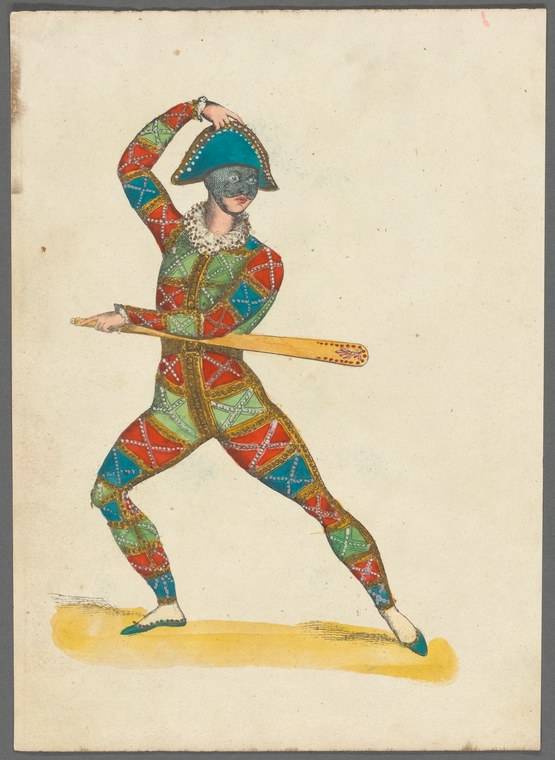
A single figure is shown in dynamic motion against a plain cream background, caught mid-stride in an athletic, acrobatic pose. The dancer wears a richly patterned costume in red, teal, and green, with a diamond or harlequin-pattern design covering the entire body. A matching teal cap or helmet sits on the head, and the figure holds a long stick or staff horizontally across the body. The pose is energetic and unstable—one leg is extended sharply forward while the other bends beneath, the torso twists, and one arm reaches upward in an exaggerated arc. The figure appears weightless, suspended between positions. A pale yellow-ochre wash marks the ground plane beneath the feet, establishing minimal spatial context. The costume's bold geometry and the acrobatic energy of the pose suggest a performer from the commedia dell'arte tradition.
The dancing
A single male figure in a lunging, airborne position with the weight distributed between an extended forward leg and a bent supporting leg. The upper body twists sharply, with the right arm raised above the head and the left arm extended, gripping a horizontal staff or baton. The pose shows no classical balletic frame or closed-position hold; instead, it suggests explosive, virtuosic movement drawing on acrobatic or comedic physical vocabulary. The body's torsion and the staff create an asymmetrical, almost chaotic silhouette.
The dance depicted
This is a representation of Harlequin (Arlecchino), a principal character of commedia dell'arte, the improvisational comic theatre tradition of Renaissance and early modern Europe. The costume—the distinctive harlequin diamond pattern—and the energetic, acrobatic physicality are signatures of the role. Harlequin was known for rapid, often uncontrolled movements, pratfalls, and physical comedy; the exaggerated pose here captures that tradition of bodily abandon and gymnastic agility. The figure holding a staff or slapstick aligns with the character's typical stage equipment.
How it was made
This is a hand-colored print, most likely a woodcut or engraving based on the clean line work and the even application of pigment. The fine detail in the costume pattern and the precision of the figure's outline suggest engraving or a finely cut block. The hand-coloring is applied in bold, flat areas—reds, teals, greens, and ochre—without shading or modeling, a technique consistent with 18th or early 19th-century theatrical prints. This method of production allowed cheap reproduction and wide distribution, making such prints ideal for advertising performers or preserving performances for audiences who could not attend.
About this work
This is a portrait print of Robert Honner, a performer, in the role of Harlequin—a defining character of commedia dell'arte comedy. The work captures the acrobatic, anarchic energy of the role through an exaggerated athletic pose and the iconic diamond-patterned costume. It belongs in a history of theatrical dance and physical comedy because Harlequin, though primarily a comedic actor, was celebrated for his physical virtuosity, rapid movement, and gymnastic prowess, skills that blur the boundary between dance and theatrical performance. Such prints preserve both the visual identity of iconic stage characters and the kinetic vocabulary of early modern popular performance.
How to look at it
Watch the pose's instability: the figure is caught between positions, neither landed nor fully airborne, which conveys the rapid, unpredictable movement for which Harlequin was famous. Notice how the staff crosses the body at an awkward angle, adding to the sense of comic chaos. The costume's bold pattern, filling the entire body, makes the silhouette readable at a distance—important for a print meant to advertise a performer to a crowd. The exaggeration of the limbs and the absence of any sense of repose or control are the point: this is a body in comic extremis, not a body in command.
The artist
The artist is not recorded in the catalogue. However, this style of hand-colored theatrical print was produced in quantity during the 18th and 19th centuries, often by specialists in theatrical portraiture who worked from performances or from sketches made in the theatre. Such prints were sold at performances, in print shops, and by itinerant vendors, and they often carried the performer's name and the character in the title block.
The period
Commedia dell'arte flourished across Europe from the 16th through 18th centuries, reaching peak popularity in the 1700s. By the early 19th century, its influence had begun to fade, though Harlequin remained an iconic figure in pantomime, particularly in English theatre. This print likely dates to the late 18th or early 19th century, a period when printed portraits of actors and performers became a major commercial medium. The rise of theatrical prints coincided with the growth of professional theatre as public entertainment and with the development of new colored printing technologies that made such images affordable.
Where it lives
This work is held in the Prints depicting dance collection at the New York Public Library, a collection that preserves visual records of dance and theatrical performance from a range of periods and traditions. Such prints are typically bound in albums, kept as individual sheets, or housed in print cabinets.
Dance in this work
Questions about this work
Was Harlequin actually a dancer?
Harlequin was primarily a comic actor, but the role depended on physical virtuosity—rapid movement, tumbling, acrobatics, and rhythmic bodily control—that overlapped significantly with dance. Harlequin was celebrated for his speed, agility, and the ability to move his body in unexpected ways. The distinction between dance and theatrical acrobatics was much less rigid in early modern performance than it is today.
What is the diamond pattern on the costume?
The pattern is the hallmark of Harlequin's costume in commedia dell'arte and later in English pantomime. The motley (patchwork, often diamond-patterned) costume signified the character's role as a servant, trickster, and figure of physical comedy. The pattern was instantly recognizable to audiences and served as a visual trademark of the character.
What is the stick the figure is holding?
This is likely a slapstick, a prop traditionally carried by Harlequin and other comic characters in commedia dell'arte and pantomime. The slapstick was both a comedic weapon (used to strike other characters or objects for comic effect) and a symbol of the character's role as an agent of chaos and slapstick humor.
Who was Robert Honner?
The catalogue record does not provide biographical details. However, the fact that this print was produced suggests Honner was a performer of sufficient fame that his portrait in a celebrated role was marketable as a print commodity—likely a stage actor of the late 18th or 19th century specializing in comedy or pantomime roles.
More dance artwork





