49 works in this view — arrow keys or swipe to move between them.
Dance in Art
Beseda-Quadrille: pro Pianoforte
Unknown artist
- Collection:
- Prints depicting dance
- Source:
- New York Public Library
- Rights:
- Public domain — free to use, share and adapt.
- Recorded as:
- Public Domain
This object documents how the quadrille and ballroom culture were visualised and commodified in 19th-century Central Europe, and shows the aesthetic conventions by which dance was represented in printed materials aimed at amateurs and professionals alike. The title's explicit reference to Slavonian melodies also reveals how regional identities were negotiated through the supposedly 'universal' forms of ballroom dance.
What you are looking at
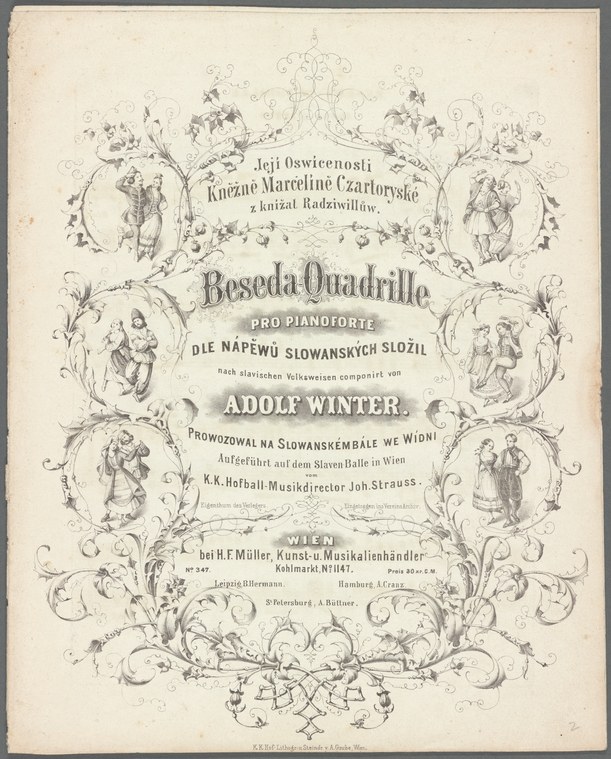
This is the ornamental title page of a piano score for a quadrille, framed by an elaborate Rococo border of scrollwork, foliage, and cherubic figures. At the four corners and sides sit pairs of dancers in Regency-era dress — the women in high-waisted gowns with full skirts, the men in tailcoats and breeches — captured in positions of elegant partnering. The dancers are rendered in a light stippled or dotted technique that suggests movement without anatomical detail. The central text announces the work in German and Polish, crediting the composer Adolf Winter and noting its performance at the Slavonian Hall in Vienna. The overall effect is one of formal gentility: the dancers exist as decorative emblems framing the practical purpose of the page — they signal the ballroom context of the music without dominating the composition.
The dancing
The paired dancers throughout the border maintain a formal, upright posture consistent with Regency ballroom etiquette. The couples are shown in a closed or semi-closed position, with the man's arm extended and the woman's body turned toward her partner. Their limbs are delicate and elongated; their skirts are rendered with considerable volume, suggesting the full-length ball gowns of the 1820s–1840s period. The positions vary slightly from pair to pair, suggesting the sequential figures of a quadrille — one couple may be in a promenade position, another in a turn — but without the precision of step notation. The gestures are restrained and dignified rather than energetic.
The dance depicted
This is a quadrille, a social ballroom dance for four couples arranged in a square. The quadrille was the dominant dance form of the Regency and Victorian ballroom and was structured in five or six distinct figures, each with its own choreography. The title's reference to 'napevů slowanských' (Slavonian melodies) suggests this version incorporates Slavic folk material, adapting it to the quadrille form — a common practice of the period, when composers drew on regional idioms to enliven the standard ballroom repertory. The score was composed by Adolf Winter and performed in Vienna, a major center for both European ballroom dance and Central European musical nationalism.
How it was made
This is a lithograph, evident from the fine dotted tone used to render the figures and the delicate letterpress text. Lithography allowed for the combination of detailed ornamental borders with bold typography, making it ideal for the commercial music publishing of the 19th century. The soft tonal effects and the ability to layer multiple print runs would have made this an economical way to produce an attractive and legible cover page for sheet music distributed across Vienna and the Slavic lands.
About this work
This is a commercial music-publishing artefact — a lithographed title page for a piano-reduction score of a quadrille composed in mid-19th-century Vienna. The quadrille was the most widely danced social ballroom form of the era, and the decorative framing of dancers was a conventional way to signal both the genre and the cultural prestige of the music. The dancers themselves are rendered in the Rococo-influenced ornamental style of German and Austrian music publishing, where figures were often depicted as graceful emblems rather than as realistic performers. The work documents the intersection of Central European musical nationalism (the incorporation of Slavic folk material) and the cosmopolitan ballroom culture of Vienna.
How to look at it
Attend to the pairing conventions shown in the corner vignettes: the closed or semi-closed hold, the upright carriage, the woman's turned-out position and the man's supporting frame. Notice how each pair appears to occupy a distinct figure or moment, suggesting the sequential nature of the quadrille. The ornamental border serves a practical purpose — it frames the text and declares the genre through visual convention — but also embodies a cultural assumption that ballroom dance was an elite, refined activity worthy of decorative elevation.
The artist
Adolf Winter is credited as the composer. He is identified as a director or musician ('Musikdirektor') associated with the Slavonian Hall in Vienna (Slavonische Salle). No further biographical details are recoverable from the document, but his engagement with Slavic musical material and his presence in Vienna suggest he was part of the mid-19th-century Central European musical scene that blended cosmopolitan ballroom idioms with folk and regional traditions.
The period
The quadrille was at the height of its popularity in the 1830s–1860s. It had emerged in France in the early 19th century and spread rapidly to London, Vienna, and across Europe, becoming the standard opening dance of any formal ball. The period of this publication coincides with the rise of musical nationalism in Central Europe, when composers and publishers actively sought to incorporate folk melodies — including those of Slavic, Hungarian, and other subject populations of the Austro-Hungarian Empire — into commercially successful ballroom music. Vienna was a major centre for this cross-pollination, and the Slavonian Hall was one of several ethnic-specific or regional dance venues where such fusion music would have been performed.
Where it lives
This lithographed title page is held in the New York Public Library's collection of dance-related prints. It is part of a body of commercial sheet-music cover art from 19th-century Central Europe.
Dance in this work
Questions about this work
What is a quadrille?
A quadrille is a social ballroom dance for four couples (eight people) arranged in a square formation. It was structured in five or six distinct figures, each with its own musical phrase and choreography. It dominated European and American ballrooms from the 1820s through the 1880s and was often the opening dance of a formal ball.
Why are Slavonian melodies used in this dance?
In the 19th century, composers in Vienna and other Central European centres increasingly incorporated folk melodies from Slavic, Hungarian, and other regional traditions into ballroom music. This reflected both musical nationalism and the cosmopolitan character of the Austro-Hungarian Empire, where multiple ethnic traditions coexisted in urban spaces like Vienna.
How do I read the dance from the images of couples shown?
Each pair of dancers in the border appears to show a different moment or figure of the quadrille. Look at the arm positions, the proximity of the partners, and the orientation of the bodies — together these suggest the sequential, structured nature of the dance form. The closed position and upright carriage are typical of ballroom dance of the period.
More dance artwork





