49 works in this view — arrow keys or swipe to move between them.
Dance in Art
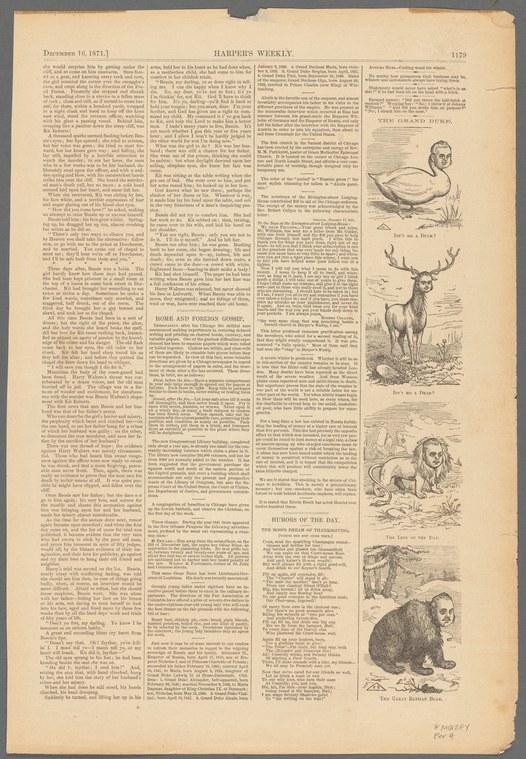
Ye grand ducal ball at the Academy of Music
Unknown artist
- Collection:
- Prints depicting dance
- Source:
- New York Public Library
- Rights:
- Public domain — free to use, share and adapt.
- Recorded as:
- Public Domain
The image preserves the visual form of the ballroom waltz and cotillion as they were actually danced in 1871, at a moment when these dances were at their height of respectability and popularity. For researchers of Victorian dance culture, it provides evidence of partner positioning, frame, dress, and the social context of elite ballroom dancing in post-Civil War America.
What you are looking at
This is a page from Harper's Weekly dated December 16, 1871, featuring an engraved illustration titled "Ye Grand Ducal Ball at the Academy of Music." The composition depicts an elaborate formal ball in progress, with multiple couples arranged across the space in various configurations of the waltz and cotillion. The figures are dressed in high Victorian formal wear—the men in dark tailcoats and the women in full-skirted ball gowns with the characteristic silhouette of the early 1870s, with tight bodices and voluminous skirts gathered and draped at the back. The setting suggests an ornate ballroom with architectural details visible in the background. The scene captures the moment mid-dance, with couples turning and processing through the prescribed figures of the evening's cotillion, the dominant social dance of the period. The engraver has rendered the movement through the tilt of bodies, the positioning of arms, and the swirl of the women's skirts, conveying both the formality of the occasion and the fluidity of the dance.
The dancing
The dancers are shown in closed position characteristic of the period waltz and cotillion—the gentleman's right hand on the lady's waist, her left hand on his shoulder, with their outer hands connected in frame. The bodies lean slightly into the turn, and the women's full skirts sweep outward with the centrifugal force of the rotation, a key visual indicator of the waltz. The dancers' posture is upright and formal, with the head position showing the characteristic Victorian ballroom carriage. Multiple couples are distributed through the composition, some shown in full figures and others suggested in the background, giving depth to the ballroom scene and suggesting the scale of the event.
The dance depicted
The image depicts the waltz and cotillion as danced in the elite American ballrooms of the early 1870s. The Grand Ducal Ball would have been a major social event, and the dances shown—the waltz (represented by the turning couples) and the cotillion (a figure dance typically performed in sets)—were the standard ballroom dances of this moment. The formal dress, the ornate setting, and the configuration of couples in lines and circles all point to a structured, choreographed social dance of the highest social register. The rendering suggests these were precision dances requiring practice, with partners moving through memorized patterns rather than improvising.
How it was made
This is a wood engraving, the standard medium for newspaper and magazine illustration in the 1870s. The technique allowed for fine detail and subtle tonal gradations through closely spaced parallel lines (hatching), visible in the rendering of the fabrics, shadows, and architectural elements. Wood engraving was the primary method of reproducing images for mass circulation in periodicals of this period; the block could be set directly with type in a printing form. The medium's technical demands meant that accomplished engravers like those working for Harper's Weekly were highly trained professionals who could convey complex scenes with clarity and liveliness despite the constraints of black-and-white line work.
About this work
This is a page from the popular American illustrated weekly Harper's Weekly, documenting a major social event in New York ballroom culture. It serves as both a news illustration and a record of how the waltz and cotillion were performed at the highest levels of American society in the early Reconstruction era. The engraving captures not only the appearance of the dancers and their dress but also conveys through pose and composition the movement and character of the dances themselves—the controlled rotation of the waltz and the structured patterns of the cotillion. For historians of dance, dress, and American social life, it is valuable evidence of ballroom practice at a specific historical moment.
How to look at it
Observe the repeated turning figures of the couples in the center and foreground: the women's skirts fly outward, and the men's bodies lean into the rotation. This is the waltz in motion. Then look at how the couples are arranged overall—in this type of composition, you can often discern the geometric patterns of the cotillion, the figure dance that would have been performed in sets. Notice the precision of the engraving's line work: the artist has conveyed both the elegance of the scene and enough anatomical and postural detail that the actual structure of the dances is readable.
The artist
The illustration is uncredited, as was typical for Harper's Weekly wood engravings of the period. The magazine employed a stable of highly skilled engravers, including Thomas Worth and other accomplished practitioners, who translated drawings (often by other artists) into engraved blocks. The speed and precision required for weekly publication meant that these were workshop productions rather than signed artworks, though the technical skill is evident throughout.
The period
In 1871, the waltz and cotillion were established features of American upper-class social life, fully respectable after decades of resistance from moral critics. The Civil War had ended just six years earlier, and the Reconstruction period saw a reinvigoration of formal social life among the Northern urban elite. Harper's Weekly, founded in 1857, was the leading illustrated news magazine in America and served a middle- and upper-class readership interested in current events, fashion, and high society. The illustration of such balls was a regular feature, combining news value (recording the event) with aspirational appeal (showing readers how the elite dressed and danced).
Where it lives
This is a page from Harper's Weekly, a weekly illustrated newspaper published in New York. The holding collection describes it as part of a group of prints depicting dance. Harper's Weekly is held in many libraries and archives; individual issues are widely available through HarpWeek (a digital archive) and other public sources.
Dance in this work
Questions about this work
How do I know this is a waltz and not some other dance?
The couples are in closed position with the characteristic frame, and the women's skirts are shown swinging outward from the rotation—a visual signature of the waltz that contemporary viewers would have recognized instantly. The formal, turning movement of the figures is distinct from other period dances like the quadrille, which involves more linear progression and figure-work.
What does 'Grand Ducal Ball' mean?
A ball given by or honoring a grand duke (a European royal or noble title). Such events were major occasions in cosmopolitan American cities and drew coverage in the society pages and illustrated press. The title suggests either a foreign dignitary's visit to New York or a high-society ball given in their honor.
Why does the print look so different from a photograph or a painting?
This is a wood engraving, made by carving an image into the end-grain of a wooden block. The technique created images from parallel lines and dots rather than continuous tone, and each line was cut by hand. This gave engravings a distinctive linear quality and made them ideal for printing alongside type in newspapers and magazines.
What can this tell us about how people actually danced in 1871?
The posture, frame, and positioning visible here reflect real ballroom practice. The engraver has rendered the dancers with enough anatomical accuracy that we can see how the partner connection worked, how bodies were held, and what the characteristic movement of the waltz looked like at the time. This is documentary evidence from inside the ballroom.
More dance artwork





