49 works in this view — arrow keys or swipe to move between them.
Dance in Art
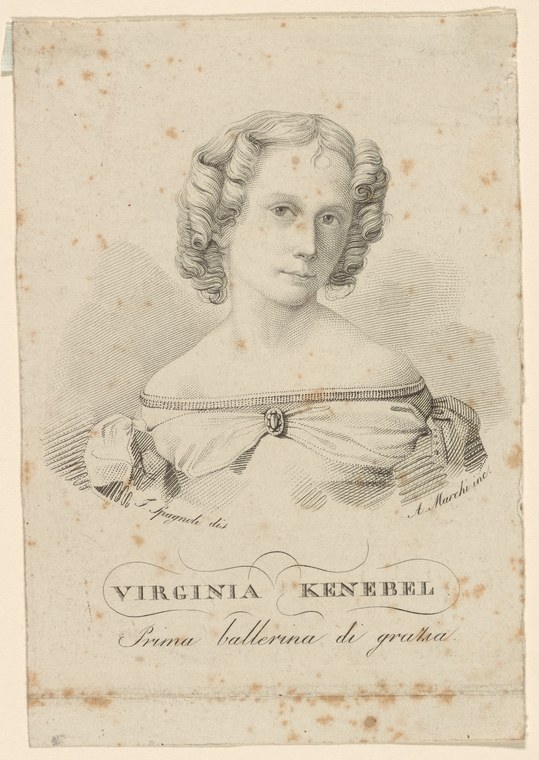
Virginia Kenebel, prima ballerina di grazia
Unknown artist
- Collection:
- Prints depicting dance
- Source:
- New York Public Library
- Rights:
- Public domain — free to use, share and adapt.
- Recorded as:
- Public Domain
Engraved portraits like this are among the few visual records of many 19th-century dancers; they were the standard means of circulating celebrity images before photography became widespread. Kenebell's name and the "di grazia" ranking visible here are often the only surviving documentary evidence of minor and intermediate-rank theatrical performers, making such portraits invaluable to the history of ballet and its institutions. The work illustrates how the ballet world organized and ranked talent, and how dancers' professional identities were constructed and disseminated through mass-produced prints.
What you are looking at
A bust-length portrait of a woman shown from the shoulders up, rendered in fine line engraving. She faces slightly to the left, her head turned to present a three-quarter view. Her hair is arranged in long, elaborate ringlets that frame her face and fall past her shoulders—a fashionable style of the mid-19th century. She wears a draped garment with a low, off-shoulder neckline trimmed with a decorative beaded or pearled band; the fabric is drawn across her torso with a brooch or clasp at the center. The background is plain, unmarked paper, typical of portrait prints. Below the image, in flowing script, appear the name "VIRGINIA KENEBELL" and the designation "Prima ballerina di grazia" (prima ballerina of grace). The engraving is finely detailed, using parallel lines (hatching) to suggest volume and shadow in the face and neck, and delicate cross-hatching to render the texture of the fabric and hair. The paper shows age—foxing and staining consistent with a 19th-century print.
The dancing
A single female figure presented in frontal or near-frontal pose, the body relaxed and stationary. No active dance movement is captured; this is a portrait type rather than a scene of performance. The woman's posture is upright but not stiff, the shoulders broad and relaxed. Her gaze is composed and direct. The bare shoulder and draped garment suggest the formal portrait conventions of the period and may reference the classical or Romantic aesthetic costume worn by theatrical dancers of the era, but the figure herself is posed as a static subject for portraiture, not mid-movement.
The dance depicted
Virginia Kenebell is identified as a prima ballerina di grazia—a grade of rank within the classical ballet hierarchy of the 19th century, below prima ballerina assoluta but conferring leading status. The designation suggests she was a professional dancer of note, likely performing in European opera houses during the mid-1800s. The "di grazia" classification was applied to dancers who excelled in graceful, flowing, often lyrical roles, in contrast to the technical "di forza" designation. The portrait itself does not depict her dancing; it is a publicity or memorial image of the type circulated to promote theatre performers. The style of dress, the engraving technique, and the overall composition are consistent with 1840s–1860s theatrical celebrity portraiture.
How it was made
This is a steel or copper-plate engraving, executed with a burin (gravers tool) to create fine parallel lines. The technique allows the precise rendering of facial features and the subtle gradation of tone through varied line density—visible in the modelling of the cheeks, the eyes, and the folds of drapery. Engraved portraits were the standard reproductive medium for theatrical publicity, gallery collections, and biographical reference in the mid-19th century. They could be printed in large editions and distributed widely, making them the primary medium for circulating images of celebrated performers to the public and to theatre archives. The presence of the image in the New York Public Library's collection of prints depicting dance reflects this historical function—such portraits were systematically gathered as documentation of theatre history.
About this work
This is a mid-19th-century engraved portrait of Virginia Kenebell, a professional ballet dancer of rank within the classical ballet system. It is not a depiction of her dancing, but rather a formal celebrity portrait of the type commissioned and reproduced to publicize leading theatrical performers. The inscription identifies her status—prima ballerina di grazia—indicating she held a significant position in the ballet hierarchy of her era. The work belongs in a gallery of dance in art because it documents both the conventions of theatrical celebrity portraiture and the professional structure of Romantic-era ballet: it shows us how dancers were marketed, remembered, and preserved in the historical record, and it testifies to the fact that Kenebell's name and rank were considered important enough to engrave and distribute. The image is evidence of her standing and of the visual culture surrounding professional ballet in the middle decades of the 19th century.
How to look at it
This portrait asks to be read as a document rather than a scene of performance. The viewer should attend to the formal elements that signaled theatrical rank and celebrity in the 19th century: the fashionable arrangement of hair, the classical drapery, the direct and composed gaze, the typography of the inscription. The engraver has lavished care on the face and shoulders to convey personality and professional status. The absence of any prop, setting, or reference to specific roles is typical of the era; the dancer is presented as a generalized theatrical subject, not as a character or in a moment of choreography. The style and finish of the print suggest it was made for a theatre archive or a collector, not for mass-market consumption.
The artist
The artist is not recorded in the catalogue. The engraving is competently executed in the style standard to mid-19th-century theatrical portraiture; it may have been produced by a commercial print shop attached to a major opera house or by a freelance engraver specializing in theatre publicity. Such prints were often unsigned or bore only a publisher's mark, and attribution is now lost. The inscription and printing style are consistent with Italian or Continental European production of the 1840s–1860s.
The period
The mid-19th century saw the professionalization and international circulation of ballet as a theatrical art. The Romantic era (roughly 1830–1860) elevated the ballerina to the status of celebrity, and dancers like Marie Taglioni, Fanny Cerrito, and Carlotta Grisi became internationally famous. The grading system evident in Kenebell's title—prima ballerina di grazia versus prima ballerina assoluta—was formalized during this period to manage the growing profession. Engraving was the dominant reproductive medium for preserving and circulating images of celebrated performers before the daguerreotype and later photography could be mass-produced affordably. Theatre companies, impresarios, and print publishers maintained extensive catalogues of dancer portraits, which were sold to the public, archived by theatres, and collected by enthusiasts. This print is a product of that commercial and institutional system.
Where it lives
The work is held by the New York Public Library in their collection of prints depicting dance. It entered the collection as part of the Library's systematic effort to document theatre history and performing artists. Its presence in a major research library reflects its status as a historical document of theatrical practice and personnel.
Dance in this work
Questions about this work
Who was Virginia Kenebell?
She was a professional ballet dancer of the mid-19th century, ranked as a prima ballerina di grazia. Beyond the inscription on this portrait and her inclusion in the NYPL collection, her biography is not well documented in readily available sources. She was active during the era when the ballet profession was becoming more structured and international, but few surviving records detail her career. This portrait itself is likely one of the primary visual records of her existence.
What does 'prima ballerina di grazia' mean?
It is an Italian ranking within the classical ballet hierarchy, designating a leading female dancer specializing in graceful, lyrical roles. The classification emerged during the Romantic era as ballet companies and theatres formalized their personnel structures. It placed a dancer below the rank of prima ballerina assoluta (absolute first ballerina) but conferred significant status and leading roles. The distinction between "di grazia" (of grace) and "di forza" (of force/technique) indicated the dancer's technical and stylistic strengths.
Is this an engraving or a lithograph?
This is a line engraving, executed with a burin on a metal plate. The fine parallel lines and precise, consistent detail are characteristic of the engraving technique. Lithography, invented later, uses a chemical process on stone and produces a characteristically different surface texture and line quality. The cataloguing record does not specify the medium, but the technique is identifiable from the image itself.
Why are there no dance poses or costumes in the portrait?
This is a formal celebrity portrait of the type used for publicity and archival documentation, not a theatrical scene. Dancers were typically portrayed in street dress or classical drapery to emphasize their personal celebrity rather than their roles. Costume-specific portraits existed but were less common. This image presents Kenebell as a distinguished professional, allowing the inscription to carry all the information about her standing in the ballet world.
More dance artwork





