49 works in this view — arrow keys or swipe to move between them.
Dance in Art
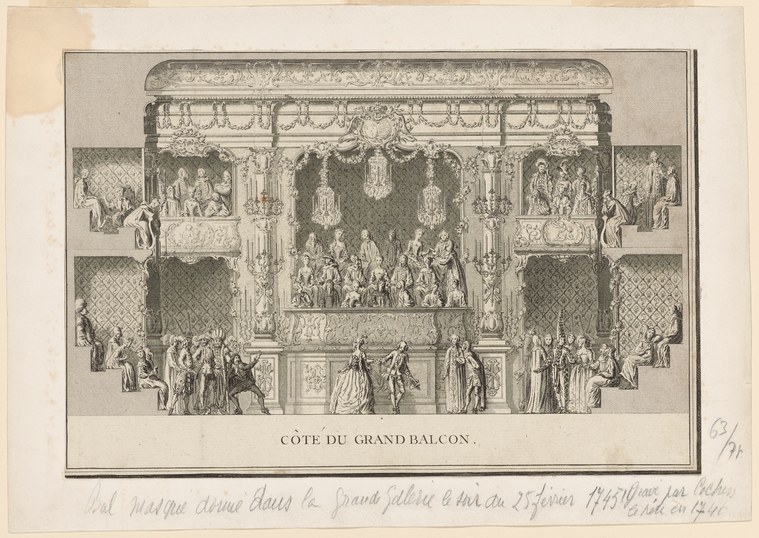
Côté du grand balcon
Unknown artist
- Collection:
- Prints depicting dance
- Source:
- New York Public Library
- Rights:
- Public domain — free to use, share and adapt.
- Recorded as:
- Public Domain
This image is a rare documentary record of an actual court dance event, with a specific date and venue. It shows the architectural staging of dance, the social composition of the audience, and the formal arrangement of dancers within a theatrical space—information that choreographic notation alone cannot provide. For historians of Baroque dance and theater, it is primary evidence of the scale, setting, and social function of courtly dance in the 1740s.
What you are looking at
This is an engraved cross-section view of a grand Baroque or early 18th-century theater, labeled "Côté du grand balcon" (Side of the grand balcony). The image shows a multi-story interior with three tiers of galleries and boxes, all crowded with spectators in period dress. The central stage occupies the middle ground, lit and elevated, where a formal dance or court scene is unfolding. The stage itself is framed by classical columns and elaborate architectural ornament, with garlands or festive drapery hung above. The performance space and audience areas are rendered in fine detail: rows of aristocratic figures in long coats, breeches, and elaborate gowns lean from boxes or stand in the pit; the architecture frames the scene with ornamental moldings, and cross-hatching creates depth and shadow throughout. The handwritten annotation at the bottom references "bal masqué dans la grande salle le 25 février 1743," indicating this depicts a specific masked ball held in 1743.
The dancing
The dancers on stage occupy the central focal point, their bodies small but distinct against the architectural frame. They appear to be arranged in a formal line or formation typical of court dance, with couples positioned at intervals. The spectators throughout the theater are rendered as a dense social crowd—some seated, some standing, all attentive to the performance. The precise bodily positions of the dancers are difficult to determine at this scale, but their placement suggests organized, formal movement rather than improvised or athletic action. The dress of all figures—dancers and audience alike—is consistent with Baroque courtly fashion: the women in full-skirted gowns, the men in coat and breeches.
The dance depicted
This image documents a formal court dance, most likely a minuet, contredanse, or quadrille of the 1740s, performed at a masked ball in what appears to be a French royal or aristocratic venue. The annotation dates it to 25 February 1743. The rigid geometric arrangement of the dancers and their placement within a formal theater space suggests a choreographed group dance of the type central to aristocratic entertainment in the Baroque and Rococo periods. The presence of an orchestra (implied by the architectural arrangement) and the scale of the audience indicate this was a significant public or semi-public entertainment. Without clearer detail of the dancers' specific positions and movements, the exact dance form cannot be determined with confidence, but the setting and era strongly suggest a historic-baroque or early rococo courtly dance tradition.
How it was made
This is a fine engraving, likely produced in the 18th century or shortly thereafter, executed with the precision and cross-hatching typical of architectural and theatrical documentation engravings. The technique allows for fine architectural detail and the rendering of spatial depth through line and tone, though it compresses the dancers into relatively small figures within the larger composition. The clarity and formal presentation suggest this was produced for circulation among the educated elite—possibly as a record of a specific event, or as a model print showing contemporary theater design and social practice. Engravings of this type served both documentary and decorative purposes, and the handwritten annotation indicates this particular impression was annotated with historical information about the event it depicts.
About this work
This engraved architectural cross-section documents a masked ball held in 1743, with a choreographed court dance unfolding on a formal stage before a multi-tiered audience. The work belongs to the tradition of 18th-century theatrical and social documentation through printmaking, where the spectacle of aristocratic dance and the spatial drama of the theater itself are recorded for posterity. It is valuable evidence of how Baroque court dances were staged, who watched them, and how central dance was to elite social ritual and display.
How to look at it
Observe the rigid architectural framing of the stage and the careful arrangement of figures within it—this composition reflects the formal, geometric principles governing court dance of the period. Notice how the dancers occupy a deliberately composed space separate from but visible to the tiered audience; this separation of performers and spectators is essential to understanding how court dance functioned as a social and theatrical act. The artist's decision to show a cross-section view rather than a frontal stage view emphasizes the social structure of the theater and the hierarchical positioning of different audience members, which is as much the subject as the dance itself.
The period
In the 1740s, court dance in France and across Europe was undergoing the transition from high Baroque formality toward the lighter, more playful Rococo aesthetic. Masked balls were fashionable entertainments among the aristocracy, occasions for elaborate costume, organized dancing, and theatrical display. The engraving of theatrical interiors and social events was a well-established practice for recording and circulating knowledge of courtly spectacle; such prints served both as documentary evidence and as prestigious mementos for those who had attended or those who wished to imagine such exclusive events.
Where it lives
The work is held in the Prints collection at the New York Public Library. The handwritten annotation in French at the bottom of the impression documents the specific event depicted: a masked ball ('bal masqué') in the great hall on 25 February 1743.
Dance in this work
Questions about this work
What is a 'Côté du grand balcon'?
This is the side view of the grand balcony in a theater—a cross-sectional architectural drawing showing how the balcony and galleries are positioned relative to the stage and pit. The print shows all visible tiers of seating and the spatial relationship between the dancers and the audience.
What is a masked ball in the 18th century?
A masked ball ('bal masqué') was a fashionable aristocratic entertainment where guests wore masks and costumes, attended performances or participated in organized dances, and mingled in an atmosphere of playful anonymity. These events were common in 1740s Paris and other European courts and were celebrated as highlights of the social season.
How do we know when and where this dance happened?
The annotation at the bottom of the print, written by hand on the engraving, identifies it as taking place on 25 February 1743 in 'la grande salle' (the great hall). This is likely a contemporary or near-contemporary note added by an owner or archivist to document the specific event.
Can you identify the specific dance being performed?
From this view and at this scale, the precise dance form cannot be determined with certainty. The formal arrangement and period suggest it could be a minuet, contredanse, or quadrille—all common court dances of the 1740s. The architectural staging and scale indicate it was a choreographed group dance organized for public display.
More dance artwork





