49 works in this view — arrow keys or swipe to move between them.
Dance in Art
La leçon de danse
Unknown artist
- Collection:
- Prints depicting dance
- Source:
- New York Public Library
- Rights:
- Public domain — free to use, share and adapt.
- Recorded as:
- Public Domain
The print is a primary source for how Regency women were trained in dance and what constituted 'correct' deportment in the ballroom. It shows the master-class structure and the formal, upright aesthetic of early 19th-century social dance before the Romantic ballet's innovations shifted ideal body position. The work also documents the economics and social geography of dance—a skilled master teaching in a townhouse interior, attended by women of evident means.
What you are looking at
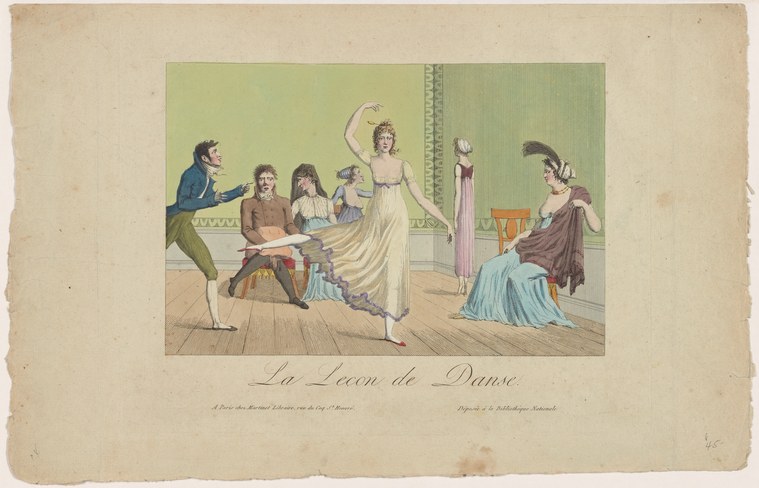
A dance lesson unfolds in a neoclassical interior with panelled walls and a decorative frieze. A male instructor in a blue coat and breeches gestures expressively with one arm raised, demonstrating to a group of four female pupils arranged before him. The women wear high-waisted muslin gowns with long skirts in the Regency style; one wears a striped dress, another pale blue, and a third holds a shawl aloft in an arched gesture. A fifth woman sits on a low bench to the right, watching. The floor is bare wood, and a small orange chair stands against the back wall. The composition captures a moment of active instruction, with the dancing women mid-movement and the master commanding their attention through his elevated posture and animated arm.
The dancing
The instructor stands in profile with one arm raised above shoulder height in a sweeping gesture, the other extended forward at chest level—a classical demonstration pose. The dancing women are in varied positions: two face the instructor with arms raised or extended in mimicry of his movement, one executes what appears to be a balletic arabesque with one leg extended behind and arms aloft, and another holds a shawl or sash in a flowing arch overhead. The seated woman observes with her head turned toward the group. The women's bodies are upright and elongated in the neoclassical aesthetic, with little flexion at the knees and weight carried high.
The dance depicted
This is a lesson in Regency-era social dance, most likely the cotillion, quadrille, or minuet—the fashionable partner and group dances of the early 19th century. The engraving's French title, *La leçon de danse* (The Dance Lesson), and its domestic setting confirm this is an instructional scene rather than a theatrical performance. The women's posture and the instructor's demonstrative gestures are consistent with the formal, upright carriage required of Regency ballroom dancing. The costume and setting place this firmly in the period 1800–1820, when such private lessons were a standard part of genteel education for young women.
How it was made
This is a hand-coloured engraving or aquatint, worked in delicate tints of ochre, green, blue, and rose. The technique allowed precise delineation of the interior architecture and costume detail, while the subtle colour wash suggests form and atmospheric depth without overwhelming the linear composition. The print's small size and portable format indicate it was intended for circulation among the educated middle and upper classes—likely as a print sold separately or bound into instructional books on dancing or etiquette. The quality of the engraving suggests a professional urban publisher, probably French given the title.
About this work
This is a domestic genre scene documenting the private instruction of fashionable Regency women in ballroom dancing. It belongs to a substantial tradition of late 18th and early 19th-century prints depicting dance instruction, courtship, and social life, and it captures a specific moment in the professionalization of dance pedagogy—when the ability to dance correctly was essential social capital for genteel families. The scene records not only what was danced but how it was taught: through demonstration, imitation, and the careful correction of body position and deportment. For historians and dancers, it offers direct evidence of how the body was held, how instruction was conducted, and what the social context of dance was for an urban, moneyed audience in the Regency period.
How to look at it
Note the instructor's elevated arm and extended torso—this is the pose he is teaching, and it models the upright, elongated line that defined Regency elegance. Watch how the women's bodies echo his line without fully mirroring it; some are still learning, their posture less secure. The shawl held aloft by one dancer is not incidental—it was a fashionable prop in social dance of the period, used to enhance the line of the arm and add grace to movement. The seated woman is key: she documents the real time of instruction, the moment before or after a demonstration, when a pupil rests and observes. The artist has chosen a teaching moment rather than a finished dance, showing the labour behind the grace.
The period
In the early 19th century, social dancing was an essential skill for respectable women and a crucial moment for courtship and social advancement. The Regency period (1811–1820) saw the codification of the quadrille and cotillion, imported from the Continent and performed at increasingly formal assemblies and private balls. Dance masters were established professionals who maintained studios in fashionable neighbourhoods and advertised their services to the gentry. Print culture played an important role in disseminating ideal forms of deportment and dance technique through prints and instructional books; such images functioned as both documentation and prescriptive guidance for proper behaviour. This print belongs to a wave of such didactic imagery aimed at women, positioning dance mastery as inseparable from class identity.
Where it lives
The work is held in the New York Public Library's Prints collection. It is a commercial print of the early 19th century, likely published in France or Britain, and was intended for purchase and domestic display or binding into instructional volumes on deportment and dance.
Dance in this work
Questions about this work
What dance is being taught here?
The costume, posture, and setting indicate this is a lesson in the cotillion, quadrille, or minuet—the fashionable Regency ballroom dances. The artist does not depict a complete figure or a fully-formed partnership, but rather a moment of instruction in arm position and carriage. The shawl held by one dancer was a common accessory in social dance of this period.
How does this differ from theatrical dance instruction?
This is a scene of social dance pedagogy for respectable women in a domestic or semi-public setting. There is no stage, no audience beyond the pupils, and no theatrical costume. The goal is competence in ballroom dancing as a social skill, not performance or virtuosity. The master's role is corrective and demonstrative rather than artistic.
Why was dance instruction important for Regency women?
The ability to dance correctly was a marker of gentility and education. A young woman who danced well was more marriageable and more secure in her social position. Private lessons with a skilled master were a luxury good, available only to families of means, making them a visible sign of status and aspiration.
What does the shawl tell us?
The shawl or sash was not merely decorative but a functional element of social dance technique. Women were taught to hold and move light fabrics to enhance the line of the arm and body, adding grace and visual interest to movement. It also provided something for the hands to do in movements that did not involve a partner.
More dance artwork





