49 works in this view — arrow keys or swipe to move between them.
Dance in Art
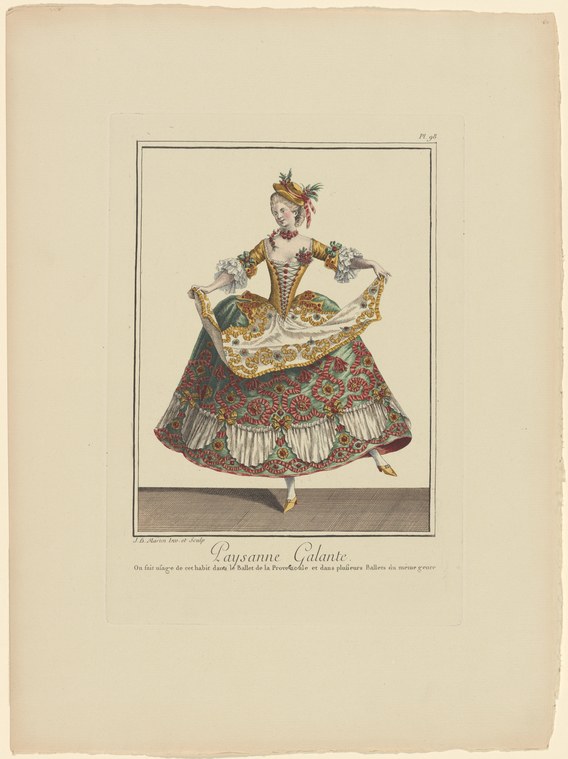
Paysanne galante
Unknown artist
- Collection:
- Prints depicting dance
- Source:
- New York Public Library
- Rights:
- Public domain — free to use, share and adapt.
- Recorded as:
- Public Domain
This image is vital evidence of how baroque court dance was understood, taught, and preserved in the early 18th century—not through notation or written description, but through the circulating print. It shows the dancer's body frozen in a moment of courtly grace, making visible the posture, the line of the limbs, and the carriage that written dance manuals could only approximate. For historians and dancers, it documents both the aesthetic ideal of the period and a professional or semi-professional performance practice that shaped European dance for generations.
What you are looking at
A single female dancer in elaborate early 18th-century court dress stands in a three-quarter pose against a plain background. She wears a richly patterned brocaded skirt in deep red and gold with deep vertical pleating, a corsetted bodice with gold trim, short puffed sleeves decorated with flowers or jewels, and a deep ornamental collar of layered lace and gold that frames her shoulders. Her hair is styled high with feathers and ornaments. She stands on the balls of her feet in a lifted, elegant posture, her weight slightly forward, one leg extended behind in a gesture of graceful extension. Her arms are raised in an open, welcoming frame. The pose captures a moment of courtly movement—neither fully static nor narrative, but a display of refined bodily control and the magnificence of her costume.
The dancing
A single dancer, female, posed in an upright stance with elevated carriage characteristic of baroque court dance. Her weight is carried on the front foot with the back leg extended in a pointed position behind her. Both arms are raised in an open, symmetrical frame at shoulder height, palms somewhat outturned in a gesture of presentation. The lifted posture, pointed feet, and controlled turnout of the hips suggest trained technique in the courtly idiom. The body is held in a composed S-curve, with the head held high and the overall frame conveying aristocratic restraint and dignity.
The dance depicted
This is almost certainly a depiction of a French court dance of the early 18th century, most likely a minuet or a related courtly social dance such as a courante or sarabande. The title 'Paysanne galante' (the gallant country woman) suggests a pastoral or allegorical character type—possibly from a ballet de cour or a theatrical entertainment—rather than an actual peasant. The costume, pose, and refined technique all indicate this is a professional or noble performer executing a choreographed court dance. The extended leg, lifted carriage, and symmetrical arm placement are consistent with the aesthetic of baroque court dance, where the body's elevation and geometric precision were paramount.
How it was made
This is a hand-colored engraving, executed in the style typical of early 18th-century French fashion and theatrical prints. The fine linear work establishing the figure's outline and the delicate parallel hatching used for shading are characteristic of engraving. The color has been added by hand in tempera or watercolor after printing, as evidenced by the even application and the slight variations in saturation. This combination of technique allowed the work to be reproduced in monochrome and then individually colored, making it both an art print and a practical record—circulating among the court, in theaters, or among collectors of costume and dance imagery. The precision and refinement of both line and color suggest this was a luxury object.
About this work
This is a hand-colored engraving of a female court dancer in early 18th-century French dress, shown in a posed moment of baroque courtly movement. The figure is identified in the caption as 'Paysanne galante,' a character type drawn from theatrical ballet or courtly entertainment, and she is portrayed executing a refined, controlled movement in the idiom of court dance. The work preserves both the visual spectacle of baroque costume and the somatic aesthetic of courtly movement—the lifted body, the extended line of the legs, the controlled arms. As a printed and hand-colored sheet, it circulated as a record of theatrical fashion, court dance practice, and aristocratic taste, serving audiences who wished to collect, study, or emulate the movements and costumes of professional and noble dancers.
How to look at it
Note the precision of the pose: the back foot is pointed and barely touches the ground, the front knee is straight but not locked, and the body rises vertically through the torso. This is not a position of rest but of sustained effort—a moment of display. The symmetry and openness of the arms, the high carriage of the head, and the stillness of the face reflect the baroque ideal of courtly dignity. The richness of the costume—the layered collar, the embroidered skirt, the jeweled sleeves—is part of the dance itself; the figure is not merely moving but presenting both body and dress as a unified spectacle. The engraver has chosen to freeze a moment of poised grace rather than a moment of transition or vigor, emphasizing the refinement and control that baroque court dance prized above all.
The period
Early 18th-century French court and theatrical culture was dominated by the refinement and codification of baroque dance technique. This was the era of Raoul-Auger Feuillet's choreographic notation system (published 1700), which standardized the recording of court dances and made them portable and reproducible. Ballet de cour—the fusion of dance, music, and spectacle at court—remained a central cultural practice, and character dances performed by professionals in elaborate costumes (such as peasant or pastoral types) were popular elements of court entertainment and public theatrical performances. Prints like this one served multiple functions: they documented the costumes worn by famous dancers, circulated knowledge of fashionable movement, and celebrated the intersection of dance, fashion, and aristocratic culture. Hand-colored engravings were a standard medium for distributing such imagery to a literate and wealthy audience across Europe.
Where it lives
This engraving is held in the New York Public Library's collection of prints depicting dance. It is part of a tradition of theatrical and court dance prints from the early modern period that served as records of costume, character, and technique.
Dance in this work
Questions about this work
Who was the Paysanne galante, and where was this dance performed?
The 'Paysanne galante' is a character type—the refined or courtly country woman—rather than a specific historical dancer. Such characters appeared in ballet de cour (court ballets) and in theatrical productions that drew on pastoral themes. Without more information from the print's caption or publication details, the specific dancer and performance cannot be identified, but the costume and context suggest this was a professional or noble performer in a court or public theatrical setting of the early 18th century.
What does the pose tell us about baroque dance technique?
The extended leg, lifted posture, and controlled arm placement show that baroque court dance valued elevation, turnout, and geometric clarity. The body is held upright and composed, with weight carried forward and the leg extended in a pointed line. This contrasts with later ballet, which would emphasize even greater height and articulation, and with other dance traditions that prioritize fluid or grounded movement. The pose reflects the aristocratic aesthetic of baroque dance: control, refinement, and the presentation of the body as a harmonious sculpture.
Why were dance prints like this one made and circulated?
Dance prints served practical and cultural functions. They documented the costumes worn by celebrated dancers, allowing fashionable audiences to study and emulate them. They circulated knowledge of choreography and movement across Europe without requiring attendance at court or theater. They also celebrated the intersection of dance, costume, and aristocratic taste, functioning as luxury goods for collectors and connoisseurs. In an era before photography, they were a primary means of recording and preserving the visual ephemera of theatrical dance.
More dance artwork





