49 works in this view — arrow keys or swipe to move between them.
Dance in Art
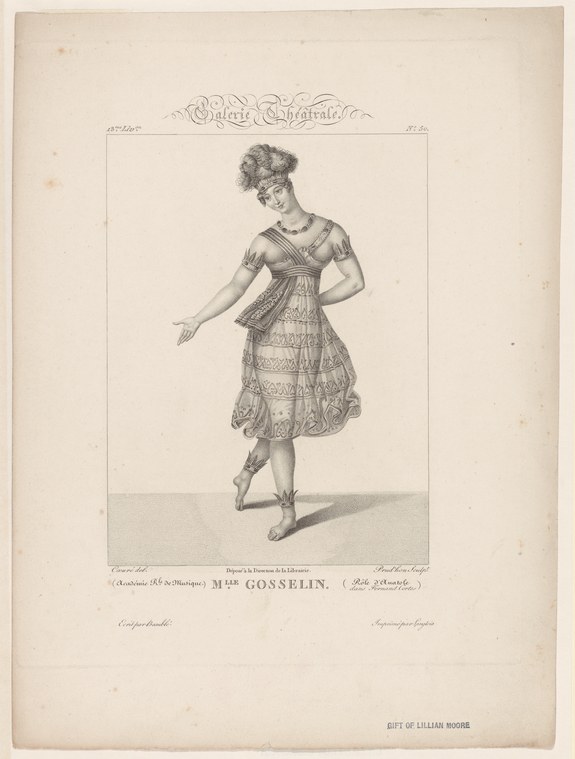
Mlle. Gosselin, rôle d'Anatole dans Fernand Corte. : Imprimé par Langlois. Ecrit par Beaublé. Déposé à la direction de la Librairie
Unknown artist
- Collection:
- Prints depicting dance
- Source:
- New York Public Library
- Rights:
- Public domain — free to use, share and adapt.
- Recorded as:
- Public Domain
This print documents a named historical dancer and a specific theatrical role, providing rare visual evidence of early 19th-century stage costume and the female performer's public image. The Galerie Chorégraphique series is one of the few surviving records of working dancers from this period before photography, making each figure invaluable to understanding the appearance and circulation of theatrical dance in Napoleonic Europe.
What you are looking at
A single female dancer stands in a classical contrapposto pose against a plain background, wearing an early 19th-century Empire-waist dress with short puffed sleeves, a fitted bodice with decorative cross-hatching, and a full skirt falling to mid-calf with horizontal bands of patterned ornamentation. Her dark hair is arranged in an upswept style typical of the Regency period. She extends one arm gracefully downward while the other rests at her side, her weight settled on one leg in a relaxed standing position. The engraving is printed in black ink on cream paper with ornamental text at the head reading "Galerie Chorégraphique" and identifying information below the figure.
The dancing
The dancer stands in a composed, almost portrait-like stance rather than mid-movement. Her posture is upright but not rigidly formal; her extended arm hangs naturally from the shoulder, and her legs are not in a turned-out position. The pose suggests a moment of rest or presentation rather than active dancing—she appears to be displaying the costume and her bearing as a performer rather than demonstrating a step or phrase of movement.
The dance depicted
The print belongs to the Galerie Chorégraphique, a French publication series of theatrical dancers that circulated in the early 19th century. Mlle. Gosselin performed in the role of Anatole in "Fernand Corte," likely a now-forgotten ballet or theatrical work. The image presents her in character dress rather than in action, functioning as a publicity portrait of the performer in her costume. Without further context on "Fernand Corte," the specific dance vocabulary cannot be determined from the pose alone.
How it was made
This is an engraving, printed from an inked copper or steel plate. The fine parallel lines (hatching) used to render the fabric's sheen and the dress's decorative patterns are characteristic of hand-engraved work. The technique allowed for precise reproduction and wide circulation; multiple impressions could be pulled from the same plate, making these prints affordable to collectors and dance enthusiasts. The relatively uniform quality of impression and the professional finish suggest this was a commercial publication.
About this work
This is a theatrical portrait engraving of a named performer, Mlle. Gosselin, in character costume from the early 19th-century Parisian stage. It belongs to the Galerie Chorégraphique, a series documenting dancers and their roles for a literate public interested in theatre and choreography. The work sits at the intersection of dance history and theatrical portraiture, preserving both the costume conventions and the physical presence of a performer now otherwise unknown. Such prints were instruments of theatrical celebrity and cultural circulation in Regency-era Paris.
How to look at it
Note the precision with which the fabric's texture and the costume's ornament are rendered through engraved line; the artist understood how to convey the weight and drape of the dress. Observe the studied informality of the pose—the dancer is presented as a person in costume, not as a body in motion. The slight turn of the head and the downward gaze create a sense of theatrical presence even in stillness. The horizontal bands decorating the skirt follow the silhouette and may suggest the kind of lightweight muslin dresses favoured for classical theatrical roles of the period.
The artist
The engraving was printed by Langlois and written (likely composed or described) by Beaublé, both names associated with French commercial print production of the 1810s–1820s. The Galerie Chorégraphique was a collaborative publishing venture, with multiple engravers and writers contributing to the series. Individual attribution of the engraver is not recorded in the available catalogue information.
The period
The early 19th century saw the rise of theatrical portraiture as a commercial art form in Paris and London. The Empire silhouette—high waist, short sleeves, minimal corseting—was at its height of fashion and appeared frequently in stage costume for both classical and contemporary roles. Dance prints circulated widely among bourgeois collectors and theatre-goers, functioning as souvenirs and as records of celebrated performers. The Galerie Chorégraphique appeared during the Restoration period, when Paris was reasserting itself as the centre of European theatre after the Napoleonic Wars.
Where it lives
The print comes from the New York Public Library's collection of prints depicting dance. It is part of the Galerie Chorégraphique series, a commercial publication from early 19th-century Paris. The inscription "Gift of Lillian Moore" appears at the foot of the sheet, indicating it was donated by a major 20th-century dance historian and collector.
Dance in this work
Questions about this work
Who was Mlle. Gosselin?
Mlle. Gosselin was a theatrical performer in Paris during the early 19th century, named in this print as having danced the role of Anatole in 'Fernand Corte.' Beyond this image and the Galerie Chorégraphique series, little else about her career is currently documented. She represents the many working dancers of her era whose performances and reputations did not survive into the historical record.
What is the Galerie Chorégraphique?
The Galerie Chorégraphique was a French print series published in the early 1810s–1820s, documenting Parisian theatrical dancers in their stage costumes and roles. Each print carried the dancer's name, the name of the role, and the title of the work. The series functioned as both theatrical publicity and a visual archive of early 19th-century dance and costume.
Is this dancer performing or posing?
The pose is primarily a theatrical portrait rather than a snapshot of movement. Mlle. Gosselin is shown standing at ease in her costume, presenting herself as a performer. This was typical of theatrical portrait engravings of the period, which aimed to preserve the appearance and costume of the actor or dancer rather than to capture a particular moment of performance.
More dance artwork





