49 works in this view — arrow keys or swipe to move between them.
Dance in Art
The Redowa waltz ... composed by Fr[iedrich] Bürgmuller
Unknown artist
- Collection:
- Prints depicting dance
- Source:
- New York Public Library
- Rights:
- Public domain — free to use, share and adapt.
- Recorded as:
- Public Domain
The Redowa is a crucial link in the evolution of the waltz and a window into how ballroom dance was commercialized and democratized in the mid-nineteenth century. This print, tied to a specific composition and a named dancing master in Philadelphia, documents the transatlantic circulation of dance fashions and the role of published music and imagery in standardizing technique and style among amateur dancers.
What you are looking at
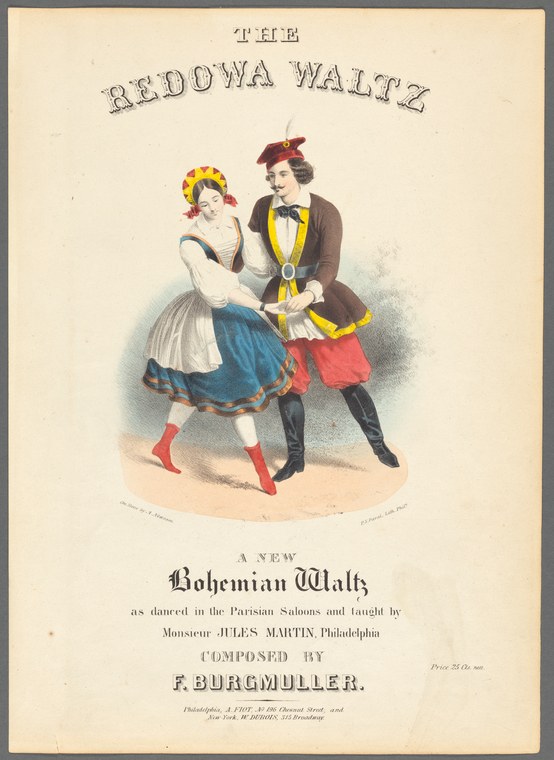
A colored lithograph shows a couple in mid-waltz against a plain cream background. The woman wears a white blouse with puffed sleeves and a deep blue skirt trimmed with white, with a yellow floral wreath crowning her dark hair and red stockings visible above her shoes. The man is dressed in a brown jacket with yellow trim, matching yellow waistcoat, and red knee-breeches in the Bohemian style of the 1830s–40s. He holds her right hand elevated while his left arm encircles her waist; both figures lean slightly into the turn. The woman's skirt swings outward in a graceful arc, catching the moment of rotation. The artist has rendered the figures with soft shading and attention to fabric texture, particularly the luminosity of the woman's sleeve and the weight of her skirt. A faint shadow beneath the couple grounds them on an invisible floor.
The dancing
The couple is in a closed ballroom hold—his right hand clasping her left at shoulder height, his left arm around her waist, her right arm resting on his shoulder. Both bodies incline slightly forward and into the turn, with the woman's weight appearing to be on her back foot as her skirt swings. The closed frame and the relative positions of their heads (hers tilted toward his) suggest the intimate, face-to-face positioning typical of the waltz. The artist has captured the moment mid-rotation, with both figures balanced and moving as a unit.
The dance depicted
This is a Redowa, a Bohemian variant of the waltz that emerged in the 1830s and became a salon favorite across Europe and North America through the 1840s and 1850s. The Redowa is faster and more energetic than the Vienna waltz, with a distinctive rhythm and sharper turning action. The inscription credits the composition to Friedrich Burgmüller, a renowned composer of dance music and pedagogue, and notes that it was danced in the Parisian salons and taught by Monsieur Jules Martin of Philadelphia. The closed position and the turning motion visible here are consistent with ballroom waltz technique, though the Redowa's slightly lighter, more buoyant carriage distinguishes it from the grander Vienna waltz.
How it was made
This is a hand-colored lithograph, a process that allowed for rapid, inexpensive production and wide distribution. The composition was drawn on stone, printed in black, and then colored by hand—a common practice for popular dance prints of the mid-nineteenth century. The soft tonal modeling, particularly in the shading of the figures and the graduated background, shows the advantages of the lithographic crayon; the technique allowed artists to achieve subtlety and nuance impossible in woodcut. The presence of color and the refined rendering suggest this was marketed to middle-class parlor dancers and aspiring waltzers, not merely as a curiosity but as a guide to fashionable deportment.
About this work
This is a mid-nineteenth-century dance instruction print documenting the Redowa, a Bohemian waltz that swept across European and American ballrooms in the 1840s. The image combines practical demonstration—the closed position, the turning action, the carriage of the body—with fashion illustration, showcasing the dress appropriate to ballroom dancing of the period. Burgmüller's Redowa was a popular teaching composition, and this print served to disseminate both the music and the correct execution of the dance to amateur musicians and dancers in parlors far from the great ballrooms of Paris and Vienna. The work represents the intersection of music, fashion, and choreographic instruction in the commercial culture of nineteenth-century social dance.
How to look at it
Pay attention to the moment the artist chose: the height of the turn, when both figures are balanced and leaning into the rotation, the woman's skirt caught mid-swing. Notice the closed position of the arms and the face-to-face carriage—this was the signature of ballroom waltz propriety, implying both formality and intimacy. The dress is key: the woman's Bohemian wreath and the man's distinctive brown jacket with yellow trim place this specifically in the 1840s fashion for all things Bohemian. The softness of the rendering—the way the lithograph captures the fabric of the skirt and the play of light on the sleeve—suggests this was meant not just as a diagram but as an inspiration, showing the aspiring dancer not only how to move but how to appear.
The artist
The print credits the composition to Friedrich Burgmüller (1806–1874), a German composer, pianist, and teacher renowned for his dance music and pedagogical works. Burgmüller composed hundreds of short, elegant pieces for piano and was also a prolific arranger for ballroom orchestras. He taught in Paris and his compositions were widely published and distributed across Europe and America, making his music a standard feature of ballroom practice and instruction. The dancing master credited on the print—Monsieur Jules Martin of Philadelphia—is otherwise undocumented but represents the network of professional dancing masters who brought European ballroom technique to American cities in this era.
The period
The Redowa emerged in Prague in the 1830s and spread rapidly through Vienna, Paris, and beyond in the 1840s, riding the wave of enthusiasm for all things Bohemian in the Romantic era. The 1840s saw the waltz at the height of its dominance in European and American ballroom culture; the Redowa was marketed as a more spirited, nationalistic alternative to the Vienna waltz. This was also the golden age of lithographic dance prints and instruction manuals: as ballroom dancing became a central accomplishment of the middle-class parlor, commercial publishers produced thousands of images and musical arrangements to meet demand. Burgmüller's works were at the center of this trade; his compositions were affordable, technically accessible, and fashionable.
Where it lives
This print is held by the New York Public Library's collection of prints depicting dance. It is one of thousands of commercial lithographs produced in the mid-nineteenth century to accompany popular music and to instruct and inspire amateur dancers in the parlor.
Dance in this work
Questions about this work
What is the Redowa and how does it differ from the Vienna waltz?
The Redowa is a Bohemian variant of the waltz that emerged in Prague in the 1830s. It is faster and more energetic than the Vienna waltz, with a livelier rhythm and sharper turning action, and was often associated with nationalism and Bohemian folk culture. While it uses the same closed ballroom position as the Vienna waltz, the Redowa has a lighter, more buoyant character and was considered more spirited and less formal.
Who was Friedrich Burgmüller and why is his name on this print?
Friedrich Burgmüller was a celebrated German composer and pianist (1806–1874) known for his accessible, elegant compositions for piano and for ballroom orchestras. His dance music was widely published and used for instruction and social dancing across Europe and America. This print advertises a Redowa that he composed, which was likely available in sheet music and was performed or danced to in ballrooms and parlors.
What is a hand-colored lithograph and why were these prints so popular?
A lithograph is an image drawn on stone with a greasy crayon, then printed and colored by hand. This process was much faster and cheaper than engraving or woodcut, allowing publishers to produce hundreds of copies and distribute them widely. Hand-colored lithographs were the dominant medium for popular prints in the 1840s and 1850s, including dance instruction and fashion illustration, because they combined technical sophistication with affordable production.
Who was Jules Martin and why is he named as a dancing master?
Monsieur Jules Martin was a professional dancing master in Philadelphia who taught ballroom dancing, including the Redowa. The print credits him as the choreographer or teacher associated with this version of the dance, reflecting the commercial practice of linking published music and dance prints to named professionals who could authorize or popularize them. He represents the network of European-trained masters who brought ballroom technique to American cities in this era.
More dance artwork





