49 works in this view — arrow keys or swipe to move between them.
Dance in Art
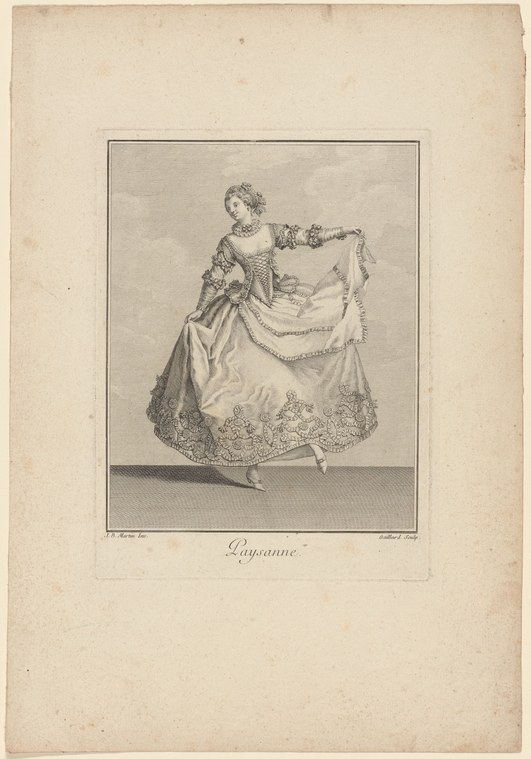
Paysanne
Unknown artist
- Collection:
- Prints depicting dance
- Source:
- New York Public Library
- Rights:
- Public domain — free to use, share and adapt.
- Recorded as:
- Public Domain
For historians of eighteenth-century dance and theater, this is direct evidence of costume, character type, and the aesthetic of theatrical display in the period. For dancers today, it offers a window into a now-extinct tradition of character dance and the social world in which it was performed and collected.
What you are looking at
A single female dancer stands in a three-quarter pose against a plain background, her body angled to the right in a moment of display. She wears an elaborate dress of the mid-eighteenth century: a fitted bodice with short, ornamental sleeves, a voluminous skirt of pale fabric decorated with dense embroidered or patterned trim along the hem, and what appears to be a decorative apron or overskirt caught up at the side to reveal the underskirt beneath. Her left arm extends gracefully to the side, holding up the gathered fabric of her skirt in a gesture of presentation; her right arm hangs naturally. She wears her hair styled high and curled, adorned with what may be a small ornament or jewel. The pose is self-consciously theatrical—a single instant extracted from movement for display—and the dancer's posture conveys both composure and the physical pleasure of wearing and moving in such expensive dress. The engraving is delicately rendered with fine parallel lines building tone and shadow; the background is neutral, allowing the figure to dominate.
The dancing
One female dancer in a stationary pose, weight shifted slightly to one side, creating a graceful S-curve through the body. Her left arm lifts the skirt away from her body in a gesture of display and controlled movement; the other arm rests at her side. Her stance suggests she is between steps rather than performing a defined step or position—the image captures a moment of showmanship rather than technical execution. The body position and arm carriage are typical of theatrical or court dance of the eighteenth century, emphasizing extension, composure, and the revelation of expensive costume.
The dance depicted
This is a theatrical or aristocratic dance of the mid-eighteenth century, most likely a *paysanne*—a rustic or pastoral dance character popularized in opera and ballet of the period. The title itself identifies the character type: a peasant woman, despite the costume's obvious expense and refinement. The paysanne was a standard role in French opera-ballet and in the diversissements of court dances, always performed in stage costume by trained dancers, and always carrying a class irony—elegant artifice pretending at rusticity. The pose and dress here are consistent with how such dances were notated and remembered: a moment of elegant display, the dancer demonstrating both the character type and her own trained elegance.
How it was made
This is an engraving, rendered with fine parallel hatching to build tone and shadow—a technique suited to wide circulation and reproduction. The delicate linework and small scale suggest this may be a page from a printed collection of dance figures, theatrical characters, or perhaps a record of a specific performer. Engravings of this type were common in the eighteenth century as a way to document and disseminate knowledge of current dance fashions and theatrical roles, reaching an educated audience of dance practitioners, theater-goers, and the aristocracy. The technique allowed for precise rendering of costume detail while remaining reproducible and collectible.
About this work
This engraving documents a moment in the theatrical dance of the ancien régime: a single figure in character costume, captured in a pose of elegant display. It belongs to a long tradition of printed records of dance figures and theatrical roles—images that served both as memory aids for performers and as fashionable prints for collectors. The work is important not as a record of movement or technique, but as evidence of how eighteenth-century society understood and represented dance: as spectacle, as character, and as an expression of courtliness and control even when dancing a peasant. The image is also a record of the material culture of dance—the expense of the costume and the investment in its display.
How to look at it
Notice the moment the artist chose: not a step or a turn, but a pose of display, the dancer pausing to show the costume and her trained deportment. The extended arm and gathered skirt are the key gesture—this is the moment of the dance made visible, a flash of elegance and control. The precision of the costume detail—the embroidered hem, the fit of the bodice, the arrangement of the hair—tells you that the dress itself was a major concern, and that this dance was an aristocratic or court entertainment, not a folk tradition.
The artist
The artist is not recorded. The initials or monogram visible at the bottom of the print—if present—may identify the engraver, but the catalogue does not preserve this information. The work appears to be a page from a larger collection of theatrical or dance figures, a common publishing format in eighteenth-century France.
The period
The paysanne and other character dances were at the height of fashion in French opera-ballet and court dance in the 1730s–1770s. They represented a broader Enlightenment interest in pastoral and rustic subjects—an aesthetic taste that valued elegance, refinement, and the performance of rusticity by trained professionals. In the visual arts, prints of theatrical characters and dancers were popular luxury items, part of the material culture of theater-going and dance entertainment. Such prints served as both records and advertisements, keeping current fashions and performers in public view.
Where it lives
Held in the New York Public Library's collection of prints depicting dance. The work appears to be a single-leaf engraving, likely part of a larger printed series or collection of theatrical and dance subjects circulated in the eighteenth century.
Dance in this work
Questions about this work
What is a paysanne?
A paysanne is a female character type in eighteenth-century French opera-ballet and court dance, representing an idealized peasant woman. Despite the rustic character, paysannes were always performed by trained dancers in elaborate stage costume, and the role allowed for displays of grace, technical refinement, and theatrical charm. The paysanne and related rustic characters were fashionable throughout Europe in the eighteenth century, appearing in operas, ballets, and court spectacles.
What does the pose tell us about how the dance was performed?
The pose suggests a dance centered on display, grace, and the revelation of costume rather than complex footwork or virtuosity. The extended arm and gathered skirt indicate a focus on elegant gesture and composure—the dancer demonstrating her training and her beauty, not performing acrobatic steps. This is consistent with what we know of eighteenth-century theatrical dance from other sources: it prized line, extension, and courtly deportment above speed or difficulty.
Why would a peasant character wear such an expensive dress?
The paysanne was never meant to be a realistic representation of a peasant woman. It was a theatrical fantasy, an idealized and costume-enhanced version of rusticity created for entertainment of the aristocracy and educated urban audiences. The expensive fabric and elaborate embroidery were part of the appeal—they allowed the dancer and the audience to enjoy the pleasures of elegant dress while maintaining a pleasant fiction of rural simplicity. This kind of class irony was built into the character and the appeal of the role.
More dance artwork





