49 works in this view — arrow keys or swipe to move between them.
Dance in Art
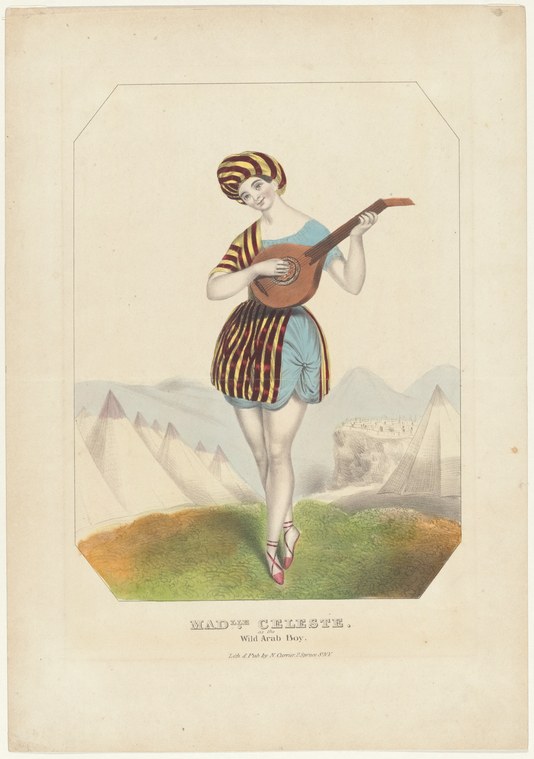
Maddle Celeste as the wild Arab boy
Unknown artist
- Collection:
- Prints depicting dance
- Source:
- New York Public Library
- Rights:
- Public domain — free to use, share and adapt.
- Recorded as:
- Public Domain
This work documents the emergence of exotic dance as popular entertainment in the mid-19th century and reveals how European artists and audiences understood—and fantasized about—non-European dance and bodies. It also preserves the stage presence of a named performer whose work would otherwise be lost to history, showing how athletic, acrobatic movement was theatricalized and gendered through costume and narrative.
What you are looking at
A young female dancer stands alone in an exotic landscape of pyramids and palm trees, posed in a confident contrapposto with her weight on one leg. She wears a striped tunic in brown and gold with blue sleeves, short enough to display her legs and pink heeled shoes. She holds a stringed instrument (a lute or similar) across her body, angled downward as if she has just finished playing or is about to begin. The setting is a tinted theatrical backdrop in pale yellows and greens, with distant pyramids and buildings suggesting an Orientalist fantasy of the Middle East or North Africa. The composition is intimate—a single figure against a vast, imagined landscape—and the hand-colored engraving technique gives the work a delicate, precious quality.
The dancing
The dancer's posture is relaxed and naturalistic rather than formally trained. Her weight shifts onto her right leg, with the left leg slightly extended. Both arms frame the lute, which she holds diagonally across her torso. Her head is tilted with a confident, inward gaze. There is no visible turnout or balletic carriage; instead, the pose suggests a popular or vernacular dance idiom intended to read as natural and improvisational rather than classical.
The dance depicted
The image depicts a figure identified as Maddle Celeste in a role associated with Orientalist theatre. The costume and props suggest this is a theatrical or acrobatic spectacle rather than documentation of actual Middle Eastern or North African dance practice. The dancer is posed as if mid-performance, holding an instrument that would have been exotic and alluring to a 19th-century European audience. This is a theatrical fantasy of 'the wild Arab boy'—a character type from Romantic-era popular entertainment—rather than any ethnographic record. The acrobatic poise and muscular confidence of the figure suggest tumbling or athletic dance, common in circus and music-hall entertainments of the period.
How it was made
This is a hand-colored engraving (the inscription indicates it is from the H. Cramer Collection). The engraved line work is fine and delicate, defining the figure with precision, while watercolor or gouache has been applied by hand to add color to the costume, landscape, and skin tones. This technique was standard for popular theatrical prints of the 1830s–1860s, allowing for affordable mass production while retaining the prestige of printmaking. Such prints circulated widely in theatrical audiences and among collectors of performance memorabilia.
About this work
This is a theatrical portrait print of a named performer, Maddle Celeste, in an exotic dance role. The work is a product of 19th-century Orientalist popular theatre, in which European and American entertainers adopted fantasized versions of non-European dress and movement to thrill urban audiences. Celeste appears to have been known for acrobatic and gymnastic performance, and this image captures her in character, posed with the instruments and costume of an imagined 'wild Arab boy.' The print belongs to a large genre of theatrical memorabilia that documented and advertised performers and roles to theatre-going publics.
How to look at it
Note the confident stance and the deliberate, almost defiant gaze of the performer. The artist has chosen a moment of pause—not mid-leap or mid-gesture, but standing and looking outward, holding the lute as if inviting the viewer into her world. The exotic landscape behind her is rendered in soft, atmospheric tones, making her the clear focal point. The pink heels and striped costume are rendered in bright color against the muted background, drawing the eye to the body and the performer's legs. This was a deliberate theatrical aesthetic: the exotic setting serves as a frame for the performer's body and presence.
The artist
The artist is not recorded. The print carries an inscription crediting the H. Cramer Collection, suggesting it is part of a larger archive of theatrical prints, likely assembled by a collector or publisher of theatrical memorabilia in the 19th century. Such prints were often produced by commercial engraving shops and hand-colored by workshop assistants, making individual attribution difficult.
The period
This print dates to an era of explosive growth in popular theatre, circus, and music-hall entertainment. The 1830s–1860s saw the rise of the 'danseuse' as a celebrity figure, and European theatres were captivated by exotic and acrobatic performers. Orientalism was at its peak as an artistic and theatrical mode, shaping how European and American audiences fantasized about Africa, Asia, and the Middle East. Women performers, particularly acrobats and dancers, were increasingly visible and celebrated, though their labour was often presented through a lens of exoticism and eroticism rather than artistry.
Where it lives
The print is held in the New York Public Library's collection of prints depicting dance. The inscription credits the H. Cramer Collection, indicating it was part of a curated archive of theatrical prints, likely assembled in the 19th or early 20th century.
Dance in this work
Questions about this work
Who was Maddle Celeste?
Maddle Celeste was a 19th-century theatrical performer known for acrobatic and exotic dance roles. This print is one of the few records of her stage presence. Little else about her career has survived in historical records, making such prints valuable documents of women performers from this era.
What is a 'wild Arab boy' in 19th-century theatre?
This was a stock character type in Orientalist popular theatre—a romanticized, exoticized figure meant to evoke a fantasy of Africa, Arabia, or the Middle East. The role had nothing to do with authentic cultural practice; it was a European theatrical invention designed to thrill audiences with imagined exoticism and athleticism.
Why is she holding a lute?
The lute was a conventional prop signifying exotic or Oriental performance. Combining music and dance was common in music-hall and circus entertainment. The instrument identifies the character and suggests a narrative of cultural 'otherness' rather than representing any actual musical practice.
What does this tell us about women in 19th-century dance?
This print shows how women performers, especially acrobats and dancers, achieved visibility and celebrity through exotic and athletic roles. It also reveals how their bodies and labour were framed through Orientalist fantasy rather than treated as serious artistry. The image is both a record of performance and a document of how women's bodies were commodified and exoticized for profit.
More dance artwork





