49 works in this view — arrow keys or swipe to move between them.
Dance in Art
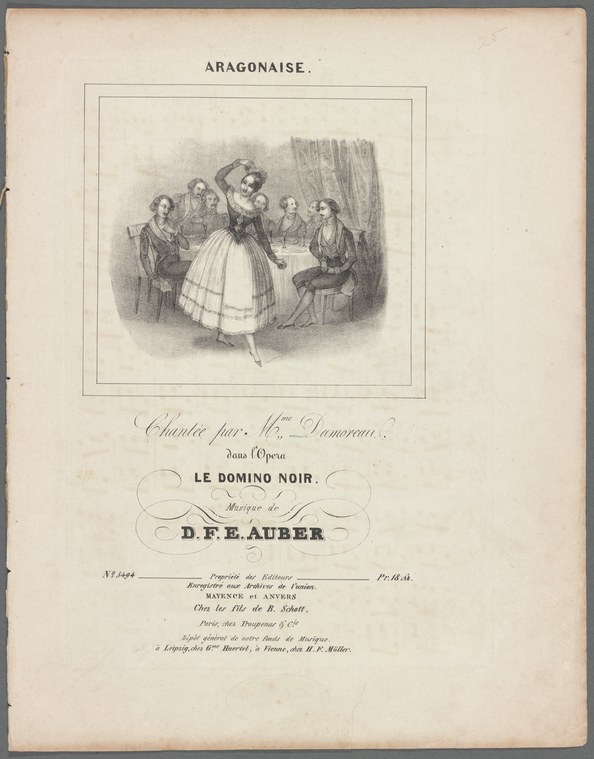
Aragonaise: chantée par Mme. Damoreau dans l'opéra Le domino noir
Unknown artist
- Collection:
- Prints depicting dance
- Source:
- New York Public Library
- Rights:
- Public domain — free to use, share and adapt.
- Recorded as:
- Public Domain
This print documents a major operatic work and a celebrated performer at a specific historical moment, but more importantly it shows us how dance functioned in nineteenth-century opera as a display vehicle for the solo performer. The print preserves the costume, the pose, and the theatrical context of a performance practice that left no other trace. For historians of dance, theatrical prints like this one are primary documents of how bodies moved and were displayed in non-ballet contexts.
What you are looking at
A woman in a full white ball gown stands center stage, captured mid-performance in a dramatic pose with one arm raised expressively. She is surrounded by five or six male onlookers seated in period dress, arranged in a semi-circle observing her from close range. The setting appears to be an intimate theatrical or salon space, suggested by the draped curtain visible at the upper right. The woman's pose—weight on one leg, body animated, arms deployed for dramatic effect—suggests a moment of virtuosic display. The entire scene is rendered in fine black ink on paper with careful shading that gives depth to the figures and suggests stage lighting focused on the central performer.
The dancing
The central dancer stands in an asymmetrical pose with her torso slightly turned, one leg supporting her weight while the other appears to be in motion or extended. Her arms are deployed dramatically—one raised high, the other lower—in a configuration that suggests both technical control and theatrical expressiveness. Her full skirt, with multiple tiers of ruffled or pleated fabric, is shown in motion around her legs, indicating either a turn or a sustained dynamic pose. The seated men maintain formal posture and direct their gaze toward her, their positioning and stillness emphasizing her as the focal point of movement and attention.
The dance depicted
This is a scene from the opera *Le Domino noir* (The Black Mask), with the title indicating this is the 'Aragonaise'—a Spanish-inspired dance number performed by the celebrated soprano Mademoiselle Damoreau. The Aragonaise was a fashionable theatrical dance of the 1830s–40s, typically featuring a solo female performer in a bravura display before an audience or court. The print documents a specific aria-with-dance moment from this opera, capturing the style of operatic dance that stood between classical ballet technique and the more stylized theatrical gestures of bel canto opera. The dance appears to emphasize expressive upper-body movement and dramatic pose over sustained linear extension.
How it was made
This is a finely detailed engraving or lithographic print, evidenced by the careful parallel hatching used to create shadow and volume, the precision of the line work, and the tonal range achieved through ink application. The technique allows for fine gradations in fabric texture—the woman's gauzy skirt reads distinctly from the men's darker coats—and for the subtle modeling of faces and hands. The quality of execution and the theatrical subject suggest this was a commercial print of significant production value, likely distributed as sheet music cover art or as a theatrical souvenir for purchasers interested in the opera.
About this work
This is a theatrical print documenting a moment from the 1830s-era opéra comique *Le Domino noir*, specifically the Aragonaise performed by the celebrated mezzo-soprano or soprano Mademoiselle Damoreau. The print captures the intersection of music and dance in Romantic-era opera—a context in which soloists performed elaborate choreographed numbers as part of the operatic narrative. The work is both a record of a specific performer and a performance, and an example of the commercial theatrical print culture that documented and promoted operatic entertainment to a literate, opera-going public.
The print belongs in a dance history collection because it documents a now-lost performance practice: the specialized dances performed by opera singers as integral parts of operatic spectacle. This was not ballet, but nor was it the stylized gesture work of contemporary dramatic theater. It occupied its own category—singer-dancers performing in full costume, before visible audiences, in a moment frozen by an engraver who had either witnessed the performance or worked from a sketch or description.
How to look at it
Attend to the moment the engraver chose: not a leap or a turn in progress, but a held pose—a moment of display and direct address to the viewer (through the surrounding men) rather than a moment of pure technical feat. Note how the full skirt, catching light and air, is the second focal point after the performer's raised arm and expressive face. The surrounding men are not dancing or moving; they are witnessing and validating her performance. This is the Romantic-era operatic paradigm: the solo female body on display before a rapt, stationary audience.
The artist
The engraver is not recorded in the catalogue. The print is signed 'Chantée par Mde. Damoreau' (sung by Mme. Damoreau) and notes that music is by D. F. E. Auber, the composer of *Le Domino noir*. The print was produced by the Parisian publisher Mayer, working in Antwerp and Arras during the 1830s–40s. This was a period of prolific theatrical print production, when performances were immediately translated into engravings or lithographs for sale to the opera-going public.
The period
The opera *Le Domino noir* premiered in 1837 and was a major success of French opéra comique—a genre that combined spoken dialogue with musical numbers and was looser in form than grand opera. The 1830s and 1840s saw a flourishing of opéra comique and a particular fashion for Spanish-themed subjects (the 'Hispanophilia' of the Romantic era). The Aragonaise, as a Spanish dance, fit this taste perfectly. Simultaneously, this was the era of Romantic ballet's ascendancy with dancers like Marie Taglioni—but theatrical dance was not confined to ballet. Opera singers performed elaborate dances as soloists, and these were documented and celebrated in the theatrical print culture of the period. The print itself reflects the commercial energy of Paris as a center of theatrical production and theatrical merchandise.
Where it lives
The print is held in the New York Public Library's collection of prints depicting dance. It survives as a commercial theatrical print, likely originally sold or distributed in connection with the opera's performance or publication.
Dance in this work
Questions about this work
Who was Mademoiselle Damoreau?
Mademoiselle Damoreau was a celebrated opera singer active in the 1830s–40s. She performed in Paris and other major European opera houses. The operatic world of her era valued singers who could move dramatically and perform choreographed sequences as part of their roles, and this print testifies to her prominence as a performer of such set pieces.
What is an Aragonaise?
The Aragonaise (or Aragonesa) is a Spanish regional dance, but in the context of 1830s French opera it became a theatrical set piece—a solo dance number performed in character. It typically emphasized rhythmic, spirited movement and was associated with Spanish exoticism as understood by the French Romantic imagination.
How is this different from ballet?
This is a theatrical dance performed by an opera singer as part of an opera, not a ballet dancer performing in a dance company. Opera singers typically performed in soft shoes or heeled slippers, not pointe shoes, and their training was vocal first. The movements served the theatrical and narrative purpose of the opera rather than showcasing pure dance technique. However, the distinction between 'opera dancer' and 'ballet dancer' was more fluid in the 1830s than it would later become.
Why was this image made?
Theatrical prints were commercial products. They served as souvenirs for opera patrons, promotional material for the theater, and records of celebrated performers and roles. Owning a print of a famous singer in a famous role was a way of participating in theater culture, similar to how photographs or playbills function today.
More dance artwork





