49 works in this view — arrow keys or swipe to move between them.
Dance in Art
Combat à la barrière
Unknown artist
- Collection:
- Prints depicting dance
- Source:
- New York Public Library
- Rights:
- Public domain — free to use, share and adapt.
- Recorded as:
- Public Domain
Combat à la barrière reveals that courtly movement and display extended far beyond dance as we now define it: aristocratic identity was performed and verified through formalized martial exercises, tournaments, and combat displays that followed strict choreographic and gestural codes. Understanding these practices illuminates how dance, courtship, martial training, and political display were inseparable in Renaissance and early Baroque courts—a context that shaped the development of both ballet and ballroom dancing.
What you are looking at
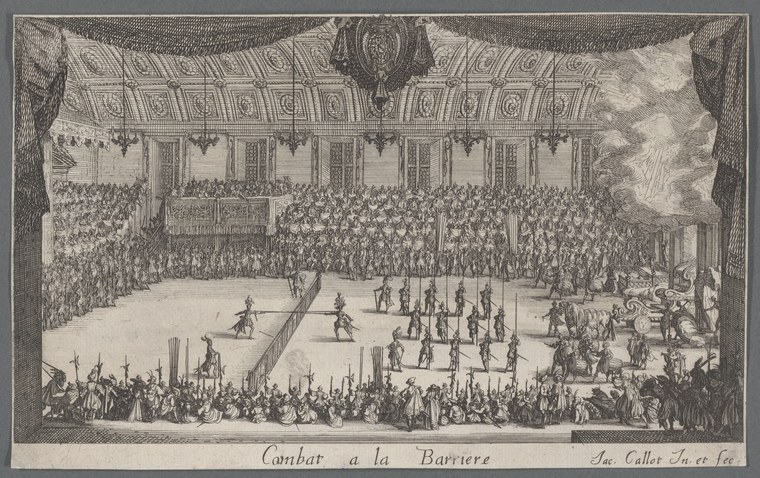
A formal aristocratic combat exhibition staged indoors in a grand hall with ornate geometric ceiling decoration and arched colonnade. Two mounted figures in the center of a large open floor perform choreographed combat—one appears to be striking or thrusting with a lance or sword while the other defends or counters. The space is ringed on all sides by seated and standing spectators in formal dress, crowded in the galleries and along the walls, indicating this is a public court event. Additional armed figures stand or move about the perimeter of the performance space, possibly waiting their turn or forming part of the display. The floor is marked out as a performance arena, clearly separated from the audience. The engraving style and the formality of the setting suggest this is a 16th- or 17th-century aristocratic spectacle, possibly a tournament or formal equestrian combat designed for elite viewing.
The dancing
The two central mounted figures demonstrate a formal, controlled physical engagement: the figure on the left extends a weapon (likely a lance or sword) in a thrust or strike that is met by the figure on the right in a defensive posture. The bodies are upright and formal rather than dynamic—the movement appears choreographed and constrained by courtly protocol. The horses are controlled and contained within the marked arena. The figures around the perimeter appear to be at-arms, standing in positions of readiness or waiting. The overall effect is of formalized, ritualized combat rather than athletic violence.
The dance depicted
This depicts a 'Combat à la barrière'—a formal court combat or tournament exercise performed as ceremonial spectacle in Renaissance and early Baroque courts. The performance is a choreographed martial display rather than a dance in the modern sense, but it is clearly an ordered, formal bodily practice conducted for courtly entertainment and display, following strict conventions of gesture and positioning. The barrière (barrier) visible in the composition would have separated fighters or marked the combat space. Such events combined elements of martial training, courtly display, and ritualized performance; they were as much about demonstrating nobility, control, and courtliness as about combat skill. This was a characteristic form of aristocratic entertainment and courtship display in 16th- and 17th-century European courts.
How it was made
This is an engraving, a print medium that allowed wide distribution to other courts and collectors across Europe. The technique—fine parallel hatching and crosshatching to create tone and shadow—is characteristic of Renaissance and early Baroque print-making, probably created in the 16th or early 17th century. Engravings of court spectacles and tournaments were popular among the nobility and served both as records of actual events and as sources of cultural knowledge about courtly life and ceremony. The precision and formality of the composition reflects both the technical demands of engraving and the courtly subject matter.
About this work
This engraving documents a formal aristocratic combat spectacle—a 'Combat à la barrière'—staged as courtly entertainment in a grand hall. Two mounted figures perform a choreographed martial display while spectators from the nobility observe from galleries around the performance space. The work belongs to a significant body of Renaissance and Baroque court imagery that records the formalized, ceremonial physical practices through which aristocratic identity was performed and displayed. While not dance in the contemporary sense, these martial spectacles were ordered bodily performances conducted to strict codes of courtly behavior, and they shared with dance the function of courtly display and the demonstration of control, grace, and nobility through movement.
The engraving's careful documentation of the space, the arrangement of spectators, and the formal positions of the combatants suggests this may be a record of an actual court event or a standard account of how such spectacles were conducted. The work is significant as evidence of how movement, ritual, and performance were central to aristocratic self-representation in this period.
How to look at it
Observe the precision of the formal positions: the upright postures of the mounted combatants, the controlled extension of the weapon, the formal arrangement of spectators, and the marked boundaries of the performance space. The engraver has chosen to capture not a moment of violent action but a formal, almost frozen moment of controlled engagement—the thrust and parry posed and composed. This reflects the courtly understanding of such combat as a display of discipline and grace rather than genuine violence. Notice how the vast crowd of spectators emphasizes that this is a public performance for the court's viewing and judgment; the combat itself is secondary to its formal presentation.
The period
The Combat à la barrière belongs to a long Renaissance and Baroque tradition of formal court spectacles and tournaments. In the 16th and 17th centuries, European courts (particularly in Italy, France, and the Holy Roman Empire) conducted elaborate staged combats, tournaments, and martial displays as forms of courtly entertainment, political display, and aristocratic competition. These events combined martial skill with theatrical presentation, courtly protocol, and often musical accompaniment. They were related to—but distinct from—the ballroom dances that were also central to court life, yet they shared the function of displaying nobility, control, and elegance through formalized movement. By the 17th century, as ballroom dancing became more central to courtly sociability, such combat displays began to decline, eventually evolving into purely ceremonial forms or disappearing entirely. This engraving documents a practice that was fundamental to how aristocracy understood and performed itself.
Where it lives
The work is held in the New York Public Library's collection of prints depicting dance. It is a historically significant document of court spectacle and entertainment, catalogued within the broader body of dance-related imagery despite depicting a martial rather than choreographic practice.
Dance in this work
Questions about this work
What is 'Combat à la barrière'?
It is a formal, choreographed combat display performed in Renaissance and early Baroque aristocratic courts as courtly entertainment and ceremonial spectacle. The 'barrière' (barrier) marked the space where combat took place. These were ordered physical performances, not genuine fights—they combined martial training, theatrical presentation, and courtly display, and they followed strict conventions of gesture and positioning.
How does this relate to dance?
While Combat à la barrière is not dance in the modern sense, it is a formalized courtly bodily practice that served similar functions: it displayed nobility, grace, and control through movement, it was performed for an audience, and it followed strict codes of behavior and gesture. It belongs to the broader ecosystem of Renaissance courtly performance practices that also included ballroom dancing.
Why would a court stage such an event?
These spectacles served multiple purposes: they displayed martial skill and bravery; they demonstrated courtly control and grace under formal constraint; they provided entertainment and competitive opportunity for the nobility; and they affirmed social hierarchy by allowing courtiers to perform their status and allegiance to the ruling court. They were also occasions for courtship and the display of wealth and power.
When was this practice common?
Combat à la barrière and similar formal court combats were most prevalent in the 16th and 17th centuries. As ballroom dancing became more central to court life in the 17th and 18th centuries, such martial spectacles gradually declined, eventually becoming purely ceremonial or disappearing entirely.
More dance artwork





