49 works in this view — arrow keys or swipe to move between them.
Dance in Art
La Promenade
Unknown artist
- Collection:
- Prints depicting dance
- Source:
- New York Public Library
- Rights:
- Public domain — free to use, share and adapt.
- Recorded as:
- Public Domain
This image documents the aesthetic and social conventions of Regency-era ballroom dance at a moment when social dancing was understood as a display of individual accomplishment and grace. The révérence figure depicted here was a fundamental element of period etiquette, and this print preserves both the form and the context in which it was valued. For historians and dancers, it is evidence of how the body was understood, displayed, and appreciated in the drawing rooms of the gentry.
What you are looking at
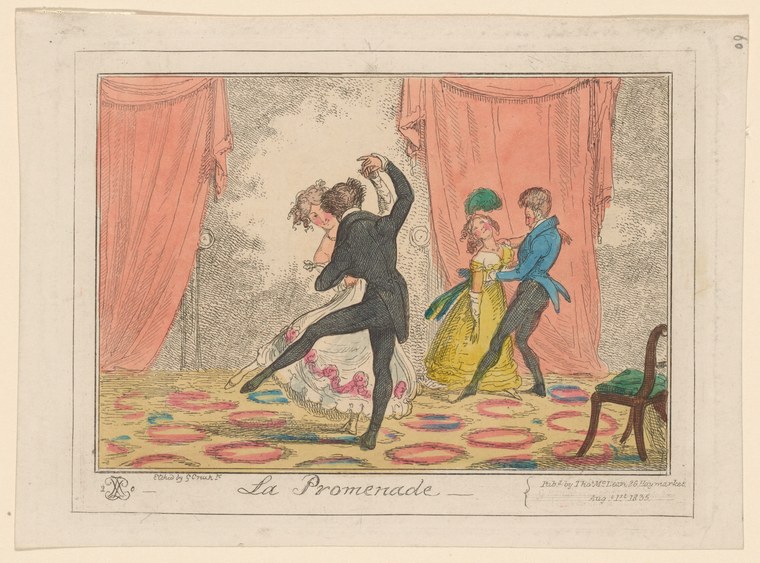
A hand-colored engraving depicting an elegant indoor promenade, likely from the late 18th or early 19th century. The scene is set in a drawing room framed by coral-pink draped curtains on either side. A parquet floor in a geometric pattern extends across the composition. In the center, a man in dark coat and breeches executes a dramatic backward lean or révérence—his body arched, one leg extended, the other supporting his weight as he gazes upward. To the right, a fashionably dressed couple—a woman in a yellow gown and a man in blue coat—interact near a window or doorway. A single chair sits isolated on the right edge. The composition captures a moment of theatrical social performance: the central figure's exaggerated posture suggests a deliberate display of grace and accomplishment, while the watching couple suggests an audience to this private but performative moment.
The dancing
The central male dancer is the visual and kinetic focus: his body creates a pronounced backward arch from roughly the waist, with his weight balanced on one leg while the other extends upward or outward. His arms are raised in an expressive gesture. This is not a partnered hold; he performs solo. The watching couple maintain an upright, formal carriage appropriate to the period—the woman's posture is straight-backed, her companion at her side. No contact is maintained between the dancers. The single chair and the overall spacing suggest this is a display of individual accomplishment rather than a reciprocal exchange.
The dance depicted
This is most likely a depiction of late 18th-century aristocratic social dance, specifically a moment from a promenade or minuet-era social sequence. The backward lean with extended leg is consistent with the révérence or courtesy figures of late Baroque and Regency-era ballroom etiquette—a demonstrative bow or courtesy meant to display grace, control, and good breeding. The title 'La Promenade' suggests a formal walking dance, possibly a transitional moment from a minuet or a movement within a cotillion or quadrille figure. The exaggerated arch of the body and the apparent attention of the couple suggests this was understood as a showy, accomplished gesture—something to be watched and admired. The domestic, intimate setting indicates this depicts social dance among the gentry or aristocracy, not theatrical performance, though the formality and the emphasis on display blur that boundary.
How it was made
This is a hand-colored engraving or etching, identifiable by the fine linear hatching visible in the background and the careful outline work defining the figures and furnishings. The hand-coloring in coral, yellow, blue, and flesh tones has been applied after printing, with visible brushwork and slight unevenness typical of period hand-coloring. The technique allowed for wide distribution among the gentry—more affordable than oil paintings, more precise and reproducible than drawings. The neat title cartouche and credit line at the bottom suggest this was a published print, likely from a series documenting fashionable social practices or dance instruction. This medium and format indicate the work was intended for a domestic or instructional audience of people who danced or aspired to learn.
About this work
This is a late 18th- or early 19th-century social dance scene, rendered as a hand-colored engraving. It documents a moment from the promenade—a formal social dance of the Regency and Napoleonic era—frozen at a moment of maximum display: a solo révérence or courtesy figure, performed for the admiration of an attentive couple. The work sits within a tradition of dance instruction imagery and fashion-conscious documentation of genteel social practice. Its format and technique suggest it was addressed to an educated, dancing public—people who recognized the gesture and understood its social significance.
The image is valuable precisely because it captures not just the posture but the *attitude* toward dance: the emphatic staging, the separation of performer and audience within an intimate space, the understanding that a refined social gesture could be, briefly, a theatrical display. It is social dance that aspires toward the condition of performance art.
How to look at it
Attend first to the geometry of the central figure's body: the artist has chosen to freeze the moment of maximum extension and lean, when the body is furthest from vertical equilibrium. This is not the beginning or end of the gesture, but its apex—the moment when grace and control are most visibly demonstrated. The contrast between the arched, dynamic central figure and the upright, still posture of the watching couple is the composition's organizing principle. Notice also the spatial separation: the performer and audience do not occupy the same plane, even though they share one room. This staging reflects a real convention of period social dance, in which certain figures were briefly 'looked at' and appreciated before the dance resumed.
The artist
The print is attributed to 'Debucourt' (or similar signature) in the inscription at lower left; the engraver or publisher is noted at lower right. Philibert-Louis Debucourt (1755–1832) was a French engraver and painter known for satirical and genre scenes of contemporary life, often hand-colored. His prints typically depicted fashionable society, social follies, and entertainments. However, without a fully legible signature or catalogue entry, the attribution remains uncertain. The style and technique are consistent with French or Franco-English prints of the 1780s–1800s.
The period
This print dates to the era of the minuet's decline and the rise of the cotillion, quadrille, and country dances as the dominant forms of ballroom social dancing. The Regency period (roughly 1811–1820 in Britain, and the Napoleonic era more broadly) saw dance instruction become a mark of gentility, and prints documenting fashionable dances and deportment proliferated. Dance was understood as a moral and physical accomplishment, and the révérence—the courtesy or bow—was a foundational gesture taught to all dancers of either sex. The exaggerated, almost theatrical quality of the backward arch here reflects a broader aesthetic trend toward heightened expression within social dance; the rigidity of the minuet was giving way to more varied and showy figures.
Where it lives
The work is held in the New York Public Library's collection of prints depicting dance. It is catalogued as part of a series or group of dance instruction and fashion imagery, typical of the NYPL's holdings in European social history and material culture.
Dance in this work
Questions about this work
What is a révérence, and why does it matter?
A révérence was a courtesy or bow—a gesture of respect and deference performed at the beginning and end of social dances. It was not merely polite; it was an accomplished movement that demonstrated control, balance, and grace. Teaching people how to perform a révérence correctly was a major part of dance instruction in the 18th and 19th centuries. This print shows an exaggerated, theatrical version of the gesture, suggesting that even within social dance, there was an appreciation for stylized display.
What is a promenade in dance?
A promenade is a slow, formal walk performed by couples or groups, often at the beginning of a dance or as a transitional figure within a larger sequence. It combined elegant posture and controlled steps with an emphasis on appearance and decorum. In ballroom dancing, promenading was less about complicated footwork than about moving gracefully through space while maintaining proper form and engaging with one's partner or the watching assembly.
Who would have looked at prints like this?
These prints were aimed at gentry and upper-middle-class people who danced socially or hired dance masters to teach their children. They functioned partly as fashion plates—showing the latest hairstyles, dress, and décor—and partly as instructional aids, helping dancers remember the correct form and sequence of figures. They were affordable enough to own or borrow, and they circulated widely among people with social aspirations.
Is this theatrical dance or social dance?
It is social dance, but the artist has staged it theatrically—isolating the moment of display and emphasizing the performer's consciousness of being watched. This reflects a real aspect of period social dance: certain figures were understood as 'showpieces,' brief moments when individual accomplishment was displayed within a structured social context. The boundary between ballroom performance and stage performance was more porous than we might assume.
More dance artwork





