49 works in this view — arrow keys or swipe to move between them.
Dance in Art
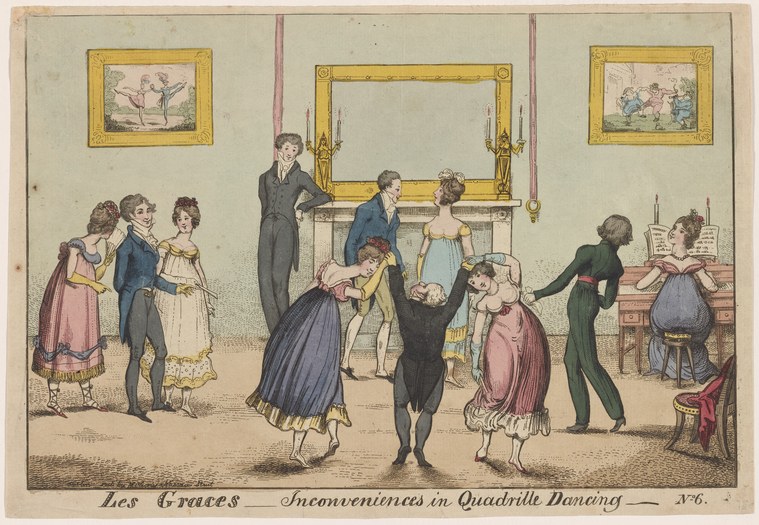
Les Graces -- Inconveniences in quadrille dancing
Unknown artist
- Collection:
- Prints depicting dance
- Source:
- New York Public Library
- Rights:
- Public domain — free to use, share and adapt.
- Recorded as:
- Public Domain
Satirical prints are honest about the gap between idealized and actual behavior. This work shows us not just the quadrille's structure but also the physical comedy, the crowding, the collision risks, and the performative anxiety that accompanied even fashionable ballroom dancing. It is a primary source for how the dance felt to those who danced it.
What you are looking at
A satirical colored engraving depicts a crowded ballroom social scene centered on a quadrille in progress. In the middle distance, four couples are arranged in the formal lines of the dance, with musicians at a fireplace mantelpiece. The composition is theatrical and busy: on the left, a man in dark coat gestures animatedly toward the dancers while accompanying women in Empire-waist gowns watch; in the center, dancers are caught mid-figure with skirts swinging and arms extended; on the right, spectators lean against furniture and converse. The setting is an elegant interior with tall mirrors, framed pictures on pale walls, and fine furnishings. The print's title, rendered in script at the bottom, identifies this as "Les Graces -- Inconveniences in quadrille dancing." The whole scene is rendered with the exaggerated poses and comic energy typical of early 19th-century satirical prints—bodies are elongated, expressions theatrical, and the overall effect is one of gentle mockery of fashionable ballroom behavior.
The dancing
The dancers themselves maintain the basic quadrille formation but with exaggerated energy. Several women's skirts are caught mid-swing, showing the vigorous action of the dance. Men and women stand in the characteristic closed and open positions of the quadrille, with arms extended for figures and turns. Spectators and attendants assume varied poses—some lean, some gesture, some stand stiffly—creating a sense of crowded social chaos around the orderly dance structure. The engraver has emphasized the contrast between the formal geometry of the quadrille and the animated, sometimes awkward bodies attempting to execute it.
The dance depicted
This is unambiguously a quadrille, the most fashionable social ballroom dance of the early 19th century, danced by four couples in a square formation. The title's reference to "inconveniences" suggests the print is satirizing the social and physical complications of the dance—collisions between dancers, skirts catching, the difficulty of maintaining decorum while executing vigorous figures. The quadrille was danced at formal balls and assemblies across Europe and the Americas, and this print captures both its rigid structure and the human comedy of its execution in a crowded ballroom.
How it was made
This is a hand-colored engraving, likely early 19th century based on style and subject. The line-work is fine and precise, typical of engraved copper-plate work, with the figures defined by bold outlines and cross-hatching for shadow. Color has been applied to clothing, walls, and upholstery by hand—unevenly in some areas, suggesting this was a commercial print made for rapid hand-coloring and sale. The technique allowed for wide distribution of satirical social commentary to a broad audience of middle and upper-class viewers who would recognize themselves in the ballroom scene.
About this work
This is a satirical social document dressed as entertainment. It captures the quadrille at the height of its fashionable dominance, roughly 1820–1840, and mocks the tension between the dance's formal structure and the messiness of actual bodies and social interaction in the ballroom. The artist understood the quadrille well enough to render its basic formation correctly, but deliberately exaggerated the physical and social chaos surrounding it. The print belongs in a dance gallery as evidence of how the quadrille was perceived by its own society: not as a serious art form but as a source of comedy, anxiety, and social performance. It is also documentary evidence for how the dance was actually danced, how costumes moved, and what ballroom spaces looked like.
How to look at it
Focus first on the center: the dancers in their squares, the poses of the figures frozen mid-motion. Then read outward to the spectators and their reactions—the man gesticulating on the left, the spectators leaning in or away from the action. Notice how the artist has depicted the women's skirts: caught in movement, sometimes entangling, sometimes swinging into the space of neighboring couples. The composition is deliberately crowded and busy, with no clear focal point, mirroring the social and physical chaos the title promises. The fine engraved line work gives precision to the absurdity.
The artist
The artist is unrecorded in the catalogue. The style and subject matter are consistent with early 19th-century French or possibly English satirical print production, a flourishing commercial tradition that produced thousands of hand-colored engravings mocking social behavior, fashion, and manners. These prints were made for a mass audience, often issued in series, and sold cheaply. The anonymity is typical; most commercial satirical prints of this period went unsigned or bore only an engraver's mark.
The period
The quadrille emerged in Paris in the late 18th century and became the dominant ballroom dance across Europe and the Americas by the 1820s and 1830s. Its rigid geometry—four couples in a square, executing a fixed sequence of figures—appealed to the Regency and early Victorian taste for order and formality, yet its vigorous turning figures and rapid tempo created the very physical chaos this print satirizes. Satirical prints were a major medium of social commentary in the early 19th century, rivaling journalism in reach and influence. Artists used exaggeration and caricature to critique fashion, manners, and social pretension.
Where it lives
This work is held in the New York Public Library's Prints collection. It is a hand-colored engraving, one of thousands of commercial satirical prints produced in the early 19th century and now distributed widely in institutional collections.
Dance in this work
Questions about this work
What is a quadrille?
A quadrille is a square ballroom dance for four couples, popular from the late 18th century through the 19th century. Dancers stand in two lines facing each other or in a square formation and execute a sequence of figures—turns, advances, retreats, and chain movements—usually in sets of eight bars of music. It was the most fashionable social dance of the Regency and early Victorian era.
What are the 'inconveniences' the title mentions?
The print satirizes the physical and social complications of dancing the quadrille in a crowded ballroom: skirts and bodies colliding, the difficulty of maintaining dignity and decorum while moving vigorously, the challenge of remembering the figures, and the social anxiety of being watched by spectators. The exaggerated poses and crowded composition emphasize the gap between the idealized formal dance and the messy reality.
How do we know this is a real ballroom and not a fantasy?
The architectural details—the fireplace, mirror, framed pictures, furniture style—and the costumes (Empire-waist gowns, men's formal coats) are all consistent with early 19th-century ballroom interiors and fashion. The quadrille formation is rendered accurately. This is satire, not fantasy: it exaggerates real social practices the artist and viewers knew firsthand.
Who danced the quadrille?
The quadrille was a dance of the upper and upper-middle classes—the fashionable world of formal balls, assemblies, and social gatherings. Both men and women participated equally, and it required some skill and practice. It was taught at dancing schools and was a marker of social accomplishment and good breeding.
More dance artwork





