49 works in this view — arrow keys or swipe to move between them.
Dance in Art
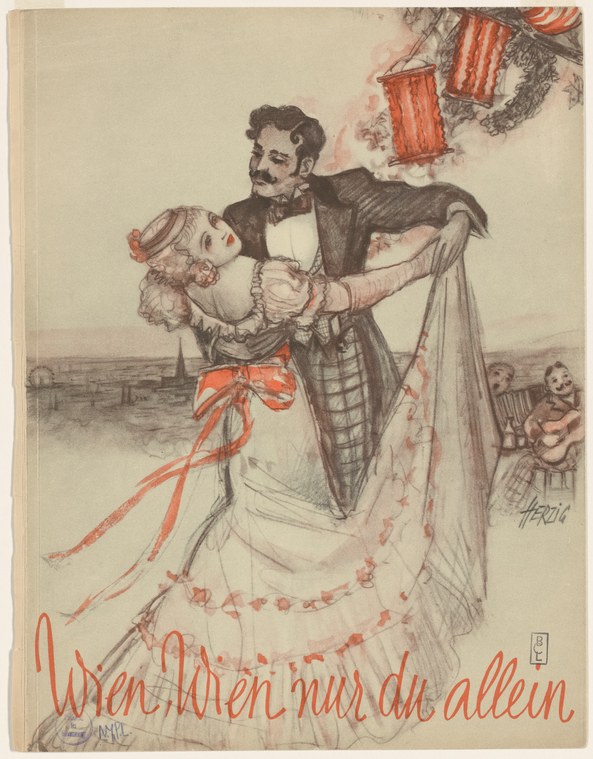
Wien, Wien nur du allein
Unknown artist
- Collection:
- Prints depicting dance
- Source:
- New York Public Library
- Rights:
- Public domain — free to use, share and adapt.
- Recorded as:
- Public Domain
The image is a direct witness to the social waltz as a performed and advertised practice. It shows the actual frame, the clothing, the setting, and the emotional register that the dance carried—not as instruction or formal technique, but as lived, theatrical, and romantic. The title links it to a canonical work of waltz literature, making it a document of how dance repertoire and dance culture intersected in the popular imagination.
What you are looking at
A man in formal evening wear—tailcoat, white shirt front, and bow tie—lifts a woman in a sweeping theatrical pose. She reclines in his arms, her body arched and supported, dressed in an elaborate white ball gown with a fitted bodice and full skirt adorned with a large red ribbon bow at the waist and a train of swags and garland. Her hair is styled up, decorated with what appears to be a small hat or ornament. The setting is a cityscape visible in soft focus behind them—a European city with church spires and rooflines, rendered in pale grey wash. In the upper right corner, festive decorations of red ribbon and greenery suggest a holiday or festive occasion. A cherub or putto figure appears in the lower right, watching the scene. The composition is a romantic theatrical moment, the kind of climactic lift or révérence that would conclude a social dance of the era. The drawing style is delicate and detailed, with careful attention to the fall of fabric and the tender geometry of the embrace.
The dancing
The man is in a classical supporting position: legs planted, torso upright and stable, both arms engaged in cradling the woman's weight—one beneath her shoulders, one beneath her thighs. The woman is entirely dependent on his frame, her body limp and trustingly supported, her legs extended and relaxed. Her arms rest lightly on his shoulders. The hold is intimate and asymmetrical: the woman is passive and fully extended, the man is active and controlled. There is no closed ballroom hold here; this is a theatrical or social-dance flourish, a moment of display and partnership rather than the technical frame of competition dancing.
The dance depicted
This is almost certainly a Viennese Waltz or a formal 19th-century Waltz, the dominant social partner dance of the Austro-Hungarian sphere and the cultural world that title invokes. The lift—specifically the pose known as a promenade position evolved into a supported lean or dip—is characteristic of the theatrical or exaggerated social waltz of the late 19th and early 20th centuries. The German title 'Wien, Wien nur du allein' ('Vienna, Vienna, thou alone') is the opening line of a famous 1873 waltz by Carl Michael Ziehrer, which became an anthem of Viennese dance culture and imperial nostalgia. The image appears to document or romanticise the social waltz as it was performed in Viennese ballrooms during the Gilded Age, a moment when the waltz had become not only a social dance but a symbol of civilisation, refinement, and imperial identity.
How it was made
This is a hand-coloured or tinted lithographic or photomechanical print. The line work is fine and controlled, executed in graphite or crayon on the stone or plate; the colour is applied selectively—flesh tones, the red ribbon and decorative elements, and the pale architectural wash are the only chromatic notes, with the rest left as cream paper. The technique allowed for mass production of theatrical or promotional imagery aimed at the middle-class ballroom and social-dance public. The delicate line and careful modelling of form suggest this was created for a commercial or theatrical print market, likely a poster for a dance hall, a waltz manual, or sheet music.
About this work
This is a romantic print celebrating the Viennese Waltz, one of the defining dances of the 19th century and the cultural identity of Vienna itself. The image captures both the technical elegance of the dance—the frame, the balance, the controlled use of a partner's weight—and its social meaning: a moment of refinement, partnership, and intimate display in the context of the formal ballroom. The title anchors the work to a specific cultural moment and a specific city's relationship to dance as a form of identity and nostalgia. The work belongs in any serious account of how dance was documented, marketed, and imagined in the Gilded Age.
How to look at it
Attend to the precision of the frame and the trust it implies. The man's legs are steady and wide; the woman is utterly supported, weightless. The artist has chosen the moment just after the upward impulse of a lift, when the woman is fully extended and the man's control is most visible. Note how the red ribbon and the holiday greenery frame the romantic content—this is not a technical demonstration but a scene of celebration and courtship. The soft architectural background places the dance in a real city, not an abstract ballroom, making the dance inseparable from Vienna itself.
The artist
The artist is not recorded. The style and production method suggest a commercial printmaker or illustrator working in Vienna or another Austro-Hungarian cultural centre in the late 19th or early 20th century, producing work for the ballroom, theatre, or sheet-music trade. The hand suggests training in fine draughtsmanship and familiarity with ballroom culture.
The period
The Viennese Waltz reached its cultural and commercial peak in the mid-to-late 19th century, particularly after the 1873 Vienna World's Fair. By the Gilded Age, the waltz had become codified as the signature dance of European refinement and imperial leisure. The rise of lithographic printing and colour reproduction technology made dance imagery widely available to the growing middle class. Simultaneously, waltz music and waltz dancing were being packaged as emblems of Vienna's cultural superiority and nostalgic imperial identity—a marketing that intensified as the Austro-Hungarian Empire began its decline. This print is both a product of that cultural moment and a vehicle for that ideology.
Where it lives
The work is held in the New York Public Library's collection of prints depicting dance. It is a commercial lithographic or chromolithographic print, likely issued as a poster, print, or sheet-music cover for the popular ballroom and theatrical market of the late 19th or early 20th century.
Dance in this work
Questions about this work
What is the title and why does it matter?
'Wien, Wien nur du allein' opens Carl Michael Ziehrer's 1873 waltz of the same name, one of the most famous waltz compositions of the 19th century. The title immediately signals that this print is not a generic ballroom scene but a specific cultural product anchored to Vienna's identity as the capital of waltz culture. By using that title, the printmaker linked the image to a canonical musical and cultural work.
How do you know this is a waltz and not another dance?
The title, the formal evening dress, the closed frame and lift, the cityscape of Vienna, and the romantic, theatrical sensibility all point definitively to the Viennese Waltz. The lift or supported dip was a common flourish in waltz performance and instruction of the period. No other social dance of the era would be captioned with a famous Viennese waltz title.
Is this a teaching tool or decorative art?
It is both. The composition and the ideal beauty of the figures suggest this was made for the ballroom market—as a poster for a dance hall, as sheet-music cover art, or as a promotional image for waltz instruction. It documents the aesthetic and aspirational content of Gilded Age ballroom culture: refinement, partnership, romance, and imperial identity.
Why is the woman so passive?
In the 19th-century social waltz, the woman's role was largely to follow the man's lead and to be displayed. A woman who is fully supported and extended shows the man's strength and control, and her own trust and grace. This was not a limitation but a central feature of the dance's social meaning and the gender dynamics of ballroom culture.
More dance artwork





