49 works in this view — arrow keys or swipe to move between them.
Dance in Art
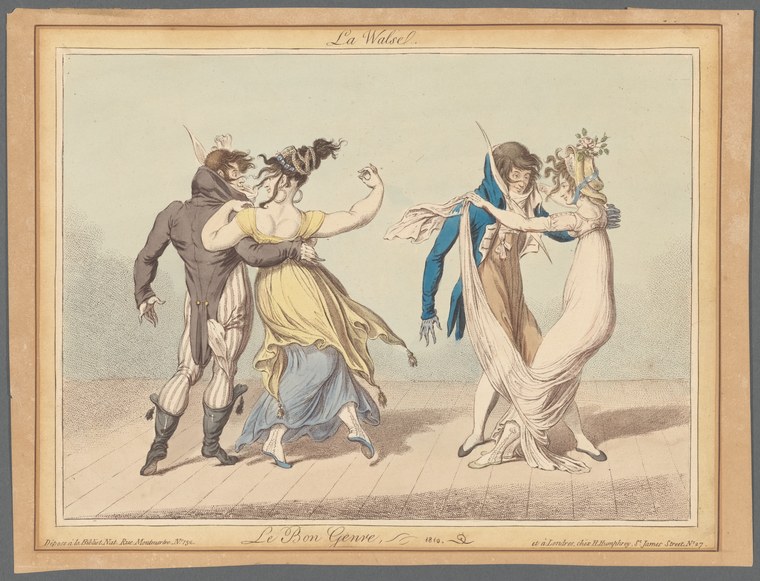
La Walse
Unknown artist
- Collection:
- Prints depicting dance
- Source:
- New York Public Library
- Rights:
- Public domain — free to use, share and adapt.
- Recorded as:
- Public Domain
The waltz was one of the most contested dances in European history, condemned from pulpits and in prints as immoral precisely because of the partner contact this image exaggerates. This engraving is primary evidence of that controversy and of how visual satire was deployed to police and publicize changing social behavior. For dance historians, it illustrates the gap between technical dance instruction and the lived social practice—and the moral weight attached to proximity and rotation.
What you are looking at
This hand-colored engraving depicts a moment of courtship or flirtation set in an elegant interior, rendered in the satirical style of late 18th-century French prints. On the left, a man in dark coat and breeches bows toward a woman in a pale yellow gown, their bodies angled toward one another in a suggestive lean. On the right, a second couple—a woman in white drapery with a blue sash and a child or young figure in light clothing—appears to witness or participate in the scene. The composition uses strong diagonal lines created by the figures' postures and the floor perspective to suggest movement and narrative tension. The engraving's title, "La Walse" (The Waltz), appears at the top in script, while a publication line at the bottom indicates this is "à Straslbourg" and dates to 1816. The pale wash background and delicate cross-hatching create a sense of theatrical indoor space, with the figures' animated poses suggesting music and the impropriety of the moment.
The dancing
The primary couple occupies the left foreground in an emphatically close proximity. The man leans sharply forward from the waist, his torso inclined toward the woman, while she reciprocates with an equal forward cant of her body, her arms raised and extended—one toward him, one across her own frame in a gesture that reads as both invitation and constraint. Their heads are close, almost touching. The second figure on the right holds a child or young person upright, the posture more vertical and observational. The engraver has captured a moment of physical intimacy and bold contact unusual for the period's formal dance positions, with weight shifted forward on the balls of the feet and bodies meeting across a very narrow distance.
The dance depicted
This is a satirical image of the waltz, the social dance that scandalized conservative Europe in the early 1810s because it required couples to maintain close physical contact and rotate around the room. The waltz had only recently arrived in Western Europe from Austria and was condemned by moralists as lascivious. This print, dated 1816, is documenting that very controversy—the title and the exaggerated proximity, the suggestive lean and touch, are the point. The postures here are not naturalistic waltz technique but rather a caricature that emphasizes the dance's transgressive closeness. The second couple may represent alternative behavior or an audience reaction. The image is part of a tradition of satirical dance prints that used the waltz as a vehicle for commentary on changing social manners and the loosening of physical restraint.
How it was made
This is a hand-colored engraving, likely intaglio work given the fine line work and the characteristic parallel hatching used to create shadow and form. The plate has been printed in black or dark brown ink and then tinted with watercolor or light wash, visible in the yellow gown, blue sash, and flesh tones. The technique allowed for wide distribution—engravings were cheaper to produce in quantity than oil paintings and reached a broad middle-class audience. The inscription and publication mark at the base indicate this is a commercial print, sold in Strasbourg. The hand-coloring suggests either a luxury version or the work of a printshop's workshop. The precision of the line and the clarity of the composition made satirical engravings an effective medium for social commentary and propaganda in the early 19th century.
About this work
This is a satirical engraving of the waltz, the dance that shocked early 19th-century society with its demand for close couple contact and rotation. Made in 1816, just as the waltz was arriving in Western Europe, the print exaggerates the physical intimacy between partners to comic or condemning effect. The engraver has chosen the moment of maximum closeness and forward lean, capturing not the technical execution of the dance but the scandal it represented. The image belongs in a gallery of dance art because it documents a crucial moment of social anxiety around the body, touch, and changing manners—anxieties that the waltz both provoked and accelerated. The print also shows how dance imagery functioned as a medium of political and moral commentary: the dance itself was the argument.
How to look at it
Focus on the physical distance between the primary couple and the angle of their spines. The artist has frozen a moment of maximum lean and intimacy—the moment that scandalized critics. Notice the woman's raised arms: one hand reaches toward the man, the other curves across her own torso in a gesture that reads as both participation and self-protection. The second couple on the right creates a frame or witness, their more formal posture contrasting with the forward momentum of the primary pair. The cross-hatching and line work are precise enough to convey cloth and musculature, but the exaggeration of the lean and closeness is deliberate caricature. This is not instruction in how to waltz; it is argument about what the waltz means.
The artist
The artist is not recorded in the catalogue. The style and inscription suggest a commercial printshop, likely in Strasbourg, producing satirical social commentary in the format typical of the post-Napoleonic period. The hand-coloring and publication details indicate production for a middle-class market. Similar prints on dance, fashion, and manners survive from this period and were often anonymous or credited only to the publisher.
The period
The waltz arrived in Vienna in the 1780s and was danced at the Congress of Vienna in 1815. By 1816, when this print was made, it was beginning to spread westward into France and the Germanic territories. Conservative society was appalled: the waltz required couples to hold each other in a closed embrace, to spin in rapid rotation, and to allow the man's hand to touch the woman's waist—all unprecedented in polite dance. Doctors and moralists published warnings about the waltz's effects on the nervous system and morality. This print sits within a flood of satirical imagery attacking the dance. At the same time, younger dancers and couples embraced it as a sign of modernity and liberation. The waltz became a battleground for debates about gender, touch, and social change that continue to echo.
Where it lives
This print is part of the New York Public Library's collection of prints depicting dance, a genre collection rather than a single-artist holding. The catalogue information is minimal—title, date inscription, and holding—but the publication mark and inscription provide evidence of place and approximate date. It represents the kind of popular satirical engraving produced in quantity for distribution and sale.
Dance in this work
Questions about this work
Why was the waltz so controversial?
The waltz required couples to maintain close physical contact—the man's hand on the woman's waist, the couple in a closed embrace, rotating rapidly. This was shocking in a society where unmarried men and women touched very little in public. Moralists, doctors, and clergy condemned the waltz as promoting lewdness, exciting the nervous system, and eroding social restraint. This print satirizes precisely that closeness and contact.
Is this image showing the actual technique of the waltz?
No. This is caricature and satire. The exaggerated forward lean, the extremely close proximity, and the overall composition emphasize the scandal of the dance rather than how to execute it. It is propaganda, not instruction. A real waltz involves a closed frame, weight on the balls of the feet, and rotation, but the technical details are subordinate here to the social argument.
What does the second couple on the right represent?
That is unclear. They may be observing the scandalous behavior with disapproval or surprise, or they may represent an alternative, more 'proper' form of address. The presence of the child or young figure adds to the sense of transgression—improper behavior on display before the young.
When was the waltz introduced to Western Europe?
The waltz originated in Austria and was danced in Vienna in the 1780s. It arrived in Paris and Western Europe more widely around 1814–1815, with major exposure at the Congress of Vienna in 1815. This print dates to 1816, placing it in the early moment of the waltz's spread and the peak of conservative outrage against it.
More dance artwork





