49 works in this view — arrow keys or swipe to move between them.
Dance in Art
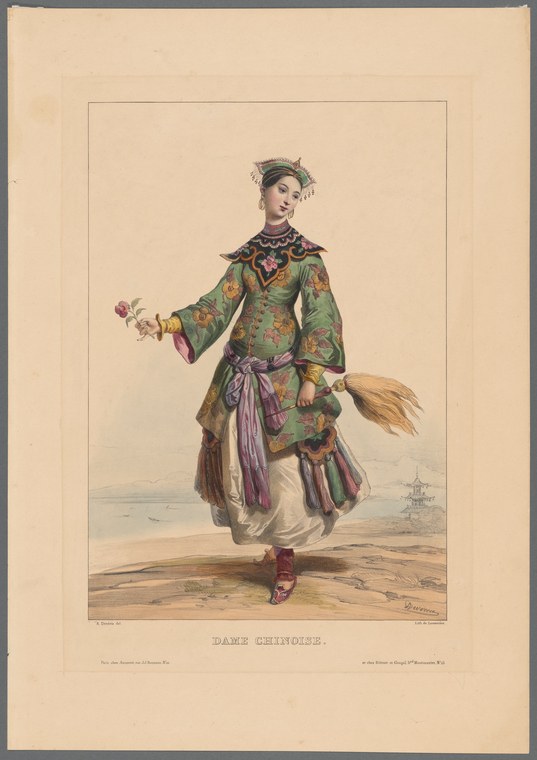
Dame chinoise
Unknown artist
- Collection:
- Prints depicting dance
- Source:
- New York Public Library
- Rights:
- Public domain — free to use, share and adapt.
- Recorded as:
- Public Domain
This image documents a crucial moment in the visual history of dance—the moment when European artists and audiences encountered non-Western performance traditions and attempted to render them legible through the codes of their own artistic practice. For historians of orientalism, costume, and the global circulation of dance imagery in the nineteenth century, it is invaluable evidence of both the allure and the profound misreadings that shaped how Chinese dance was presented to Western eyes. For dancers and choreographers interested in the reception history of Asian performance in Europe, it reveals the emphasis placed on costume, dignity, and formal presentation over technique—a bias that shaped European understanding of these traditions for generations.
What you are looking at
A single figure stands against a pale, minimally detailed ground, dressed in the elaborate costume of a Chinese court dancer or entertainer. She wears a richly embroidered green silk robe with colorful floral and bird motifs, a formal high collar, and draped sleeves that extend past her hands. Over this sits a purple-pink sash tied at the waist, and her lower body is wrapped in a cream-colored skirt visible beneath the robe. She wears red slippers and ornamental leg wraps or stockings. Her hair is arranged in an elaborate upswept style crowned with a jeweled headdress. In her left hand she holds a small flowering branch or spray; in her right, she grasps what appears to be a fan or feathered ornament. Her posture is erect and dignified, weight settled on both feet, her gaze directed upward and to the side in a composed, theatrical manner. The sparse background and frontal composition emphasize the costume and bearing rather than narrative or setting.
The dancing
The dancer stands in an upright, formally composed stance with minimal weight shift—both feet planted, knees neither locked nor deeply bent. Her arms are held away from her body with studied grace: the left arm extended at roughly shoulder height holding the floral branch, the right arm similarly positioned holding the fan or feathered object. The sleeves fall in controlled, graceful lines. Her head tilts slightly, gaze lifted, creating an impression of courtly dignity and restraint rather than dynamic movement. The posture suggests a posed moment of presentation rather than mid-motion in vigorous choreography.
The dance depicted
This appears to be a document of Chinese theatrical or court dance costume and presentation, likely from the nineteenth-century European understanding of such practices. The formality of dress, the properties (flower branch, fan), and the upright, dignified bearing are consistent with classical Chinese performance traditions, though the image itself may represent a Western artist's interpretation or a staged recreation for a European audience. The title 'Dame chinoise' (Chinese Lady) suggests this was intended as an ethnographic or orientalist study rather than a record of a specific named dance form. The image does not depict a recognizable named style familiar to Western dance taxonomies, nor does it show the kind of weight shift, turn, or footwork that would anchor it to a specific technique.
How it was made
This is a hand-colored lithograph or tinted engraving, executed with the precision and delicate color work typical of mid-to-late nineteenth-century French theatrical and costume documentation. The figure is rendered in fine detail against a soft, minimally modeled background; the fabrics, embroidery, and jewelry are rendered with studied care. The technique allowed for the kind of soft color modulation and precise linear work well-suited to costume documentation and circulation as a print to a broad middle-class audience interested in world dress and theatrical exotica. The presence of a signature or production mark at the bottom suggests publication by an established printmaker or publisher.
About this work
This is a theatrical costume study of a Chinese court or entertainment dancer, rendered as a hand-colored lithograph or engraving. It documents both the extraordinary textile wealth and formal compositional restraint of such performance dress, presenting the figure as an object of visual study—costume, bearing, and property—rather than as an agent in motion. The work belongs to the tradition of nineteenth-century European orientalist and ethnographic dance imagery, in which non-Western performance practices were visualized for metropolitan audiences through the lens of costume, dignity, and formal presentation. It is a record of how Chinese dance was understood and aestheticized in Western visual culture at a moment when such imagery circulated widely in prints, fashion plates, and theatrical archives.
How to look at it
The viewer should attend first to the costume itself—the extraordinary labor and wealth invested in the textiles, embroidery, and ornament, which the artist has rendered with meticulous care and delicate color. Then notice the posture and bearing: the upright, formally composed stance; the controlled arm positions; the lifted gaze. This is not a moment of vigorous motion but of dignified presentation. The minimal ground and frontal composition create an effect similar to a fashion plate or a museum display, emphasizing the figure's status as an object of aesthetic contemplation. Finally, observe what is omitted: there is no indication of how such a performer might move, no suggestion of footwork, no capture of mid-gesture; the image presents the performance tradition as costume, dignity, and repose rather than as kinetic practice.
The artist
The artist is not recorded in the catalogue. The style, technique, and subject matter are consistent with mid-nineteenth-century French theatrical and ethnographic printmaking. Such works were often produced by commercial printmaking houses in Paris that specialized in costume plates, theatrical documentation, and orientalist imagery for circulation to a broad audience of theater-goers, collectors, and fashion-conscious readers. The signature or imprint visible at the bottom likely credits the publisher or engraver rather than an artist-author in the modern sense.
The period
This image dates from an era of intense European fascination with world performance traditions, driven by colonial expansion, international exhibitions, and the growing appetite of metropolitan audiences for theatrical spectacle and exotic costume. The mid-nineteenth century saw a flood of such imagery—lithographs, fashion plates, and theater reviews documenting performers from around the globe. Chinese performance traditions held particular appeal in Paris, where Chinese performers, acrobats, and entertainers had appeared in theaters and exhibitions, and where Chinese aesthetics influenced fashion, interior design, and the decorative arts. At the same time, European ballet was undergoing its own transformation, moving from the court dance traditions of the Renaissance and Baroque toward romantic ballet's focus on ethereal, supernatural subjects often set in exotic locales—a context that made such images of non-European dance and dress simultaneously objects of ethnographic interest and theatrical fantasy.
Where it lives
The work is held in the New York Public Library's Prints collection, which documents dance through visual materials including theatrical prints, fashion plates, costume studies, and photographic documentation. This object belongs to a large category of hand-colored prints and lithographs that circulated in the nineteenth century as records of theatrical costume, world dress, and performance traditions.
Dance in this work
Questions about this work
Is this a document of actual Chinese dance practice, or a European fantasy?
It is almost certainly both. The costume elements and formal bearing reflect genuine features of Chinese court and entertainment dress, but the image is filtered through European artistic conventions—the frontal pose, the white ground, the emphasis on material luxury and dignified restraint. It is a record of what a nineteenth-century European artist and audience understood Chinese performance to be, not a neutral document of the practice itself. The title 'Dame chinoise' and the mode of presentation suggest this was intended for a European viewer curious about world costume and theatrical exotica.
Why is the figure so still? Isn't this supposed to be dance?
The stillness is significant. The image presents the performance tradition through costume and formal bearing rather than through movement or technique. This reflects both the practical limits of printmaking—which freezes a single moment—and a deeper European convention of rendering non-Western performance through the aesthetics of the portrait or fashion plate rather than through the languages of dance itself. It tells us as much about how European viewers were trained to look at dance as it does about Chinese performance.
What is she holding in her hands?
In her left hand she holds a small flowering branch or spray—a motif common in Chinese visual arts and performance. In her right hand, she grasps what appears to be a fan or possibly a feathered ornament (such as a peacock fan or similar theatrical property). Both are attributes that enhance the impression of courtly elegance and theatrical presentation.
Who was this made for, and how was it distributed?
This was a commercially produced print, likely made for middle-class European audiences interested in theater, costume, and world dress. Such prints were sold individually, bound in albums, or published in series in journals and theatrical reviews. They served as records of theatrical productions, documentation of world cultures, fashion inspiration, and objects of aesthetic enjoyment for a broad, educated audience.
More dance artwork





