49 works in this view — arrow keys or swipe to move between them.
Dance in Art
Native American dancing in prints
Unknown artist
- Collection:
- Prints depicting dance
- Source:
- New York Public Library
- Rights:
- Public domain — free to use, share and adapt.
- Recorded as:
- Public Domain
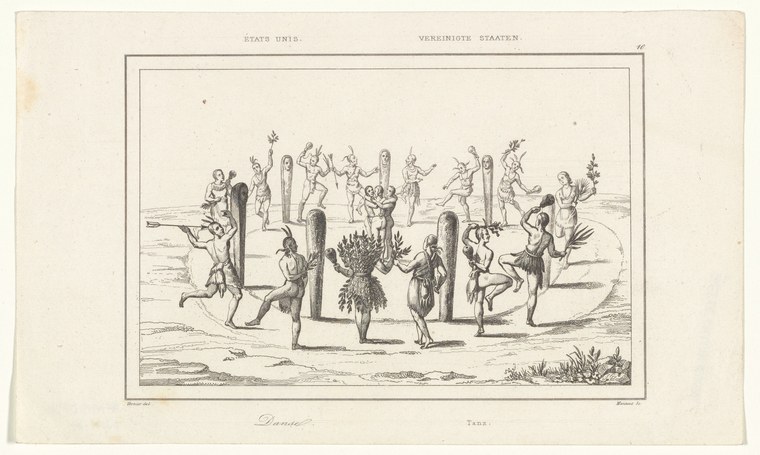
This engraving is one of the earliest European visual records of Indigenous American dancing, offering crucial evidence of how colonial observers documented unfamiliar movement practices and how those depictions shaped European understanding of Indigenous peoples. The work demonstrates both the potential and the limitations of visual evidence: it captures genuine detail about scale, costume, and group dynamics, while simultaneously reflecting the prejudices and misunderstandings of its era.
What you are looking at
A large gathering of Indigenous people is depicted in a landscape that appears to be a colonial encounter or settlement. At the center stands a prominent figure wearing elaborate feathered dress and headdress, surrounded by numerous other figures in various poses and states of undress. The composition is crowded and energetic, with figures distributed across the horizontal plane in loose groupings. Some stand with arms raised, others in profile or three-quarter view. The clothing ranges from minimal garments to decorated dress, suggesting either a ceremonial gathering or a moment of cultural display. The landscape is sparse, with minimal vegetation indicated in the foreground and a flat horizon line. The entire scene is rendered in a fine engraving technique with careful attention to human anatomy and theatrical composition.
The dancing
The dancers occupy varied stances: some stand with arms extended upward or outward, others assume more static poses. A few figures appear to be in motion with one leg raised or weight shifted, suggesting active movement. The bodies are rendered with classical anatomical proportions, displayed with minimal covering to emphasize musculature. The central figure commands attention through size, positioning, and elaborate costume. There is no evidence of paired dancing or formal holds typical of European ballroom practice; instead, the composition suggests individual or loosely coordinated movement within a larger group formation.
The dance depicted
This appears to document Indigenous ceremonial or social dancing, likely from a colonial-era account or ethnographic record. The gathering, scale, and emphasis on bodily display suggest a ceremonial or celebratory occasion rather than everyday movement. Without additional context, the specific dance tradition cannot be identified, but the image may depict practices associated with powwow, feast, or seasonal gathering traditions. The engraver's choice to emphasize gesture and group arrangement over technical footwork suggests an outsider's perspective more interested in the spectacle and scale of the gathering than its formal structure.
How it was made
This is an engraving, likely created in the 16th or 17th century, rendered with fine parallel lines (hatching) to create tone and shadow. The technique allowed for precise rendering of human anatomy and architectural detail, and the small scale and portability of such engravings made them ideal for circulation in printed books and collections. The careful anatomical rendering and theatrical composition suggest a skilled hand working from description or earlier sketches rather than direct observation. The technique's capacity for fine detail across the entire composition creates a documentary effect, even when the subject matter is exotic or unfamiliar to the intended European audience.
About this work
This engraving documents a gathering of Indigenous dancers, likely created during the era of colonial contact and exploration as part of an ethnographic or travel account. The work exists at the intersection of art, documentary, and interpretation—a European artist's rendering of unfamiliar practices for a European audience. The emphasis on spectacle, nudity, and elaborate headdress reflects both genuine observation and the conventions of exotic display prevalent in colonial-era prints. For a gallery of dance in art, it represents an important historical record of how Indigenous movement was observed, interpreted, and circulated in print culture during a formative period.
How to look at it
The viewer should first observe the composition as a whole: the scattered arrangement and varied poses convey energy and simultaneity rather than the orderly progression of European dance. Notice the engraver's attention to the central figure's headdress and costume—this symbolic detail takes precedence over footwork or technique. Attend to the bodies: the minimal clothing emphasizes physical display and musculature, while raised arms, turned torsos, and extended limbs suggest vigorous movement. The lack of clear partners or formations suggests either solo or loosely coordinated group movement, unlike the paired and patterned dances of contemporary European practice.
The period
This engraving belongs to the tradition of New World documentation that flourished in the 16th and 17th centuries, when European explorers, traders, and colonists created written and visual records of Indigenous life. Prints like this circulated widely in collections and travel narratives, shaping European imagination of the Americas. In the same period, European dance was becoming increasingly formalized and documented through written notation and didactic engravings. The contrast between the carefully rendered European dances in contemporary prints and the more chaotic, expressive Indigenous dancing depicted here reflects not only stylistic differences but also the colonial gaze that framed Indigenous movement as primitive, uninhibited, and exotic.
Where it lives
The work is held in the New York Public Library collection of prints depicting dance and Indigenous peoples. It appears to be from a printed book or collection of travel narratives or ethnographic accounts, though the specific source publication is not recorded. The object type and circulation method (engraved print) indicates it was intended for educated European audiences interested in accounts of the New World.
Dance in this work
Questions about this work
What people are depicted dancing here?
The catalogue record does not specify the nation or region. The style of headdress, body ornamentation, and landscape suggest a contact-period account, but without publication context or inscription, the specific community cannot be identified from the image alone. The engraving is a European interpretation, and its details should be read as the artist's rendering rather than as definitive ethnographic documentation.
Is this a real ceremony or invented?
The engraving likely combines observed detail with artistic convention. The anatomical rendering and attention to costume suggest the artist worked from description or earlier sketches. However, the theatrical composition, emphasis on exotic display, and European framing reflect the print's purpose as entertaining and instructive for European readers. It is documentary evidence of how colonists perceived and represented Indigenous dancing, even if not a direct record of the dance itself.
Why are people so minimally clothed?
This reflects both climate reality in many regions and the European convention of depicting exotic peoples with less covering to emphasize difference and to display the human form. In colonial-era prints, minimal clothing served multiple purposes: it was culturally accurate in some contexts, but it also aligned with European artistic tradition emphasizing the nude body and with the colonial gaze that rendered Indigenous peoples as natural, uncivilized, and available for observation.
More dance artwork





