49 works in this view — arrow keys or swipe to move between them.
Dance in Art
Native American dancing in prints
Unknown artist
- Collection:
- Prints depicting dance
- Source:
- New York Public Library
- Rights:
- Public domain — free to use, share and adapt.
- Recorded as:
- Public Domain
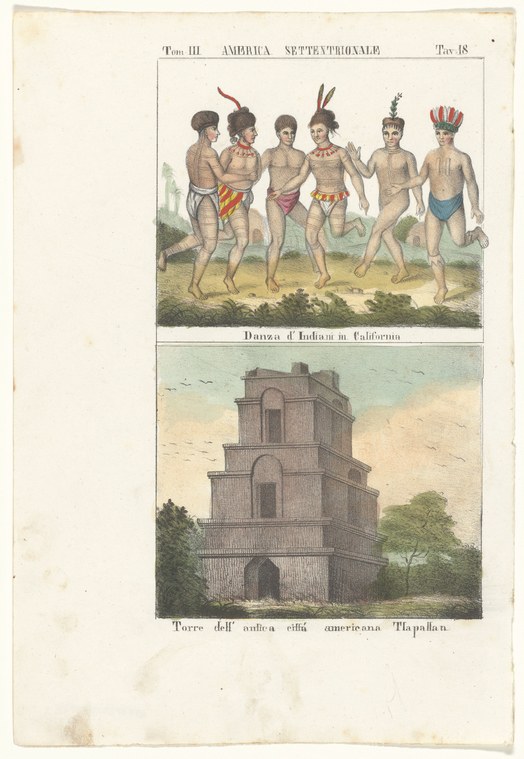
This print is a primary document of European ethnographic vision and the colonial gaze in visual culture. It shows how Native American dance was rendered legible and consumable to European audiences through the conventions of natural history illustration, and it reveals the period assumption that indigenous movement could be captured, categorized, and displayed as exotic spectacle. For dance historians, it demonstrates how movement practices of non-Western peoples entered European consciousness not through direct transmission or study, but through the mediation of engravers, travel narratives, and the commercial print market.
What you are looking at
This engraving presents two distinct scenes on a single plate. The upper register shows six Native American men in a ceremonial or social dance, arranged in a loose line across a landscape dotted with sparse vegetation. They wear minimal clothing—breechcloths and body ornaments—and are adorned with feathered headdresses, arm bands, and painted or tattooed designs on their torsos. Their postures are animated and varied: some stand with arms raised or extended, others appear mid-stride, and the overall composition suggests movement and celebration rather than formal alignment. The lower register depicts a tall, fortress-like adobe or stone structure with multiple tiers, small windows, and a dark entrance, identified by the Italian caption as "Torre dell' antica città americana 'Tlalpalan'" (Tower of the ancient American city Tlalpalan). The two scenes are presented as complementary documentation—dance and architecture as evidence of indigenous civilization.
The dancing
The six dancers occupy varied positions across the composition, suggesting captured moments in an ongoing performance rather than a synchronized formation. Several figures have one or both arms raised or extended outward; at least two appear to be in a walking or stepping stride. Their weight distribution is mobile rather than planted, and the spacing between figures—roughly two to three feet apart—suggests they are dancing individually or in loose groupings rather than coupled pairs. The postures show a range of upper-body engagement, with torsos angled and twisted, though lower-body footwork is not clearly rendered in sufficient detail to assess specific step patterns. The apparent lack of hand-holding or fixed spatial relationship suggests freestyle or improvisational movement rather than choreographed sequences.
The dance depicted
This is documentation of indigenous Californian or southwestern Native American social or ceremonial dance, likely from the early nineteenth century or earlier as observed and recorded by European travelers or ethnographers. The image does not depict a specific named dance tradition but rather presents a generic or composite view of Native American movement practices as understood by European printmakers. The feathered headdresses, body paint, minimal dress, and outdoor setting all align with period European ethnographic conventions for depicting indigenous peoples. Without inscription, historical context, or specific cultural markers, the particular tribal origin and ceremonial or social purpose of the dance cannot be determined from the image alone. The engraver has prioritized visual exoticism and movement energy over anthropological specificity.
How it was made
This is a hand-colored engraving, likely from a late eighteenth or early nineteenth-century travel narrative or ethnographic compendium. The technique—line engraving with watercolor hand-coloring—was standard for natural history and ethnographic illustration of the period and allowed for wide circulation among educated European audiences. The two-register composition and the inclusion of both cultural practice and architectural documentation suggests this plate served a didactic purpose within a larger illustrated work. The quality of the engraving line is competent but not refined, consistent with commercial rather than fine-art printing. The hand-coloring shows attention to detail in the skin tones, feather patterns, and landscape, indicating the object was produced as a finished luxury item rather than a simple reference print.
About this work
This engraving documents indigenous North American dance as understood and interpreted by European visual culture in the early nineteenth century. It presents six dancers in animated poses, ornamented with feathers and body paint, alongside a depiction of an adobe or stone structure. The work functions simultaneously as ethnographic evidence—offered to European viewers as factual record of 'American' indigenous life—and as picturesque entertainment, emphasizing the exotic and the visually unusual. It belongs in a dance archive not because it accurately documents a specific dance tradition, but because it reveals how European audiences learned about non-European movement, and what assumptions about indigenous peoples animated their consumption of such images. The pairing of dance and architecture suggests a comprehensive colonial vision: here is how they live, here is how they move, here is what they have built.
How to look at it
Attend to the variety of poses and the artist's choice to show movement in mid-gesture rather than in stable positions: the raised arms, the off-balance strides, the turned torsos all suggest the engraver was trying to capture the impression of dance as dynamic action. Note how the figures are spaced and oriented differently from one another, which suggests either the artist's attempt to show the range of individual movement within a group dance, or simply the convention of filling the composition with varied poses for visual interest. The feathered headdresses and body ornaments are rendered with particular care and color, indicating what the European audience was meant to recognize and remember. Finally, consider what is *not* shown: the music, the ground they dance on, the social context or ceremony, the faces or individual identities—all absent in favor of costume, movement, and exotic spectacle.
The artist
The engraver is not identified in the catalogue record. The style and subject matter suggest a commercial European print workshop active in the late eighteenth or early nineteenth century, producing illustrated travel narratives or ethnographic works for a middle- to upper-class European market. The competent but not exceptional quality of the engraving line, and the formulaic treatment of the landscape and figures, suggest a journeyman engraver working from a sketch or description rather than direct observation. The hand-coloring was likely executed by a separate workshop or individual, a common division of labor in commercial print production of this era.
The period
This engraving dates to the period of intensive European expansion and ethnographic documentation of the Americas, roughly 1770–1830. During this period, illustrated travel narratives and natural history compilations became major vehicles for European knowledge of indigenous peoples and practices. Dance was a frequent subject in such works, often presented as evidence of both civilization and savagery—organized enough to be recognizable as cultural practice, yet sufficiently 'primitive' to justify European superiority. The architectural documentation in the lower register reflects the parallel European fascination with pre-Columbian and indigenous structures as proof of lost civilizations. In art, the period saw the rise of ethnographic illustration as a distinct genre, positioned between natural history and fine art, and consumed voraciously by educated European audiences.
Where it lives
The work is held by the New York Public Library in its prints collection, catalogued under the broad heading of Native American ethnographic imagery. It is one of a substantial genre of hand-colored engravings produced for illustrated travel narratives and ethnographic compendia circulated among European and Euro-American educated audiences in the late eighteenth and early nineteenth centuries.
Dance in this work
Questions about this work
What dance is this showing?
The engraving does not depict a specific named dance tradition. It presents a generalized or composite view of Native American social or ceremonial movement as understood by European printmakers, without sufficient cultural markers or inscription to identify the particular tribal origin or dance form. The artist's primary interest was in conveying the impression of exotic movement and indigenous adornment rather than ethnographic specificity.
Where is the dance taking place?
The setting is ambiguous. A sparse, open landscape with low vegetation is suggested, but no specific location is identified. The architectural structure in the lower register is labeled as a tower from an ancient American city, but it is not integrated into the dance scene, suggesting the two registers are meant to be understood as separate documentary evidence of indigenous civilization rather than a single coherent moment.
Who made this print and when?
The artist and engraver are not identified in the catalogue record. The style and subject matter suggest a commercial European print workshop active in the late eighteenth or early nineteenth century. The hand-coloring indicates this was a finished luxury item, not a sketch, and suggests it circulated among educated European audiences as part of a larger illustrated travel narrative or ethnographic compilation.
Is this an accurate depiction of Native American dance?
No. This engraving reflects European ethnographic conventions and assumptions about indigenous peoples rather than direct observation or cultural knowledge. The exotic framing, the emphasis on costume and feathered ornament, the generalized poses, and the absence of social context all indicate the image was designed to appeal to European audiences' expectations of the 'savage' or 'primitive' rather than to document a specific tradition with accuracy.
More dance artwork





