49 works in this view — arrow keys or swipe to move between them.
Dance in Art
Native American dancing in prints
Unknown artist
- Collection:
- Prints depicting dance
- Source:
- New York Public Library
- Rights:
- Public domain — free to use, share and adapt.
- Recorded as:
- Public Domain
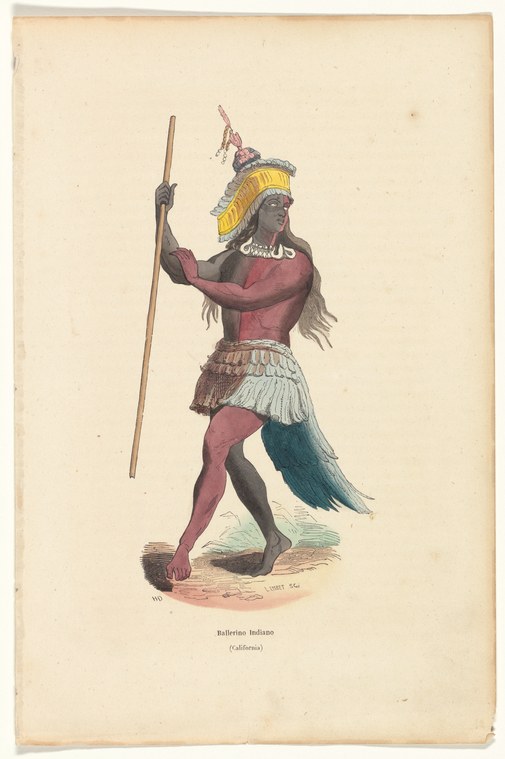
This image preserves evidence of Native American ceremonial or martial dance practice at a moment of intensive European colonial documentation, when many indigenous traditions were being suppressed or transformed. For dance historians, it offers rare visual record of a specific movement tradition and costume, though filtered through colonial perspective. The image's presence in a published series indicates that indigenous dances were recognized as culturally significant enough to merit inclusion in ethnographic records circulating in Europe.
What you are looking at
A single male figure stands against a plain tan background, weight shifted onto one leg in a dynamic stance. He wears a deep maroon or burgundy tunic with white geometric patterning at the hem, and a short white skirt with decorative bands. A distinctive yellow feathered headdress crowns his head, and he wears white beaded or decorative necklaces across his chest. He holds a long wooden staff or spear in his left hand, angled upward. His dark skin is rendered in warm terracotta tones. The figure's pose suggests active movement—his free arm is raised, and his body leans slightly forward. The rendering is hand-colored, with careful attention to textile patterns and ornamental detail. The inscription at the bottom identifies this as "Bellicose Indian (Californios)"—a colonial-era ethnographic label.
The dancing
The single standing figure displays a diagonal stance with engaged musculature. His raised arm and forward-leaning torso suggest a moment of action or ceremony. The weight is planted on the back leg, with the forward leg slightly bent, a posture common to many warrior or ceremonial dances. The arm position—one raised, one holding a weapon—is asymmetrical and suggests a specific gestural vocabulary, though the frozen moment does not reveal the full movement vocabulary of the dance itself.
The dance depicted
This image represents a Native American warrior or ceremonial dance, most likely from California tribal traditions given the inscription's reference to Californios. The posture, headdress, and weaponry (the staff or spear) suggest a dance associated with martial preparation, victory, or spiritual power. The style of the feathered headdress and the geometric patterning of the clothing are consistent with Great Basin or Southern California indigenous traditions. However, without additional documentation, the specific dance tradition cannot be named with certainty. The image records a moment of ceremonial or martial movement treated as worthy of ethnographic documentation by a European artist.
How it was made
This is a hand-colored engraving or aquatint, evidenced by the clear line work defining forms and the selective application of watercolor or gouache over a printed base. The technique allowed for mass production of ethnographic imagery for European audiences, while the hand-coloring added specificity and visual interest. The printed line provides sharp definition of costume elements and body contours, while the coloring conveys texture and volume. This method was standard for 18th- and early 19th-century natural history and travel documentation, indicating this work was made for a broad educated audience rather than a specialized scholarly one.
About this work
This is an ethnographic print documenting a Native American ceremonial or warrior dance, rendered in the conventions of 18th- or early 19th-century European natural history illustration. The figure's dynamic stance, distinctive costume, and ceremonial weapon suggest a tradition of martial or spiritual power. The hand-colored engraving process allowed the image to circulate widely among European audiences as part of the visual documentation of colonial encounter. The work sits at the intersection of dance documentation and colonial representation—it records actual movement vocabulary while filtering it through European aesthetic conventions and ethnographic categories.
How to look at it
Attend to the figure's weight distribution and the angle of his body—these reveal the artist's understanding (or lack thereof) of actual movement mechanics. The positioning of the staff and the raised arm suggest a specific moment in a larger movement sequence; consider what motion preceded and follows this frozen frame. Notice the detailed rendering of costume elements—the feathered headdress, the geometric patterns, the ornamental necklaces—which indicate either close observation or reliance on earlier pictorial sources. The inscription's label reflects the terminology of colonial ethnography and should prompt questions about whose perspective is being presented.
The artist
The artist is not recorded in the catalogue. The work is part of a series of hand-colored ethnographic engravings, a common format in 18th- and early 19th-century European publishing. Such series typically combined work by multiple artists and engravers; the hand-coloring may have been done by workshop assistants. The style and method are consistent with plates produced for natural history volumes, travel narratives, or comparative ethnographic atlases published in Germany, France, or the Low Countries during this period.
The period
This print dates to an era of intense European ethnographic documentation of non-European peoples, particularly following colonial expansion in the Americas. The late 18th and early 19th centuries saw the publication of massive illustrated comparative ethnographies—works like Johann Friedrich Blumenbach's *Decas Craniorum* or similar anthropological atlases—in which indigenous peoples, their dress, and their practices were rendered as objects of scientific study. Dance, as a marker of cultural identity and spiritual practice, was frequently included in such documentation. However, these images operated within a framework that positioned indigenous peoples as static, timeless subjects rather than as living communities with dynamic traditions.
Where it lives
This work is held by the New York Public Library as part of its print collection. It is a hand-colored engraving, likely one plate from a larger series of ethnographic illustrations. The collection designation "Prints depicting dance" indicates it has been identified as dance material within the library's holdings.
Dance in this work
Questions about this work
What tribe or nation is this dancer from?
The inscription identifies this as "Bellicose Indian (Californios)," a colonial-era ethnographic label. This terminology refers to indigenous peoples of California, but is imprecise by modern standards. The costume details—feathered headdress, geometric patterning, style of ornament—are consistent with Great Basin or Southern California traditions, but without additional documentation, a specific tribal affiliation cannot be determined from the image alone. The term "Californios" itself has colonial origins and does not reflect native self-identification.
Is this a real dance or a European invention?
The dynamic posture, costume details, and ceremonial weapon suggest this records an actual indigenous dance tradition. However, the image is filtered through European aesthetic conventions and ethnographic categories. The artist may have witnessed such a dance, worked from description, or drawn on earlier illustrations. The specific details of movement—how the dance actually unfolded, its music, its ritual function—are not fully legible from a single frozen pose.
Why is there a European label on a Native American figure?
This is characteristic of 18th- and 19th-century ethnographic prints, which were created by European artists for European audiences. The labeling reflects the colonial framework in which indigenous peoples were being documented and classified as natural history subjects. The label prioritizes European categories ("Bellicose," "Indian") over indigenous names or self-identification.
What can this image tell us about how the dance was actually performed?
The figure's weight placement, the angle of his body, and the positioning of his limbs suggest real anatomical understanding of movement. The dynamic diagonal stance and engaged musculature indicate the artist observed or understood the kinetic qualities of the dance. However, a single frozen moment cannot convey the full movement vocabulary, music, spatial patterns, or ritual function. This image is best read as evidence that the dance existed and commanded ceremonial significance, rather than as a complete record of how it was performed.
More dance artwork





