49 works in this view — arrow keys or swipe to move between them.
Dance in Art
Native American dancing in prints
Unknown artist
- Collection:
- Prints depicting dance
- Source:
- New York Public Library
- Rights:
- Public domain — free to use, share and adapt.
- Recorded as:
- Public Domain
This image is a primary document of how Indigenous movement and ceremony were represented in the European print market during the age of exploration and colonization. Rather than depicting dance as a living, kinetic practice, it frames Native Americans as subjects of display and ethnographic fascination—a distinction that reveals as much about European attitudes toward Indigenous peoples as it does about the actual traditions being represented. Understanding such images is crucial to recognizing how colonial visual culture shaped, distorted, and instrumentalized representations of Indigenous dance and ritual.
What you are looking at
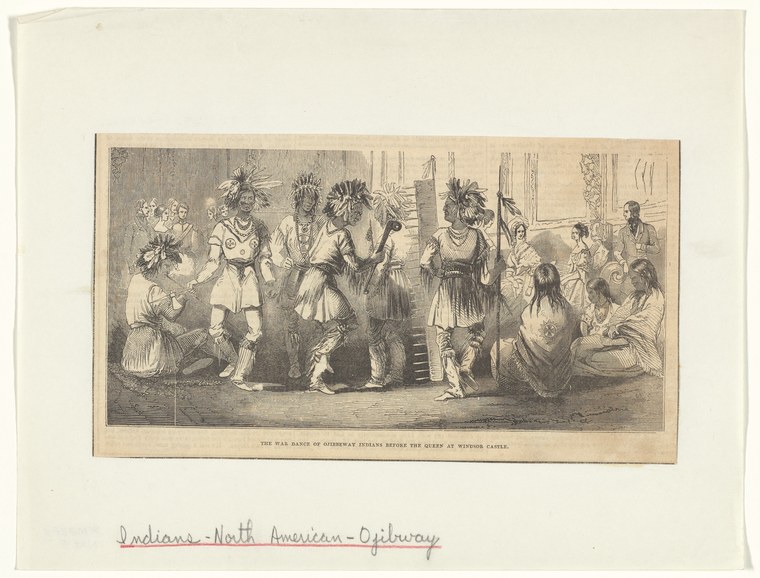
This engraving depicts a formal gathering of Native Americans in European dress, arranged in a theatrical interior space with classical architectural elements—columns and draped wall panels visible at right. The scene is densely populated with figures of varying heights and positions: some standing in prominent posture at center and left, others seated or kneeling on the ground at right, creating a pronounced hierarchy of attention. The central figures wear elaborate feathered headdresses and decorated garments that combine Native American regalia with European-style tailored clothing, including fitted tunics and leggings. The composition suggests a formal presentation or ceremonial moment—possibly a diplomatic reception or ethnographic display—rather than an active dance in progress. The lighting, created through the engraver's cross-hatching technique, is even and formal, emphasizing the institutional nature of the space and occasion.
The dancing
The figures are arranged in a static, frontal composition rather than in fluid dance posture. Several central figures stand with upright, formal bearing, their arms at rest or gesturing with measured deliberation. The seated and kneeling figures at right adopt postures of deference or audience participation. There is no evidence of partnering holds, synchronized movement, or the dynamic weight-shift typical of active choreography. The headdresses are substantial and architecturally rigid—feathered crests rising vertically from the head—which would restrict fluid movement. The overall impression is of presentation and display rather than kinetic performance.
The dance depicted
While the subject is labeled as Native American dancing, the image does not convincingly depict an active dance in the ethnographic or ceremonial sense. The formal, static arrangement, the emphasis on costume and regalia over movement, and the architectural framing suggest this may be a theatrical or ethnographic representation—possibly a curiosity cabinet display, a staged reception, or an engraved record of a visit or presentation. If dance or ceremonial movement is occurring, it is subordinate to the primary event, which appears to be formal observation or protocol. The headdresses and some garments point toward Plains or Eastern Woodlands traditions, but the European setting and clothing integration suggest either a colonial encounter scene or a 19th-century exhibition piece.
How it was made
This is an engraving executed with fine parallel line-work (hatching and cross-hatching) to model form and create tonal depth—a technique characteristic of reproductive engravings from the 18th or 19th century. The paper is cream-toned and somewhat aged. Engravings of this type were produced for publication in books, periodicals, or as standalone prints, and they reached a broad educated audience. The formal, illustrative style and the ethnographic subject matter suggest this may have been created for a historical account, travel narrative, or museum catalogue. The inscription at the bottom of the image (partially legible in the photograph) would typically identify the subject, artist, and publication context, but is not fully readable here.
About this work
This engraving presents a formal scene of Native Americans in a European interior, rendered in a style consistent with 18th- or 19th-century ethnographic or historical documentation. The composition emphasizes costume, regalia, and ceremonial presentation over kinetic dance performance, suggesting it may record a diplomatic encounter, a staged exhibition, or a theatrical representation rather than an observed ceremony. The work sits at the intersection of ethnographic curiosity, colonial encounter documentation, and the European tradition of recording the exotic and unfamiliar through engraved illustration. It belongs in a gallery about dance and culture because it records how Native American bodies, dress, and ritual were perceived, staged, and circulated in European visual culture—even when the actual choreography remains secondary to the ethnographic gaze.
How to look at it
Observe the deliberate, formal composition: the hierarchy of standing figures at center and left, the subordinate seated figures at right, the architectural framing that places the scene in a European institutional space. Note the careful delineation of costume and regalia—the feathered headdresses, the decorated garments—which occupies the engraver's attention more than the articulation of movement or gesture. The lack of dynamic posture, of weight in transition, of partnering or synchronized motion, suggests this is a moment of presentation and viewing rather than performance. The fine engraved lines that create the image also create distance: this is not a sketch from life, but a mediated, composed representation designed for circulation and collection.
The artist
The artist is not recorded. The engraving style and subject matter suggest the work was produced by a professional printmaker working for a publisher or historian in the 18th or 19th century, likely in Europe. Such ethnographic engravings were often created by artists who had not witnessed the scenes firsthand, working from written accounts, earlier images, or secondhand descriptions, which would account for the formal, conventionalized composition and the blend of accurate and invented details.
The period
This engraving was created during an era of intense European fascination with and documentation of non-European peoples, driven by exploration, trade, and colonial expansion. In the visual arts, ethnographic scenes were popular subjects in prints, books, and museums. Such representations typically emphasized exotic costume, difference, and the authority of the European observer over the observed subject. In Native American history, this period corresponds to ongoing colonial contact, displacement, and the erasure and appropriation of Indigenous practices into European entertainment and curiosity. Dance was often represented not as living cultural practice but as a marker of 'savagery,' exoticism, or historical interest.
Where it lives
The work is held in the New York Public Library as part of a collection of prints depicting dance, catalogued under the heading 'Prints depicting dance.' An inscription at the bottom of the print (visible but not fully legible in the photograph) would normally provide the title, artist attribution, publication details, and date; these details remain to be transcribed and verified.
Dance in this work
Questions about this work
Is this actually a dance scene?
The image is labeled as depicting Native American dancing, but what we see is primarily a formal presentation or ceremonial gathering in a European interior. While some figures may be engaged in ritual or ceremonial movement, the composition emphasizes display and observation over kinetic performance. The static poses, rigid headdresses, and formal institutional setting suggest ethnographic representation rather than active choreography.
What do the headdresses tell us?
The elaborate feathered headdresses are substantial, architecturally constructed objects that rise vertically from the head. Their style suggests Plains or Eastern Woodlands traditions, though the engraver may have worked from secondhand descriptions. Such headdresses would restrict the range of head and neck movement, which is one indication that this scene prioritizes visual display over dance practice.
Who is represented here?
The inscription at the bottom of the print would normally identify the specific group, occasion, or individuals represented. Without a legible inscription or publication context, we can only note that the figures are identified as Native American and that the scene is set in a European interior, suggesting a diplomatic reception, museum display, or theatrical staging rather than an observed ceremony.
Why does this matter for dance history?
This image documents how European culture consumed, represented, and instrumentalized Native American ritual and ceremony. By emphasizing costume and exotic difference over movement and cultural meaning, it exemplifies the ethnographic gaze—the reduction of living practice to visual spectacle. Recognizing this distinction is essential to understanding how colonialism shaped and distorted representations of Indigenous dance.
More dance artwork





