49 works in this view — arrow keys or swipe to move between them.
Dance in Art
Esther de Bongars
Unknown artist
- Collection:
- Prints depicting dance
- Source:
- New York Public Library
- Rights:
- Public domain — free to use, share and adapt.
- Recorded as:
- Public Domain
The image provides rare visual evidence of how an early 19th-century stage performer actually moved and was dressed, offering historians a window into theatrical practice before photography. The engraving's circulation and professional production suggest that Esther de Bongars was a celebrated figure in her time, yet she has left minimal written record—making this image potentially one of the most reliable documents of her performance persona and technique.
What you are looking at
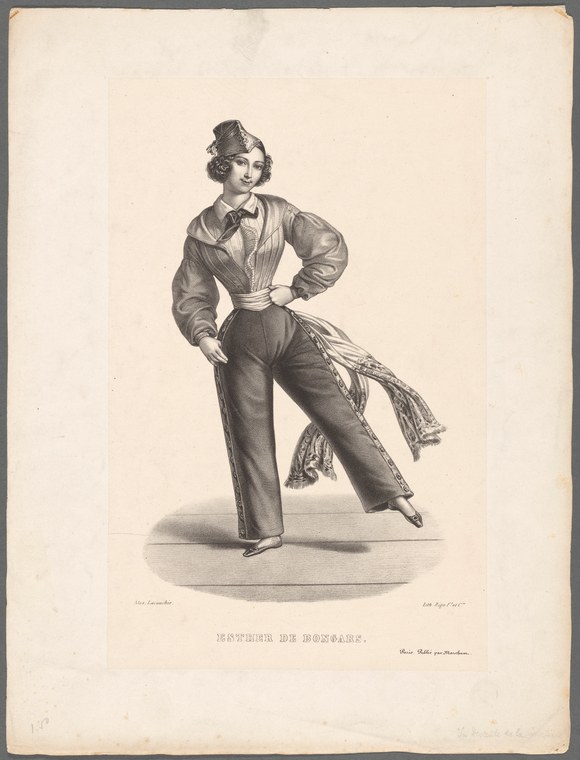
A single female figure stands in three-quarter profile against a plain background, her body angled to the left. She wears a fitted jacket with full, puffed sleeves and a high collar, tucked into high-waisted trousers that extend to her ankles. A shawl or scarf is draped loosely across her hips and legs. Her posture is distinctly theatrical: one leg is planted firmly while the other is raised and extended behind or to the side, knee bent, in a pose suggesting active motion or dramatic pause. Her upper body leans forward slightly, with one arm bent at the elbow and the other at her side. The figure has short, neatly arranged dark hair and gazes toward the left edge of the frame. The engraving technique creates clear outlines and fine hatching for shadow, with a soft ground beneath her feet suggesting a stage or studio space.
The dancing
The single dancer occupies the center of the composition in a dynamic, asymmetrical stance. Her weight appears to shift toward the standing leg, while the raised leg—bent at the knee—creates the impression of motion arrested mid-step or mid-leap. Her arms are not in a closed ballroom hold or strict classical position; instead they sit naturally at varied heights, one slightly lifted. The posture suggests a performer captured in a moment of theatrical action rather than a formal, symmetrical pose.
The dance depicted
The costume and pose suggest early 19th-century theatrical or entertainment dance, likely from the Romantic era of ballet when trouser-wearing male performers or cross-dressed female performers took the stage. The title 'Esther de Bongars' may indicate either a celebrated dancer of that period or a character role. The raised leg, forward lean, and animated gesture point toward theatrical movement vocabularly of the 1820s–1840s, though the exact genre—whether romantic ballet, pantomime, or variety theatre—cannot be determined with certainty. The engraving's style and the performer's clothing suggest a documented star or celebrated role from early 19th-century Paris or London stages.
How it was made
This is an engraving, identifiable by the fine parallel lines (hatching) used to build tone and shadow, the crisp outlines, and the overall clarity of line work characteristic of the medium. The inscription at the base appears to credit both a draughtsman ('del.') and engraver ('Lith. reg.'), suggesting it was drawn by one artist and engraved by another, a standard practice for theatrical portraiture of the period. Engravings of this type were economical to produce and distribute, making them ideal for marketing performers to the theatre-going public; they would have circulated as loose prints or in theatrical journals.
About this work
This engraving documents a theatrical performer named or known as Esther de Bongars, captured in a moment of dynamic stage movement during the early 19th century. The figure wears period-appropriate stage dress—a fitted jacket and trousers—and assumes a pose that suggests active performance rather than stillness, with one leg raised and the body angled in mid-action. The work belongs to a tradition of theatrical portraiture that used engraving to celebrate and promote individual performers, making their likenesses available to audiences and aficionados far beyond the theatre itself. It is both a record of a specific performer and a document of how early 19th-century theatrical dance was conceived, costumed, and marketed.
How to look at it
Observe the deliberately unstable posture: the raised leg and forward-tilting torso do not suggest rest or a formal portrait stance, but rather a performer frozen mid-movement. The artist has chosen a moment of apparent action or transition, not a static presentation. The careful rendering of the jacket seams and trouser fit indicates the engraver's interest in costume detail, which would have helped viewers understand the visual spectacle of the stage performance. The plain background throws all attention onto the figure's pose and dress, a choice typical of theatrical portraiture meant to make the costume and silhouette immediately legible to the public.
The period
This print dates from the early 19th century, an era when theatrical dance was undergoing rapid evolution. Romantic ballet was emerging across Europe; the rise of the professional female dancer in trouser roles or male-coded parts challenged earlier gender conventions on stage. Theatrical portraiture in engraved form was a major medium for promoting stars and spreading knowledge of celebrated performances beyond the cities in which they occurred. This image sits within a broader culture of theatrical print culture—comparable to published playbills and costume engravings—that documented and celebrated the theatrical moment.
Where it lives
The work is held in the New York Public Library's collection of prints depicting dance, suggesting it was part of a broader curatorial effort to document theatrical and dance history through printed imagery. The precise printing credits and title inscription at the base indicate this was a professionally produced theatrical print, likely distributed through theatrical venues or print shops in the early 19th century.
Dance in this work
Questions about this work
Who was Esther de Bongars?
The print provides her name and image, but biographical records are scarce. She was evidently a celebrated theatrical performer in the early 19th century, famous enough to warrant an engraved portrait for public circulation. The absence of extensive historical documentation, despite the professional quality of this print, suggests the gaps that exist in theatrical archives, particularly for performers whose careers predate systematic record-keeping.
What is she wearing and why?
She wears a fitted jacket with puffed sleeves and high-waisted trousers—a costume that reflects early 19th-century theatrical fashion. Trouser roles were significant during the Romantic era, allowing female performers to play male characters or simply to move more freely on stage than long skirts permitted. The precise tailoring visible in the engraving suggests this was a notable costume, perhaps iconic to her performance or role.
How do we know this is a dance image?
The raised leg, forward lean, and dynamic asymmetrical posture all indicate theatrical movement. The pose is neither static nor formal; it captures what appears to be mid-step or mid-leap. The engraving's inclusion in a dance prints collection, along with the theatrical costume and animated pose, all confirm its relevance to dance history.
More dance artwork





