49 works in this view — arrow keys or swipe to move between them.
Dance in Art
Pastoral scene
Unknown artist
- Collection:
- Prints depicting dance
- Source:
- New York Public Library
- Rights:
- Public domain — free to use, share and adapt.
- Recorded as:
- Public Domain
This image is one of the few surviving contemporary documents of how ordinary people danced in the 16th and 17th centuries, showing galliard technique and social formation in authentic practice rather than courtly idealisation. For historians of dance, the print provides visual evidence of body position, height of elevation, and spatial organisation that written descriptions cannot supply. For artists and performers, it demonstrates how Renaissance dancing was integrated into social life and landscape, offering a model of dance as lived experience rather than formalised spectacle.
What you are looking at
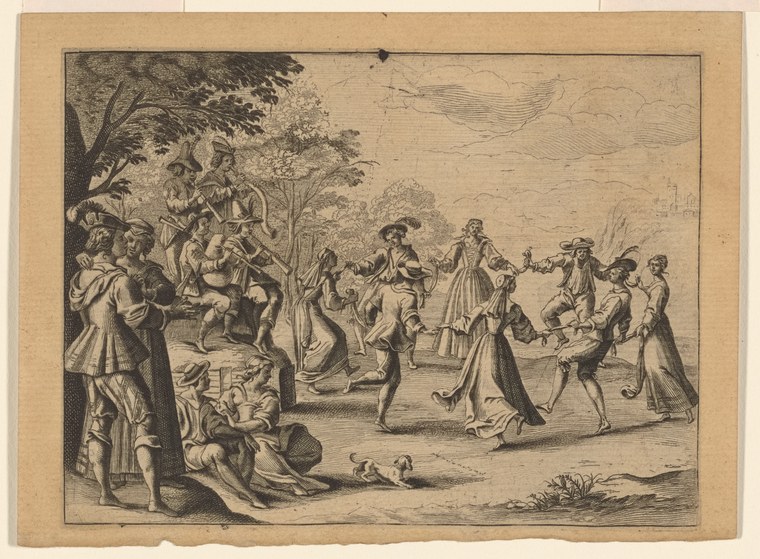
A woodland gathering unfolds across this engraving, with figures arranged in loose groupings under leafy trees. In the foreground, couples and groups stand and gesture animatedly; at left, a woman in flowing robes sits or reclines while others stand near her. The middle distance shows a cluster of elegantly dressed figures—men in doublets and women in long gowns with full skirts—gesturing and moving together. At right, figures appear to be dancing or in motion, arms raised and bodies angled toward one another. The ground is bare earth scattered with low vegetation; the sky is light and open. The engraver has captured a moment of leisured social animation in a rural or parkland setting, with the informality of dress and grouping suggesting a country entertainment rather than a court ceremony.
The dancing
The bodies show the characteristic stance of Renaissance and early modern social dance: upright carriage, arms often raised or extended, turning at the hips. Several figures at right display the lifted, rotating positions typical of galliards or other jumping dances—one appears to be in mid-leap or elevation. Most couples stand at a comfortable distance from each other rather than in closed hold; the frame is open and the dancers face each other or move in parallel. The composition suggests simultaneous dancing by multiple pairs rather than a single line or formation, with at least eight to twelve figures actively engaged.
The dance depicted
This appears to depict rural or village social dancing of the 16th or early 17th century, most likely galliard, a vigorous jumping dance that was popular across Europe in this period. The elevated positions of several figures at right—particularly the high leg action and the turning of the torso—are characteristic of galliard technique. The mixture of standing, gesturing, and active dancing, together with the informal grouping and pastoral setting, suggests this is a representation of how such dances occurred in practice: not as formal court spectacles but as social entertainment among people of modest rank. The engraver has chosen to show multiple stages of the dance simultaneously—some figures preparing, others in motion—rather than a single frozen moment.
How it was made
This is an engraving on paper, recognisable from the precise parallel hatching used to build tone and shadow, the clean incised line, and the fine detail in the rendering of fabric and vegetation. The technique allowed for mass production and circulation through prints, making it an image intended for a broad audience beyond the court. The careful composition and the attention to accurate rendering of dance posture suggest the print was made for educated viewers interested in documenting social customs and entertainment. The wear and browning visible in the paper are consistent with a 16th or 17th-century origin, as is the hand-colouring that may once have been applied.
About this work
This engraving documents a moment of social dancing in a rural or parkland setting, capturing the energetic informality of Renaissance-era entertainment. The figures display the characteristic techniques and open frame of galliard and related jumping dances popular in the 16th and early 17th centuries. The work belongs to a tradition of print documentation that recorded not only court dances and masques but also the everyday social dancing of ordinary people—a crucial historical resource for understanding how dance was actually practised beyond the idealised representations of court spectacle.
As a print, the work demonstrates how dance imagery circulated and was consumed in the early modern period. Unlike a painting commissioned for a specific patron, an engraving could reach readers, scholars, and artists across Europe, shaping how dance was understood and remembered. The pastoral setting and the mixture of stages of movement—some figures dancing, others preparing or watching—give the image an ethnographic quality, as if the artist were recording an actual social custom rather than composing an allegorical or theatrical scene.
How to look at it
Notice the varying positions of the dancers: those at right are caught in active elevation or turning, with legs lifted and arms extended, while those at left and centre stand more quietly, creating a sense of temporal progression or simultaneous activity at different intensities. The artist has chosen to show the galliard's characteristic high action and rotation rather than a moment of rest, capturing the dance at its most energetic. Observe also the open spatial frame in which the dancers move—no one is in the tight closed hold of a later waltz or foxtrot, but rather in the approaching-and-parting pattern typical of Renaissance social dancing. The engraver's fine hatching in the foliage and clothing contrasts with the clarity of the figures' outlines, drawing the eye to the bodies and their movement.
The period
The galliard, from which this image likely derives, was one of the most popular and energetic dances of the 16th and early 17th centuries across northern Europe. It appears in dance manuals from Italy (Arbeau's Orchesographie, 1589) and in countless prints and paintings documenting both court and village entertainments. The woodcut and engraving tradition of the 16th century made dance imagery widely available, moving beyond manuscript and court commission to reach a broader reading public. This particular image belongs to that democratisation of dance documentation: it shows not the formalised court galliard performed by nobility but the rougher, more exuberant version practised in rural settings, suggesting a continuity between courtly and popular dance forms.
The pastoral or idyllic landscape setting was a convention of the period for representing leisure and entertainment, drawing on Virgilian and Renaissance literary traditions. Such scenes allowed artists and printers to situate social dancing within a broader context of rural ease and natural harmony, connecting dance to the countryside and to an imagined pre-urban social order.
Where it lives
This work is held in the New York Public Library's collection of prints depicting dance, catalogued as an engraving from the holdings of the Dance Collection. The collection is part of the Library's broader archive of dance imagery spanning from the Renaissance to the modern era.
Dance in this work
Questions about this work
What dance is being shown here?
The elevated positions and vigorous jumping motion visible in several figures suggest this is a galliard or a related Renaissance jumping dance. The galliard was enormously popular across Europe in the 16th and early 17th centuries and appeared in both court performances and village entertainments. Dance manuals of the period show the galliard as the most energetic and technically demanding of social dances, and this print captures that characteristic liveliness.
Where and when would this dance have been performed?
Based on the pastoral setting and the informal dress and grouping, this appears to document a village or country entertainment rather than a court spectacle. The galliard was danced at all social levels, from nobility to ordinary people, and this image suggests the rougher, more exuberant village version. The engraving itself likely dates from the late 16th or 17th century, when such prints were widely circulated.
How do I know this is an engraving and not a painting or drawing?
The technique is visible in the parallel hatching lines used to build shadow and tone, the precision of the incised line, and the way details like foliage and fabric are rendered through fine linear patterns rather than continuous colour. These are characteristic of engraving on copper or steel plate. The paper itself is old and hand-coloured, consistent with prints of this era meant for circulation and sale.
More dance artwork





