49 works in this view — arrow keys or swipe to move between them.
Dance in Art
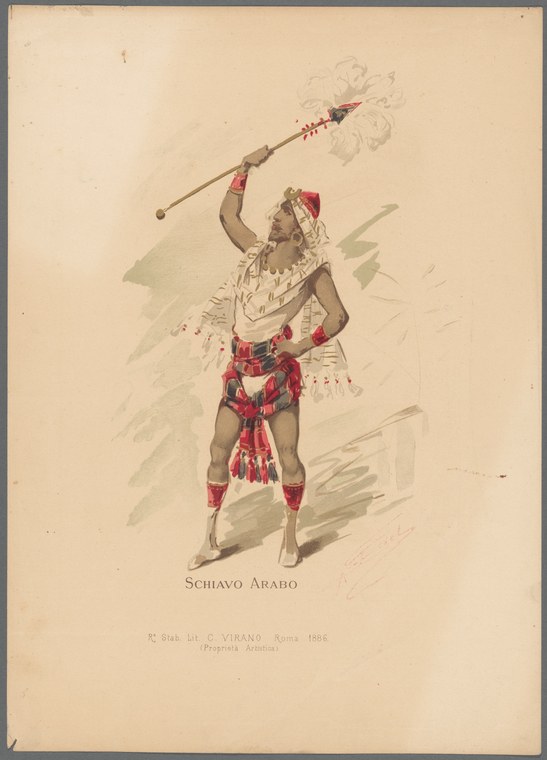
Schiavo Arabo
Unknown artist
- Collection:
- Prints depicting dance
- Source:
- New York Public Library
- Rights:
- Public domain — free to use, share and adapt.
- Recorded as:
- Public Domain
This work documents a specific moment in theatre history when 'exotic' character roles were mainstream entertainment, and shows exactly how such performers were costumed and positioned on stage. For dance historians, it reveals the movement vocabulary and visual logic of 19th-century theatrical performance beyond the ballet canon. It also serves as evidence of how colonial and racial assumptions shaped European performance and entertainment.
What you are looking at
A single male figure stands in a dynamic contrapposto pose against a pale background, one arm raised high holding a long staff or spear topped with white plumage or feathers. His musculature is rendered in warm brown tones. He wears an elaborate costume of red and white: a fringed loincloth or skirt in red with geometric patterns, white wrappings at the calves, red arm ornaments or bracelets, and what appears to be a red cap or headdress. A white patterned garment—possibly a shell breastplate or decorated chest piece—covers his upper body. His weight is shifted onto one leg in a stance suggesting movement or readiness. The pose is theatrical and frontal, designed to display the figure and costume to full advantage. The inscription below reads 'SCHIAVO ARABO' (Arab Slave).
The dancing
A single standing male figure in a wide-legged stance with the torso upright and one arm raised vertically. The raised arm extends fully, gripping a tall staff or spear. The other arm hangs at the side. The weight appears distributed across both legs, with subtle asymmetry suggesting a moment frozen mid-movement or in a display posture. The musculature is emphasised, and the pose prioritises visibility of the elaborate costume over any specific movement vocabulary.
The dance depicted
This appears to be a representation of performance from the colonial period, likely depicting a performer in a theatrical or exhibition context rather than a traditional dance form. The costume and pose suggest this may represent a staged interpretation of 'exotic' performance for European audiences—a common practice in 19th-century theatre, circus, or ethnographic exhibition. The staff or spear, the elaborate ornamental dress, and the display posture are consistent with theatrical performance of the period, but the image does not clearly depict a recognisable dance technique or movement phrase. It may represent a solo performance turn or display moment rather than a dance proper.
How it was made
This is a watercolour and ink drawing on paper, likely a costume design or theatrical character study. The technique uses transparent washes to model the figure's musculature in warm tones, with pen or ink for outlines, details of costume, and the inscription. The style and execution suggest this is a design drawing or character sheet—the kind circulated for costume makers, performers, or theatre documentation. The paper's age and the hand-lettered inscription suggest this is a primary document of theatrical practice, not a reproduction.
About this work
This is a 19th-century theatrical costume study depicting a performer in 'exotic' dress styled as an 'Arab Slave'—a category and a role common in European theatre, opera, circus, and exhibition from the late 1700s onward. The drawing documents both the costume and the performer's stance, likely intended for costume production or performance rehearsal. It belongs in a dance gallery because theatrical performance of this period was fundamentally a movement art, and because understanding how bodies were dressed, posed, and displayed on stage is central to dance history. The work is also a historical document of how non-European performance was interpreted, staged, and marketed to European audiences—a practice inseparable from colonial power and racial ideology.
How to look at it
Note how the figure is positioned frontally and symmetrically despite the raised arm, making display and visibility the priority. The pose emphasises the costume's components—the patterned loincloth, the shell breastplate, the cap, the arm ornaments—each rendered clearly. The staff is held vertically, creating a strong vertical axis. This is not a captured moment of movement but a display stance, similar to a fashion figure or character sheet. The artist has rendered the musculature to create a heroic or impressive silhouette, consistent with how 'noble savage' characters were visually coded in 19th-century theatre.
The artist
The artist is not recorded. The inscription indicates this was produced for theatrical use, likely in Rome (the partial text mentions 'Roma 1866' or similar). The style is consistent with theatre design drawings of the mid-19th century, when hand-drawn costume and character studies were standard practice before performance.
The period
The mid-19th century saw an explosion of 'exotic' entertainment in European theatre, opera, circus, and international exhibitions. 'Oriental' and 'African' characters populated ballets (such as Giselle, La Bayadère), operas (Aida premiered in 1871), and theatrical spectacles. These roles were staged fantasies, designed for European audiences and performers, drawing on costume tradition, orientalist painting, and colonial stereotypes rather than on any authentic cultural knowledge. Simultaneously, actual non-European performers began appearing in European circuses and exhibitions—a context that sits uneasily between entertainment, ethnographic display, and exploitation. This drawing sits at the intersection of these practices.
Where it lives
The work is held in the New York Public Library's collection of prints depicting dance. The inscription and style suggest it originated as a theatre design drawing, likely European, mid-19th century. Its presence in a dance collection reflects the library's broad definition of dance as encompassing theatrical performance.
Dance in this work
Questions about this work
What does 'Schiavo Arabo' mean and why is it titled that?
'Schiavo Arabo' means 'Arab Slave' in Italian. This was a stock theatrical character type in 19th-century European theatre and opera. The title likely names the character role rather than describing an actual person. Such roles were common in operas and ballets of the period, and the character typically appeared in 'harem' or 'oriental palace' scenes.
Is this a dance, and if so, what kind?
This is a theatrical performance costume study rather than a representation of a specific dance technique. The pose is a display stance designed to show off the costume, not a captured movement phrase. It documents theatrical performance practice and staging, which is part of dance history even where no particular dance vocabulary is visible.
Who performed roles like this, and where?
Such roles appeared in European ballets, operas, and theatrical spectacles. They were performed by professional European dancers and actors costumed as 'exotic' characters, not typically by performers from the regions the characters supposedly represented. These performances reflected 19th-century European fantasies about the colonial world rather than any authentic cultural practice.
What is the date and origin of this drawing?
The inscription indicates a Rome connection and a date in the 1860s, but the exact date and artist are not recorded. The style is consistent with mid-19th-century theatre design drawing. It was likely created as a working document for costume makers or performers.
More dance artwork





