49 works in this view — arrow keys or swipe to move between them.
Dance in Art
Schiavo Egizio
Unknown artist
- Collection:
- Prints depicting dance
- Source:
- New York Public Library
- Rights:
- Public domain — free to use, share and adapt.
- Recorded as:
- Public Domain
This image reveals the visual and conceptual apparatus of 19th-century European theatrical exoticism: how ballet and opera constructed 'otherness' through costume, pose, and the commodification of enslaved and colonized identities. For historians of dance, it demonstrates both the technical virtuosity of costume design and the racial and colonial ideologies embedded in theatrical spectacle of the period. The work is a primary document of how European dance theatre viewed and staged Africa and the African diaspora.
What you are looking at
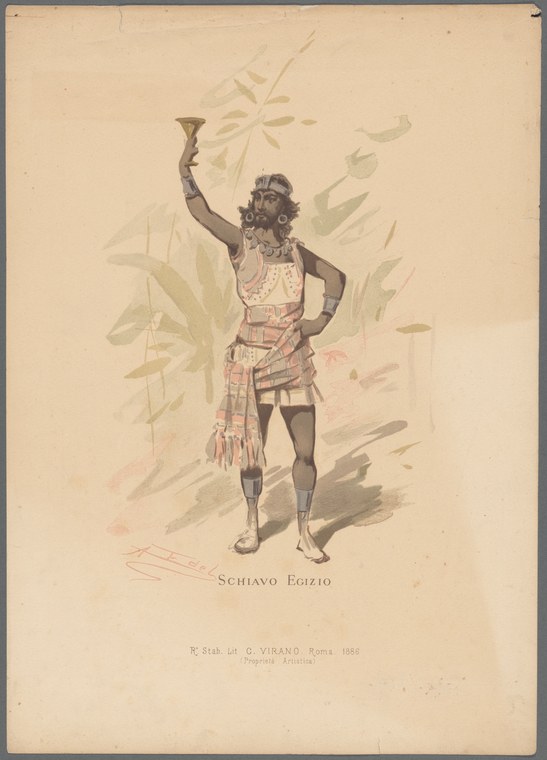
A single male figure stands in a commanding pose against a plain background with faint linear watercolor washes suggesting drapery or setting. The man has dark skin and is depicted in a classical contrapposto stance: weight on his left leg, right leg relaxed, torso twisted slightly. His left arm is raised high, holding what appears to be a torch or ceremonial object aloft; his right arm is bent at the elbow and positioned at his side. He wears a short pleated skirt or kilt in striped fabric (pink and tan), a decorative beaded or patterned chest piece, and ankle wraps or leg bindings. His hair is styled in tight curls. The pose suggests theatrical presentation—a moment of display or proclamation rather than active dance movement. The figure is rendered in a naturalistic style typical of 19th-century theatrical costume studies, with careful attention to anatomical proportion and ethnographic detail.
The dancing
A single standing male figure in a frontal-facing stance with contrapposto weight distribution. The raised left arm holding the torch is the dominant gesture—extended fully upward and slightly back, creating an axis of vertical lift through the body. The right arm hangs loosely, lending asymmetry. The legs are relatively still, with minimal indication of active footwork or dynamic lower-body engagement. The overall frame is statuesque and declarative rather than kinetic, suggesting a posed moment or tableau rather than mid-movement.
The dance depicted
The work is titled 'Schiavo Egizio' (Egyptian Slave) and appears to be a costume design or theatrical character study rather than a documentation of functional dance. The pose and gesture—the raised torch, the formal stance, the ethnographic attention to dress—suggest this is a character from a 19th-century theatrical production, likely ballet or grand opera, rather than documentation of an actual Egyptian or African dance tradition. The torch and statuesque pose recall classical theatrical conventions for depicting enslaved or subjugated figures in European dramatic works. The work cannot be identified as depicting a specific named dance form; instead, it shows how European theatre visualized and costumed 'Egyptian' characters during the 1800s.
How it was made
This is a hand-colored engraving or lithograph, executed in a refined theatrical style typical of 19th-century costume documentation. The figure is rendered in pen or engraving line with careful hatching for musculature and volume, then tinted with watercolor or chromolithographic washes—notably the flesh tones, the striped fabric, and the warm background. The technique allowed for precise reproduction and distribution of costume designs to theatrical companies and the public; the refined finish suggests a commercial or archival print made for circulation among dancers, designers, and theatregoers.
About this work
This is a costume design for a theatrical character identified as 'Egyptian Slave,' part of a 19th-century European dramatic tradition of exoticized stage roles. The work documents how ballet and opera companies of the period dressed and presented non-European characters—in this case, through a classical contrapposto pose, ethnographic detail in the costume, and symbolic attributes like the torch. The figure is frozen in a moment of theatrical presentation rather than captured mid-dance, reflecting the conventions of character studies and costume plates that circulated among theatrical professionals. The work belongs in a dance collection because it shows how dance theatre imagined and staged non-European identities during a specific historical moment, and because such costume documentation was essential to the production and transmission of choreography.
How to look at it
Attend first to the pose: the raised arm and torso orientation create a moment of offering or proclamation, not dynamic motion. This is a static presentation, designed to display costume and character type rather than show movement or steps. Note the ethnographic precision of the costume details—the pleating, the beading, the ankle wraps—which signal 'authenticity' to a European audience while in fact representing European fantasy about Egypt and Africa. The torch is a symbolic attribute that ties this figure to classical drama and slavery, invoking both ancient Rome and contemporary colonial hierarchies. The figure's idealized musculature and contrapposto stance are borrowed from classical sculpture, placing this 'slave' within a genealogy of European aesthetic tradition.
The artist
The artist is not recorded in the catalogue. The signature or attributive mark visible in the lower left of the print cannot be conclusively read. The work is part of a large collection of theatrical costume prints held by the New York Public Library, suggesting it was either a professional theatrical publication or part of a theatrical archive assembled during the 19th or early 20th century. The refinement of execution and the commercial finish indicate it was made by a skilled theatre designer or print specialist rather than an amateur; such prints were standard apparatus of theatrical production and distribution.
The period
This work dates to the 19th century, when European ballet and opera were at the height of their imperial ambitions and when theatrical exoticism—the staging of colonized, enslaved, and non-European peoples as spectacle—was a dominant aesthetic mode. Works like Verdi's *Aida* (1871) and the many 'Egyptian' and 'Oriental' ballets of the period were vehicles for this exoticizing gaze. The costume documentation reflects both the technical sophistication of theatrical production and the unexamined racism of European culture during the height of colonial expansion. The print medium allowed such imagery to circulate widely, normalizing and aestheticizing colonial hierarchies.
Where it lives
The work is held by the New York Public Library as part of its collection of theatrical prints and designs. The citation 'R. Stab. di G. VIRAND, Roma 1886' suggests Roman publication or printing in 1886, though the identity of G. Virand and the full nature of the original publication remain unclear from the visible inscription.
Dance in this work
Questions about this work
Is this a real Egyptian dance?
No. This is a European theatrical costume design, created for a 19th-century ballet or opera production. It shows how European artists imagined and staged 'Egyptian' characters, not how people in Egypt actually danced or dressed. The pose and costume reflect European aesthetic conventions and colonial ideologies rather than historical or ethnographic accuracy.
What is the figure holding?
A torch or ceremonial staff held aloft. In European theatrical tradition, the raised torch was a symbolic gesture associated with proclamation, enlightenment, or (in the context of slavery imagery) servitude or subjugation. It is a prop designed to tell the audience about the character's role in the dramatic narrative.
Why is this in a dance collection?
Because costume documentation was essential to theatrical dance production and because such images reveal how dance companies and choreographers understood and staged non-European identities. The work is a historical document of both the technical craft of theatre and the ideologies that shaped 19th-century performance.
When was this made?
The print is dated 1886 in the inscription visible at the bottom. The work belongs to the late 19th century, during the height of European imperial theatre and the global popularity of exoticized ballet and opera productions.
More dance artwork





